

A 2026 genetic study found that the Deep Maniots of southern Greece preserve an unusually concentrated set of paternal lineages. More than 80% of the sampled Y chromosomes belonged to J-M172 (J2a), and 51% belonged to its local subclade J-L930. Those are frequencies among paternal lines—not percentages of each person’s total ancestry.
The results support long male-line isolation and continuity from a population established before the Medieval period. They do not show that Deep Maniots are genetically unchanged, “pure,” or direct biological replicas of ancient Spartans. Maternal DNA tells a more diverse story, and the study did not sequence a continuous series of ancient people from Mani.
Published in Communications Biology, Uniparental analysis of Deep Maniot Greeks reveals genetic continuity from the pre-Medieval era examines how geography, founder effects, and a patrilineal clan system shaped one of mainland Greece’s most distinctive populations.
The short answer: the sampled Deep Maniot paternal lines are dominated by rare branches connected by the authors to Bronze Age, Iron Age, and Roman-period populations of Greece and the eastern Mediterranean. Their expansion dates point to a major bottleneck around 380–670 CE. The maternal record is much more varied, showing that continuity and mobility existed together.
Who are the Deep Maniots?#
Deep Mani—also called Inner or Mesa Mani—is the southern end of the Mani Peninsula in the Peloponnese. Its traditional northern boundary runs approximately from Areopolis in the west to Skoutari in the east. Rocky terrain, scarce farmland, and defensible settlements helped communities remain relatively isolated from surrounding regions.
In antiquity, Mani belonged to the broader Laconian world. Under Rome, communities in the region participated in the League of the Free Laconians, which lasted from 195 BCE to 297 CE. Written evidence then becomes thin for several centuries. By around 950 CE, the Byzantine emperor Constantine VII described Mani’s inhabitants as descended from the “Romans of old” rather than the Slavic groups that had settled elsewhere in the Peloponnese.
For the wider setting, see our account of Roman-era mobility and Slavic-period ancestry in the Balkans.
What the study actually analyzed#
The researchers studied 102 present-day people with confirmed Deep Maniot ancestry on their paternal line, representing major clans and families across the peninsula. The dataset combined 75 field-recruited volunteers with 27 consenting participants found through FamilyTreeDNA databases.
The paternal analysis included:
- 71 high-coverage Y-chromosome sequences, generated with targeted enrichment across more than 15 million base pairs.
- 14 Y-STR profiles, using between 12 and 111 short tandem repeat markers.
- 17 lower-resolution SNP-based paternal assignments from autosomal tests.
- Comparisons with published Y-DNA from mainland Greece, almost 13,000 West Eurasian reference profiles, ancient samples, and large genealogical databases.
The high-resolution test examined roughly 700 Y-STRs and 750,000 Y-SNPs. The team used phylogenetic trees and estimated times to most recent common ancestor (TMRCA), alongside haplotype diversity, genetic-distance analysis, and searches for close matches outside Mani.
Maternal ancestry was analyzed separately from mitochondrial DNA. The Results report 50 people with maternal roots in Mani. Because Y-DNA follows one father-to-son line and mtDNA follows one mother-to-child line, neither dataset measures a person’s complete genome-wide ancestry.
The study also compared clan genealogies and oral histories with biological inheritance along paternal lines.
Why more than 80% J2a does not mean 80% ancestry#
The clearest result is the exceptional concentration of paternal haplogroup J-M172, also known as J2a, in more than 80% of the 102 sampled Deep Maniot Y chromosomes. The paper’s mainland Greek comparison places the same broad haplogroup at no more than 16%, with higher frequencies in Crete and parts of the eastern Mediterranean but nowhere near the Deep Maniot level.
A haplogroup is a branch on one lineage tree. Every man has one Y-chromosome line, inherited through his father, but also has DNA from thousands of other genealogical ancestors. Saying that more than 80% of sampled men share J2a therefore does not mean they are “80% West Asian,” “80% Bronze Age Greek,” or any other genome-wide category.
The high frequency is best understood as a founder effect: a small number of male lines became common as their descendants expanded in an isolated population. Genetic drift—the chance rise or loss of lineages over generations—can amplify that pattern further.
Early farming and steppe-related movements transformed southeastern Europe much earlier; our overview of Neolithic Balkan ancestry explains that shared foundation.
J-L930: a local paternal founder, not an ethnic label#
The most frequent branch, J-L930, accounts for 51% of all sampled Deep Maniot patrilines. The researchers call it the “Deep Maniot Modal Lineage” because it is both common in the population and extremely rare elsewhere.
Its four daughter branches are strongly structured by geography inside Mani. Some dominate western districts, while another is concentrated in eastern Deep Mani. The earliest branching pattern led the authors to propose western Deep Mani as the most likely center of expansion.
Yet J-L930 itself has not been recovered from an ancient skeleton. Related and upstream branches occur across West Asia, the Caucasus, the Balkans, and the ancient Mediterranean, but that cannot identify a precise homeland for J-L930. Its distant origin remains unresolved.
The second major local lineage, J-FTF87157, represents 11% of all sampled patrilines and is especially frequent near the peninsula’s southern tip. Its parent branch and descendants appear among Bronze and Iron Age people from Greece and Greek-associated settlements in the ancient DNA record. Another lineage, R-FTE77744, accounts for 8% and belongs beneath R1b-Z2103, a branch with deeper steppe and Early Bronze Age connections.
These comparisons make pre-Medieval survival plausible. They do not turn haplogroups into exclusive markers of Greeks, Spartans, Dorians, or any modern nation.
A founder event around 380–670 CE#
The two most common local paternal lineages—J-L930 and J-FTF87157, together 62% of the sample—show a steep increase in branches after approximately 380–670 CE. The authors interpret this as population expansion following a substantial bottleneck.
That interval overlaps major upheavals in the eastern Mediterranean: plague, political fragmentation, Slavic settlement in Greece beginning in the sixth century, and later maritime insecurity. Any combination of demographic contraction and renewed local growth could have intensified Mani’s isolation. The genetics cannot identify one event as the cause.
At 111-STR resolution, all 69 tested Deep Maniot haplotypes were distinct. At the more comparable 17-STR level, the study found no exact match for a Deep Maniot haplotype among its nearly 13,000-person West Eurasian reference dataset. Larger customer databases produced only a handful of close non-Maniot matches, most interpreted as descendants of historical migration out of Mani.
The researchers also did not find the selected northeast-European-associated paternal branches that occur in their mainland Greek comparison. This supports limited male-line input from Migration Period populations in the sample. It cannot rule out ancestry entering through women, genome-wide ancestry not visible in Y-DNA, or paternal lines lost through drift.
DNA and the medieval clan system#
Deep Maniot society was organized around patrilineal clans that occupied defined territories, built tower houses, and maintained detailed traditions of kinship. Historians often dated the surviving clan system to the sixteenth or seventeenth century because that is when documentary evidence becomes more abundant.
The genetic results push minimum dates earlier. In 11 clans represented by at least two sampled men, estimated common ancestors generally lived between 1350 and 1600 CE. Several dates align with early references to tower houses and warfare in fifteenth-century Mani.
These are minimum estimates, not exact founding certificates. Older clans may have disappeared, divided, adopted new names, or incorporated unrelated families. TMRCA ranges also carry statistical uncertainty.
The study found genetic support for several oral traditions of shared kinship. Other stories claiming descent from Byzantine emperors, Crusaders, or foreign noblemen were not supported along the paternal line. That does not make the stories culturally meaningless. As the authors stress, identity, memory, adoption, and social belonging cannot be reduced to a Y chromosome.
Maternal DNA tells a more diverse story#
The maternal sample contained at least 30 distinct mitochondrial haplogroups among 50 people. Rather than one overwhelmingly dominant branch, the lineages have affinities distributed across the ancient Balkans, eastern Mediterranean, Caucasus, western Eurasia, North Africa, and other regions.
Some maternal branches also show local founder effects. Five lineages together account for about 42% of the mtDNA sample, and estimated expansions of H7c1k1 and HV119 fall around 540–866 CE—overlapping the broad paternal bottleneck interval. Other mtDNA branches have distant matches but cannot be assigned a confident arrival date in Mani.
The contrast is compatible with a strongly patrilineal society in which local male lines persisted while women sometimes entered communities from elsewhere. It should not be turned into a literal migration map. Mitochondrial phylogeography has limited resolution, the sample is small, and a related branch found far away does not by itself reveal when or how an ancestor reached Mani.
Does the study prove continuity from ancient Spartans?#
No. The study did not analyze a representative collection of ancient Spartan genomes, nor did it demonstrate a direct Spartan-to-Maniot family tree. Historical links between Mani, Laconia, and Sparta make the question understandable, but cultural geography is not the same as biological identity.
What the paper supports is more precise: many sampled paternal lines likely reached southern Greece in the Bronze Age, Iron Age, or Roman period; a locally rooted population passed through a bottleneck in Late Antiquity; and its male descendants expanded with relatively little later paternal input.
Ancient individuals can also be mobile and socially diverse, as shown by DNA from the ancient Greek army at Himera. Neither one burial nor one modern haplogroup defines an entire historical people.
The same caution applies to comparisons with neighboring populations. Recent research on Albanian population history finds substantial regional continuity alongside Roman and medieval admixture. Population history across the Balkans is consistently a story of continuity through contact, not sealed biological nations.
The study’s most important limitations#
The evidence is unusually detailed for paternal genealogy, but several boundaries matter:
- No ancient DNA transect from Mani: the authors state that Roman and Medieval genomes from Deep Mani are needed to resolve continuity conclusively.
- Uniparental scope: Y-DNA and mtDNA each trace one line and cannot quantify complete ancestry.
- Founder effects: drift can inflate common branches and erase rare ones, making absence difficult to interpret.
- Modern and database sampling: genealogy customers are not a random population sample, and more than half the field participants lived in the diaspora.
- Small comparative groups: conclusions about the 13 sampled Outer Maniots are explicitly preliminary.
- Dating uncertainty: TMRCA estimates provide ranges and depend on mutation models and available descendants.
- Restricted sequence data: participant-level BAM, VCF, and FASTA files are available only through approved scientific requests and individual consent.
Three co-authors were FamilyTreeDNA employees. The paper discloses this relationship and states that the work had no commercial or financial conflict. Community members funded testing kits, while the funders had no role in study design.
Frequently asked questions#
Who are the Deep Maniots?#
They are a historically isolated Greek-speaking population from the southern end of the Mani Peninsula. Their villages, dialect, customary law, and patrilineal clans developed within a rugged and relatively inaccessible landscape.
What did the 2026 Deep Maniot DNA study find?#
It found an exceptionally concentrated paternal profile, dominated by J-M172/J2a and the local J-L930 branch, alongside much greater maternal diversity. The authors interpret the combined pattern as long male-line continuity and isolation beginning before the Medieval period.
Does more than 80% J2a mean more than 80% West Asian ancestry?#
No. It means more than 80% of sampled Y chromosomes fall within that paternal haplogroup. A Y chromosome represents only one father-to-son line and cannot be converted into a genome-wide ancestry percentage.
Did Slavic migrations contribute to Deep Maniot ancestry?#
The Y-DNA sample lacked selected paternal lineages that the paper associates with Migration Period northeast Europeans, suggesting limited male-line contribution. The study cannot exclude maternal input, autosomal ancestry, rare migrants, or lineages later lost through drift.
When did the Deep Maniot clans form?#
Estimated common ancestors for the sampled clans generally date to 1350–1600 CE. Those are minimum genetic estimates; the institution itself may be older, and historical clans could have disappeared before written censuses.
Are Maniots proven descendants of ancient Spartans?#
No. The study supports pre-Medieval paternal continuity in southern Greece, but it does not directly test Spartan descent. DNA also cannot establish a person’s language, political identity, or culture from a haplogroup.
A genetic archive, not a frozen population#
The responsible conclusion is not that Deep Maniots are unchanged survivors or genetically “pure.” It is that they preserve unusually strong evidence of local paternal continuity, accompanied by diverse maternal histories and normal human mobility. Their DNA is an archive of survival and connection—not a certificate of ethnicity.
Primary sources#
- Davranoglou, L.-R. et al. (2026). Uniparental analysis of Deep Maniot Greeks reveals genetic continuity from the pre-Medieval era. Communications Biology 9, 157. DOI: 10.1038/s42003-026-09597-9.
- Full article in PubMed Central.
- Supplementary text and extended analyses.
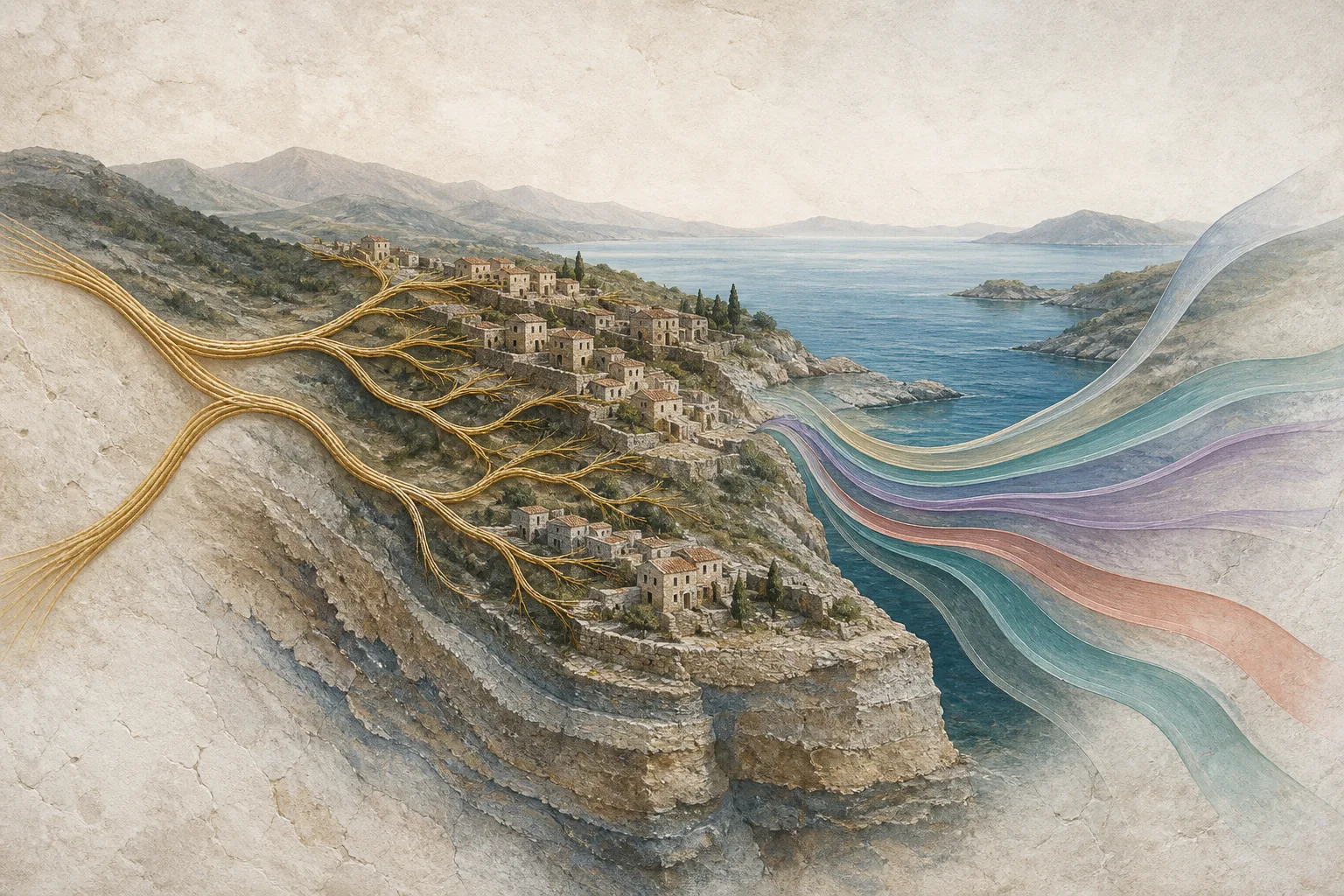
Editorial note: the illustrations in this article were generated with AI to communicate abstract ideas. They are conceptual artwork, not archaeological reconstructions, scientific figures, migration maps, or measured ancestry visualizations.


