
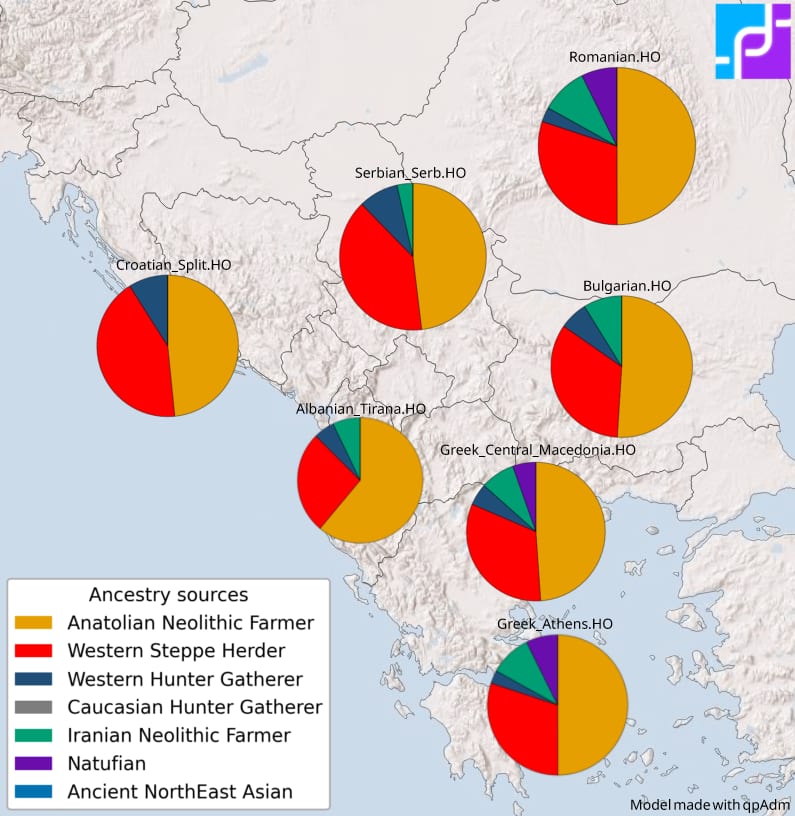
The following models present the ancestry composition of several modern Balkan populations using a single, consistent setup. The focus is on showing how different groups relate to one another when analyzed in the same way, making overall ancestry structure directly comparable across populations.
The populations included are Albanians, Greeks (from Macedonia and Athens), Bulgarians, Serbs, and Croatians. Other Balkan populations were not included because suitable datasets are not currently available.
The Neolithic horizons underneath#
Farming reached the Balkans from Anatolia in the first half of the seventh millennium BC, and the archaeological cultures that followed are the layers a modern Balkan genome still sits on. Three of them matter most for reading the models below.
Starčevo (with its Körös and Criş relatives in the Hungarian plain and Romania) is the Early Neolithic horizon of the central Balkans, roughly 6200 to 5300 BC. Its villages spread along the Morava, Danube and Tisza valleys, and the people buried at its sites are the earliest farmers of Serbia and its neighbours.
Karanovo, named after the tell in the Thracian plain of Bulgaria, is the eastern counterpart. Karanovo I and II cover the Early Neolithic there from about 6200 BC; the later phases of the same tell run through the Late Neolithic and into the Copper Age, so one mound records some two and a half thousand years of settlement.
Vinča, centred on the Danube near Belgrade and covering much of Serbia, western Romania and northern Bosnia, is the Late Neolithic horizon of roughly 5400 to 4500 BC. Vinča settlements were large and long-lived, and their copper working is among the earliest in Europe, which is why the culture is often described as bridging the Neolithic and the Copper Age.
What the ancient genomes show#
The large ancient DNA survey of the region is Mathieson et al. 2018 (Nature, "The genomic history of southeastern Europe"), which reported over two hundred newly sequenced individuals from the Mesolithic to the Bronze Age. Its main result for the Neolithic is simple: the first farmers of the Balkans, whether from Starčevo, Karanovo or later contexts, carry the same Anatolian farmer ancestry as the Neolithic populations of western Anatolia, with only a small admixture from the local hunter-gatherers they met. In most Early Neolithic genomes that hunter-gatherer share is a few percent.
That share does not stay small. Mathieson et al. describe a regional rise in hunter-gatherer ancestry through the Late Neolithic and Copper Age, so that individuals from Vinča-period and Copper Age contexts often carry noticeably more forager ancestry than the first farmers did, with some reaching double digits. The pattern is uneven across sites, which the authors read as local mixing over many centuries rather than a single event. The Iron Gates gorge of the Danube, where the Mesolithic sequence is exceptionally rich, shows the reverse process too: some hunter-gatherer individuals already carried farmer ancestry, evidence that the two populations were in contact well before the Neolithic communities replaced them.
Varna and the Copper Age#
The Varna necropolis on the Bulgarian Black Sea coast, in use around 4600 to 4200 BC, holds the oldest large assemblage of worked gold known anywhere, and it belongs to the same Copper Age world as Karanovo VI and Gumelniţa. Genetically, the Varna and other Bulgarian Copper Age individuals in the Mathieson et al. dataset remain overwhelmingly farmer in ancestry, with the elevated hunter-gatherer share of the period. One Varna individual is reported with a portion of steppe-related ancestry several centuries before the main Bronze Age arrival of steppe ancestry in the region, which the authors present as an early and sporadic contact rather than a migration. It is a reminder that the Copper Age Balkans were already in touch with the world north of the Black Sea long before Yamnaya-related ancestry became widespread.
Data and Methodology#
All ancestry models were generated using qpAdm and show strong overall model fit, indicating that the inferred ancestry proportions provide a reliable representation of population structure within the chosen framework.
Albanian and Bulgarian samples were modeled using higher-density (.DG) genotype files with increased SNP coverage, resulting in more reliable and stable estimates. The remaining populations were modeled using standard lower-density (.HO) files, which contain fewer SNPs but remain suitable for population-level comparison within the same framework.
Ancestry Composition#
Across the region, the models show a broadly shared ancestry structure built from the same underlying components. Differences between populations are mainly expressed through shifts in proportions rather than through unique or population-specific layers.
This shared structure reflects a common historical background across the Balkans, shaped by:
- Continuity from native Balkan populations, preserving deep local ancestry — see also the Deep Maniots of southern Greece for an extreme case of patrilineal continuity
- Population movements during the Roman period, linked to the eastern Mediterranean and Anatolia
- Later Slavic migrations, which had a major demographic impact across much of the peninsula
These processes are visible across all populations, with variation reflecting differences in their relative influence.
Regional Context#
Rather than forming isolated profiles, Balkan populations show patterns shaped by repeated interaction and movement across the peninsula over time.
How a present-day Balkan genome relates to these layers#
The layers above are the reason the models in this post share a structure. The Anatolian farmer ancestry that arrived with Starčevo and Karanovo is still the largest single ingredient in every population modelled here; in Balkan qpAdm models it typically accounts for around half of the ancestry or more, with the exact figure depending on which later sources are also in the model. The hunter-gatherer share that rose through the Vinča and Copper Age periods survives as a minor but real component, and the steppe-related ancestry that was a curiosity at Varna became a substantial part of the region's gene pool with the Bronze Age.
Everything after that, Roman-era movement from the eastern Mediterranean and the Slavic migrations, is layered on top of a Neolithic base that never went away. This is why a present-day Albanian, Greek, Bulgarian, Serb or Croat plotted next to a Neolithic Balkan sample sits far closer to it than to a hunter-gatherer or a steppe herder, and why the differences between the modern groups are shifts of proportion rather than different foundations. A qpAdm model that leaves the Neolithic source out will fail, whichever modern Balkan population is the target.
For a focused 4,000-year transect from the Bronze Age to the present, read our source-checked review of Albanian DNA, ancient origins, and later migration.
For the region's first-millennium transformation, continue with ancient Balkan DNA from the Roman frontier through Slavic-era migrations.
Frequently asked questions#
Were the first Balkan farmers local hunter-gatherers who adopted farming?#
No. The ancient genomes show that the Starčevo and Karanovo farmers descended mostly from Anatolian farmers who moved into the peninsula, with a small admixture from the local foragers. Hunter-gatherer ancestry then rose over the following two thousand years through local mixing, but the farming population itself was an incoming one.
Do modern Balkan populations still carry Neolithic ancestry?#
Yes, and in a large proportion. The Anatolian farmer ancestry of the Neolithic is the single largest component in every Balkan population modelled here. Later steppe, eastern Mediterranean and Slavic inputs changed its proportion but did not replace it.
Can I see how much of my own ancestry traces to these horizons?#
Yes. Neolithic farmer populations are among the sources used in qpAdm models like the ones in this post, so Ancient Ancestry, our qpAdm analysis of your own raw file, can show how much of your genome traces to the Neolithic base of the peninsula rather than to later arrivals, with a p-value and standard errors for each source.
References#
- Mathieson, I. et al. (2018). The genomic history of southeastern Europe. Nature 555, 197 to 203. https://doi.org/10.1038/nature25778


