
Notable Matches · Iconic discoveries
The Burnt City of Shahr-i Sokhta
The Burnt City of Shahr-i Sokhta (c. 3000-2550 BCE · Shahr-i Sokhta, Sistan and Baluchestan, Iran): what the published ancient DNA shows, 7 sequenced genomes, and how close your own Global25 coordinates come. Free with every Ancestry Map.
The dossier
- Catalog tier
- Iconic discoveries
- Period
- c. 3000-2550 BCE
- Found
- Shahr-i Sokhta, Sistan and Baluchestan, Iran
- Sequenced genomes
- 7 (I11462.AG, I11476.AG, I11478.AG, I8725.AG, I11474.AG, I8724.AG, I11479.AG)
Who they were
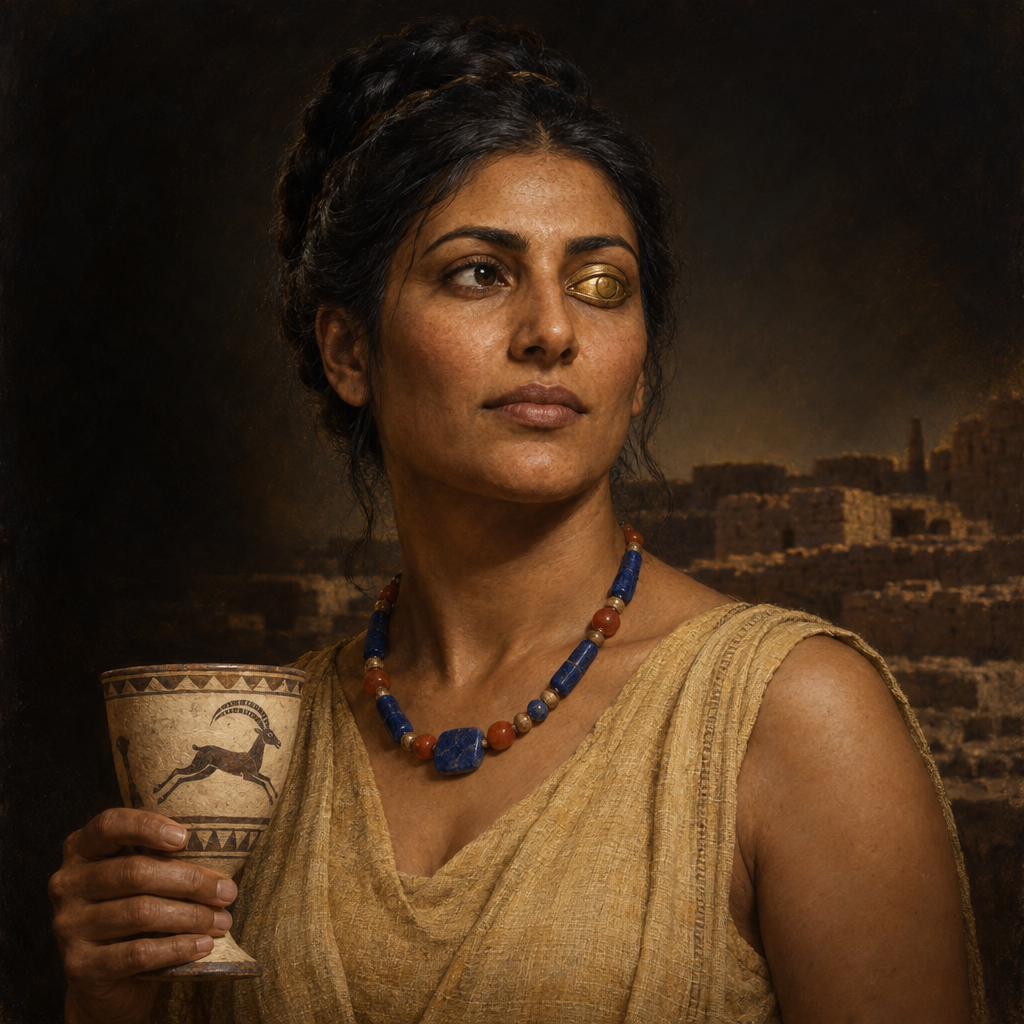
Shahr-i Sokhta, the Burnt City, sprawled across some 120 hectares of the Sistan plain and ranks among the largest cities of the early urban world, with an estimated 25,000 to 40,000 graves; UNESCO listed it in 2014. Its finds are famous: the earliest known artificial eye, a goblet painted with a goat leaping in sequence like an animation, a skull showing trepanation, and a complete board game. These seven people belong to the main Bronze Age population of the city. Their genomes are related to Iran's early farmers with roughly 16 to 21 percent Anatolian farmer ancestry, quite separate from a smaller group of outliers with Andamanese-related ancestry buried at the same site, who define the cline reaching toward the Indus.
The genome-wide data behind this entry was published in The formation of human populations in South and Central Asia.
How your distance is measured
Every Ancestry Map includes the free Notable Matches lens: your coordinates are compared to every sequenced member of every catalog entry, and the distance to the closest member is reported, a Euclidean distance in the same 25-dimensional space the Distance lens uses. Because these are a small group of real individuals, not a population average, distances naturally run larger than population distances. That is expected, not a poor result. And one thing is never claimed: a small distance means similar ancestry composition, not that the Burnt City of Shahr-i Sokhta are your ancestor. See how it looks in the live demo or read about Ancestry Map, the full Global25 report.
Questions
Who were the Burnt City of Shahr-i Sokhta?
The Burnt City of Shahr-i Sokhta (c. 3000-2550 BCE, Shahr-i Sokhta, Sistan and Baluchestan, Iran) are one of the Iconic discoveries entries in our Notable Matches catalog, represented by 7 sequenced ancient genomes published in the study "The formation of human populations in South and Central Asia".
What does "matching" the Burnt City of Shahr-i Sokhta mean?
Your Global25 coordinates are compared to the entry's sequenced members and the distance to the closest one is reported, a Euclidean distance in the same 25-dimensional reference space the Distance lens uses. A notable entry is one person or one small burial group, not a population average, so distances naturally run larger than population distances.
Are they my ancestor?
No, and no DNA test can show that. A small distance means your genome sits near theirs in a shared reference space: similar ancestry composition, not descent. Ancestrify never claims a notable individual is your ancestor or relative.
How do I see my own distance to the Burnt City of Shahr-i Sokhta?
Notable Matches is a free lens on every Ancestry Map, never sold separately. Order Ancestry Map, our Global25 analysis (29.99 EUR), and your report ranks your coordinates against the full catalog, with a portrait, dossier and map for every entry. The public demo shows the lens with example data.
More from the catalog
The catalog holds every published entry across three tiers. Browse the full Notable Matches directory. Nearby entries:
The Family of Koszycec. 2950-2700 BCE
The Seal Hunters of Gotlandc. 3000-2700 BCE
The Old Kingdom Egyptian of Nuwayratc. 2855-2570 BCE
The Vučedol Culturec. 3000-2200 BCE
The Kura-Araxes Peoplec. 3000-2350 BCE
The Collective Tomb of Buryc. 3200-2500 BCE
The Ancient City of Tepe Hissarc. 3600-2400 BCE
The Indus Peripheryc. 3100-1950 BCE
The Megalith Farmers of Falbygdenc. 3300-2800 BCE
Mota of the Ethiopian Highlandsc. 2500 BCE
The Newgrange Chieftainc. 3200 BCE
The Bell Beaker Peoplec. 2500-2000 BCE