
Notable Matches · Historical figures
The Gandharans of the Early Historic Age
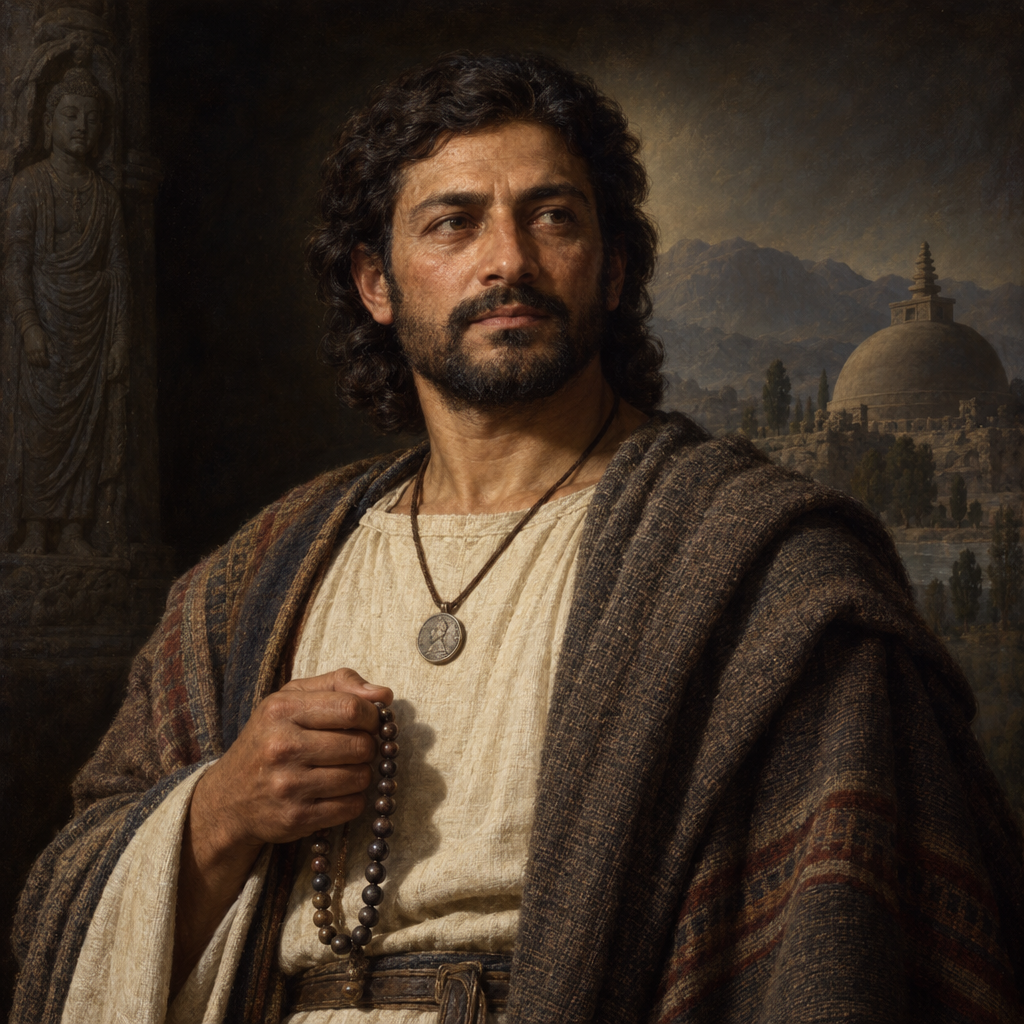
The Gandharans of the Early Historic Age (c. 650 BCE-100 CE · Saidu Sharif, Swat Valley, Pakistan): what the published ancient DNA shows, 12 sequenced genomes, and how close your own Global25 coordinates come. Free with every Ancestry Map.
The dossier
- Catalog tier
- Historical figures
- Period
- c. 650 BCE-100 CE
- Found
- Saidu Sharif, Swat Valley, Pakistan
- Sequenced genomes
- 12 (I7720.AG, I7719.AG, I6891.AG, I8220.AG, I7721.AG, I7717.AG, I7723.AG, I8245.AG, I6894.AG, I7718.AG, I8218.AG, I6896.AG)
Who they were
After the Iron Age cemeteries, the Swat Valley entered written history. Barikot, ancient Bazira, was stormed by Alexander in 327 BCE and later became an Indo-Greek town under Menander I; its excavators found an apsidal Buddhist temple built around 250 BCE, among the earliest known anywhere. Butkara and Saidu Sharif grew into great Gandharan stupa and monastery complexes. The people buried at Saidu Sharif, Aligrama and their neighbours between the seventh century BCE and the first century CE lived through that transformation, and their genomes show they were the same population as the Iron Age graves, still carrying the mixture of steppe and Indus Periphery ancestry. These twelve are townsfolk of early Gandhara at the moment Buddhism took root.
The genome-wide data behind this entry was published in The formation of human populations in South and Central Asia.
How your distance is measured
Every Ancestry Map includes the free Notable Matches lens: your coordinates are compared to every sequenced member of every catalog entry, and the distance to the closest member is reported, a Euclidean distance in the same 25-dimensional space the Distance lens uses. Because these are a small group of real individuals, not a population average, distances naturally run larger than population distances. That is expected, not a poor result. And one thing is never claimed: a small distance means similar ancestry composition, not that the Gandharans of the Early Historic Age are your ancestor. See how it looks in the live demo or read about Ancestry Map, the full Global25 report.
Questions
Who were the Gandharans of the Early Historic Age?
The Gandharans of the Early Historic Age (c. 650 BCE-100 CE, Saidu Sharif, Swat Valley, Pakistan) are one of the Historical figures entries in our Notable Matches catalog, represented by 12 sequenced ancient genomes published in the study "The formation of human populations in South and Central Asia".
What does "matching" the Gandharans of the Early Historic Age mean?
Your Global25 coordinates are compared to the entry's sequenced members and the distance to the closest one is reported, a Euclidean distance in the same 25-dimensional reference space the Distance lens uses. A notable entry is one person or one small burial group, not a population average, so distances naturally run larger than population distances.
Are they my ancestor?
No, and no DNA test can show that. A small distance means your genome sits near theirs in a shared reference space: similar ancestry composition, not descent. Ancestrify never claims a notable individual is your ancestor or relative.
How do I see my own distance to the Gandharans of the Early Historic Age?
Notable Matches is a free lens on every Ancestry Map, never sold separately. Order Ancestry Map, our Global25 analysis (29.99 EUR), and your report ranks your coordinates against the full catalog, with a portrait, dossier and map for every entry. The public demo shows the lens with example data.
More from the catalog
The catalog holds every published entry across three tiers. Browse the full Notable Matches directory. Nearby entries:
Aak of the Frisian Terps356-57 BCE
The Parthians of Gilanc. 100 BCE-50 CE
The Han Dynasty People of Shandongc. 200 BCE-200 CE
The Golden Warrior of Issykc. 750 BCE
The Hasanlu Loversc. 800 BCE
The Princess of Hasslebenc. 300 CE
The Georgians of Late Antiquity2nd-6th century CE
The Christians of Nicaea's Sunken Basilicac. 350-700 CE
Emperor Wu of Northern Zhou543-578 CE
Empress Ashina551-582 CE
The Türks of Gurvan Dovc. 540-635 CE
The Byzantine Villagers of Chhîmc. 430-760 CE