
Notable Matches · Historical figures
The Kazakhs of Kuygenzhar
The Kazakhs of Kuygenzhar (18th century CE · Kuygenzhar, near Astana, Akmola region, Kazakhstan): what the published ancient DNA shows, 3 sequenced genomes, and how close your own Global25 coordinates come. Free with every Ancestry Map.
The dossier
- Catalog tier
- Historical figures
- Period
- 18th century CE
- Found
- Kuygenzhar, near Astana, Akmola region, Kazakhstan
- Sequenced genomes
- 3 (B2_B6, B2_B3, B2_B5)
Who they were
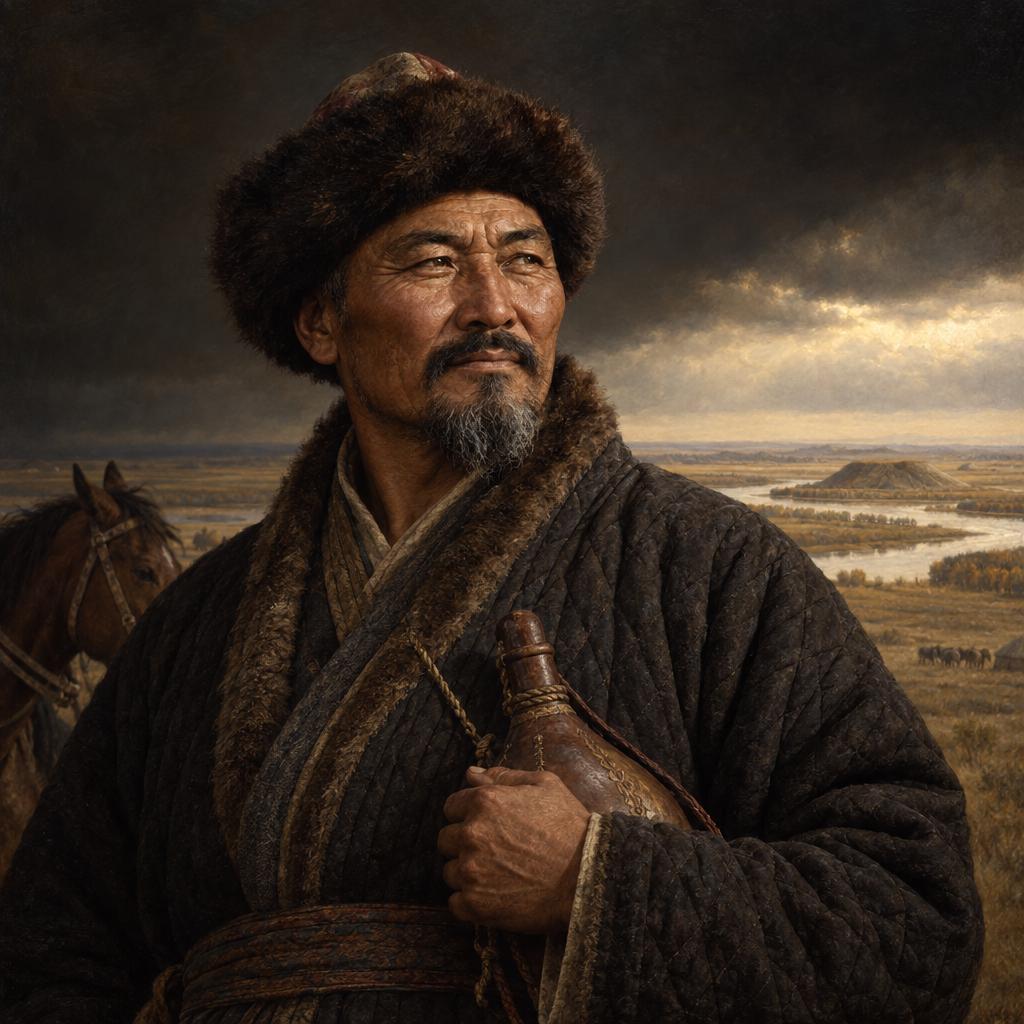
About nineteen kilometres southeast of Astana, on the right bank of the Ishim, an Early Iron Age kurgan was reopened in the eighteenth century and used again: seven Islamic-rite burials, oriented northwest to southeast and without grave goods, were set into the ancient mound. This was the final century of the Kazakh Khanate, lived under growing Russian pressure. Three of the buried are gathered here, one of them a father whose son lay in the same mound. Their genomes sit beside present-day Kazakhs and Kyrgyz, and the paternal lines found, G1b-L830 and C2a1a3-M504, remain common among Kazakh men today. Their teeth kept a surprise: two individuals carried heavy loads of the gum bacterium Tannerella forsythia whose genome already held a tetQ antibiotic-resistance gene, centuries before antibiotics existed.
The genome-wide data behind this entry was published in Genomic Analysis of 18th-Century Kazakh Individuals and Their Oral Microbiome.
How your distance is measured
Every Ancestry Map includes the free Notable Matches lens: your coordinates are compared to every sequenced member of every catalog entry, and the distance to the closest member is reported, a Euclidean distance in the same 25-dimensional space the Distance lens uses. Because these are a small group of real individuals, not a population average, distances naturally run larger than population distances. That is expected, not a poor result. And one thing is never claimed: a small distance means similar ancestry composition, not that the Kazakhs of Kuygenzhar are your ancestor. See how it looks in the live demo or read about Ancestry Map, the full Global25 report.
Questions
Who were the Kazakhs of Kuygenzhar?
The Kazakhs of Kuygenzhar (18th century CE, Kuygenzhar, near Astana, Akmola region, Kazakhstan) are one of the Historical figures entries in our Notable Matches catalog, represented by 3 sequenced ancient genomes published in the study "Genomic Analysis of 18th-Century Kazakh Individuals and Their Oral Microbiome".
What does "matching" the Kazakhs of Kuygenzhar mean?
Your Global25 coordinates are compared to the entry's sequenced members and the distance to the closest one is reported, a Euclidean distance in the same 25-dimensional reference space the Distance lens uses. A notable entry is one person or one small burial group, not a population average, so distances naturally run larger than population distances.
Are they my ancestor?
No, and no DNA test can show that. A small distance means your genome sits near theirs in a shared reference space: similar ancestry composition, not descent. Ancestrify never claims a notable individual is your ancestor or relative.
How do I see my own distance to the Kazakhs of Kuygenzhar?
Notable Matches is a free lens on every Ancestry Map, never sold separately. Order Ancestry Map, our Global25 analysis (29.99 EUR), and your report ranks your coordinates against the full catalog, with a portrait, dossier and map for every entry. The public demo shows the lens with example data.
More from the catalog
The catalog holds every published entry across three tiers. Browse the full Notable Matches directory. Nearby entries:
Jean-Paul Marat1743-1793 CE
Ludwig van Beethoven1770-1827 CE
The Kongo Kingdom at Kindokic. 1650-1800 CE
The Fallen of Le MansDecember 1793 CE
The Settlers of Avery's Restc. 1675-1725 CE
The First Africans of Avery's Restc. 1675-1725 CE
The Grande Armée of VilniusDecember 1812 CE
The Ironworkers of Catoctin Furnace1774-1850 CE
Gregor Mendel1822-1884 CE
The Kronan Sailor1 June 1676 CE
George Bähr1666-1738 CE
The Soldiers of the Reapers' War1652 CE