

Viking DNA does not describe one uniform Scandinavian people. The largest genome-wide study of the Viking world sequenced 442 ancient people from archaeological sites across Europe and Greenland and found a much more structured and mobile history: regional differences within Scandinavia, distinct expansion routes, substantial ancestry entering Scandinavia, close relatives traveling together, and people with little or no Scandinavian genetic ancestry receiving Viking-style burials.
The 2020 Nature paper Population genomics of the Viking world therefore changes the question from “What did Vikings look like genetically?” to “How did many different communities participate in a Viking world?” Archaeology identifies activities, objects, burials, and social settings; genomes reveal biological relationships and population connections. Neither can replace the other.
The short answer: Viking Age Scandinavia was regionally structured rather than genetically homogeneous. Danish-like ancestry expanded mainly into England, Norwegian-like ancestry moved toward Ireland and the North Atlantic, and Swedish-like ancestry moved east through the Baltic. At the same time, ancestry from elsewhere in Europe entered Scandinavia, and Viking cultural identity could be adopted by people without Scandinavian ancestry.
What did the Viking DNA study analyze?#
The international research team sequenced whole genomes from 442 ancient humans at a median depth of approximately 1×. The archaeological material came from Scandinavia and sites extending through the British Isles, Baltic, Poland, Russia, Ukraine, Greenland, and other parts of the Viking diaspora.
The paper focuses on the Viking Age, broadly 750–1050 CE, but it also included earlier individuals to trace changes leading into the period. Teeth and dense petrous bones supplied much of the recoverable DNA. The researchers compared the ancient genomes with large present-day datasets and applied:
- Principal-component and ancestry analyses to locate broad genetic affinities.
- Haplotype-based methods capable of detecting finer regional structure.
- f-statistics and admixture models to test shared ancestry and gene flow.
- Kinship analysis to identify biological relatives.
- Y-chromosome and mitochondrial lineages to follow single paternal and maternal lines.
- Variant-frequency comparisons to study changes in pigmentation, immunity, and lactase-persistence loci.
The 442 genomes are a major dataset, but they are not 442 randomly selected “Vikings.” Cemetery access, DNA preservation, geography, burial practice, and archaeological classification all shaped who entered the study.
There was no single Viking genetic profile#
The genomes show clear structure within Scandinavia. Viking Age people from Denmark, Norway, and Sweden were related, but they were not interchangeable. Some regions—especially cosmopolitan southern centers and trade-oriented islands—were diverse, while gene flow between other Scandinavian regions was more restricted than a simple picture of constant internal mixing would predict.
This regional structure helps explain the diaspora:
- Danish-like ancestry appears prominently in present-day England and Viking Age contexts connected to its North Sea expansion.
- Norwegian-like ancestry is associated especially with movement toward Ireland, the Isle of Man, Iceland, and Greenland.
- Swedish-like ancestry is strongly represented in eastward movement toward the Baltic.
These are broad ancestry profiles, not labels for every traveler. A person buried in Denmark could carry non-local ancestry, and parties moving in one direction could include people from several origins. At the Dorset and Oxford execution sites in England, for example, individuals carried mixtures of Danish-like, Norwegian-like, and North Atlantic-related ancestry.
Scandinavia also received migrants#
The Viking Age was not only a story of people leaving Scandinavia. The study found gene flow into the region from the south and east before and during the Viking period. Several people buried within Scandinavia carried substantial ancestry related to populations elsewhere in Europe.
That result fits the archaeology of ports, trade routes, political alliances, forced movement, marriage, and settlement. Scandinavia was connected to the North Atlantic, western Europe, the Baltic, and routes reaching the Eurasian interior. Genetic exchange ran in multiple directions.
It is more precise to describe this as ancestry related to available reference populations than to attach modern ethnic names. A genomic profile cannot tell whether an individual's parents arrived as merchants, captives, spouses, craftspeople, diplomats, or migrants for another reason.
Viking identity was not limited to Scandinavian ancestry#
Two people on Orkney, a man and a woman, were buried in Scandinavian fashion, yet their genomes were similar to present-day Irish and Scottish populations. The researchers suggest they are likely Pictish, and that Pictish people may have been integrated into Scandinavian culture by the Viking Age.
Other Orkney individuals had mixed Scandinavian and North Atlantic ancestry, while people with British-related ancestry were also found in Norway. Burial practice therefore cannot be treated as a genetic test, and ancestry cannot decide whether someone was socially accepted as a Viking.
This distinction is fundamental. “Viking” is best understood as a historically changing category connected to maritime activity, networks, status, and culture, not as a biological population with hard boundaries. The Old Norse term behind the word referred to an activity associated with seaborne raiding, while modern usage often covers whole Scandinavian societies of the period.
The broader relationship between population movement and language is equally indirect; our review of Indo-European origins and the debated hybrid hypothesis explains why genes cannot identify the language an ancient person spoke.
A Viking expedition included close relatives#
Kinship analysis turned one ship burial at Salme, Estonia, into a family story. The two vessels held the remains of dozens of men who appear to have died violently in the early Viking Age. Four of the sequenced men were brothers, and other individuals were genetically similar enough to suggest recruitment from a comparatively small community.
This is unusually direct evidence that an expedition could be organized through family and local social ties. It does not mean every raiding or trading party followed the same model. The Salme group is one extraordinary context, and biological relatives were only part of its social organization.
Were Vikings all blond?#
No. The study found that pigmentation-associated variants differed across the ancient dataset, and the popular image of a uniformly blond Viking population is not supported. Many individuals likely had brown hair, while appearance varied as it does in populations generally.
Genetic prediction of pigmentation is probabilistic. It estimates likelihood from selected variants and cannot reconstruct a person's face, exact hair shade, style, or social presentation. Nor does hair color establish whether someone was a Viking.
The paper also traced changes at loci associated with lactase persistence, immunity, and metabolism over the past two millennia. Those analyses concern population-level evolution; they should not be turned into claims that Vikings possessed a unique package of superior traits.
What survives in present-day populations?#
The study compared Viking Age genomes with present-day people and found a consistent but limited legacy. In England, the Viking Age contribution does not exceed 6%, and the authors note how hard it is to separate from earlier Anglo-Saxon ancestry. The flow also ran the other way: present-day Norwegians carry 12 to 25% of the “North Atlantic-like” ancestry found in Britain and Ireland, and Swedes a more uniform 10%.
Those are population-level model estimates, not a promise that every English person is 6% Viking. Modern individuals vary, ancient reference sets are incomplete, and Danish-like ancestry in Britain can be difficult to distinguish from ancestry introduced by earlier Angles and Saxons from overlapping source regions.
Consumer tests that advertise a “Viking percentage” simplify this uncertainty even further. They compare customers with proprietary reference panels; they cannot certify membership in a Viking community or identify a named Viking ancestor.
A map of tendencies, not fixed national routes#
The paper's Danish-, Norwegian-, and Swedish-like patterns agree broadly with historical and archaeological evidence, but they are not three sealed migration corridors.
Viking Age execution sites in England included men with different northern ancestries. A Danish-like individual appeared at Gnezdovo in present-day Russia, showing that eastward movement was not exclusively Swedish. Iceland and Greenland included both Scandinavian- and North Atlantic-related founders. Trade centers drew especially diverse populations.
The most accurate synthesis is regional tendency plus local complexity. Sea routes created repeated contact, but political units, identities, and migration groups changed across three centuries.
The study's most important limitations#
| Limitation | Why it matters |
|---|---|
| Archaeological sampling is uneven | The dataset reflects preserved and accessible burials, not a census of Viking society. |
| Median genomic depth was about 1× | Many analyses are population-level estimates rather than complete individual genomes. |
| Burial style does not equal identity | Objects and rites can be adopted across ancestry boundaries. |
| Regional ancestry labels are statistical | “Danish-like” or “Norwegian-like” does not establish birthplace, language, or citizenship. |
| Modern ancestry estimates depend on references | Overlap with other early medieval migrations complicates attribution. |
| The Viking Age lasted about three centuries | One genome cannot represent every phase, region, or kind of mobility. |
Frequently asked questions about Viking DNA#
What did the largest Viking DNA study find?#
It found strong regional structure within Scandinavia, distinct but overlapping diaspora patterns, substantial ancestry entering Scandinavia, close relatives on at least one expedition, and Viking-style burials belonging to some people without Scandinavian genetic ancestry.
How many Viking genomes were sequenced?#
The study sequenced 442 ancient humans from archaeological sites across Europe and Greenland to a median depth of roughly 1×.
Were all Vikings genetically Scandinavian?#
No. Some people buried in Viking contexts had local British or Irish-Scottish-related ancestry. Viking cultural participation and Scandinavian genetic ancestry overlapped, but neither perfectly defined the other.
Where did Vikings migrate?#
The study finds broad Danish-like movement toward England, Norwegian-like movement toward Ireland and the North Atlantic, and Swedish-like movement into the Baltic. Many sites contain more complicated combinations.
Were Vikings mostly blond?#
No. Genetic predictions suggest varied pigmentation, including many people likely to have had brown hair. Hair color is not a marker of Viking identity.
Can a DNA test prove Viking ancestry?#
It can identify similarity to selected Scandinavian or ancient reference groups, but it cannot prove that a specific ancestor lived as a Viking. Cultural identity, occupation, and community membership are not encoded in DNA.
What the Viking genomes change#
The 442 genomes replace a single Viking archetype with a network of regional populations, families, migrants, and cultural crossings. Scandinavian ancestry traveled widely, but the movement was not one-way. Local people entered Viking communities, and Scandinavia itself absorbed people from elsewhere.
The result is not that “anyone was a Viking” or that ancestry did not matter. It is that the Viking world joined biological descent, social identity, mobility, and material culture in combinations that varied from one harbor, burial, and expedition to another.
Sources and further reading#
- Margaryan, A., Lawson, D. J., Sikora, M. et al. (2020). Population genomics of the Viking world. Nature 585, 390–396. University of Cambridge accepted manuscript.
- University of Cambridge (2020). World's largest-ever DNA sequencing of Viking skeletons reveals they weren't all Scandinavian.
- Ancient sequence data: European Nucleotide Archive PRJEB37976.
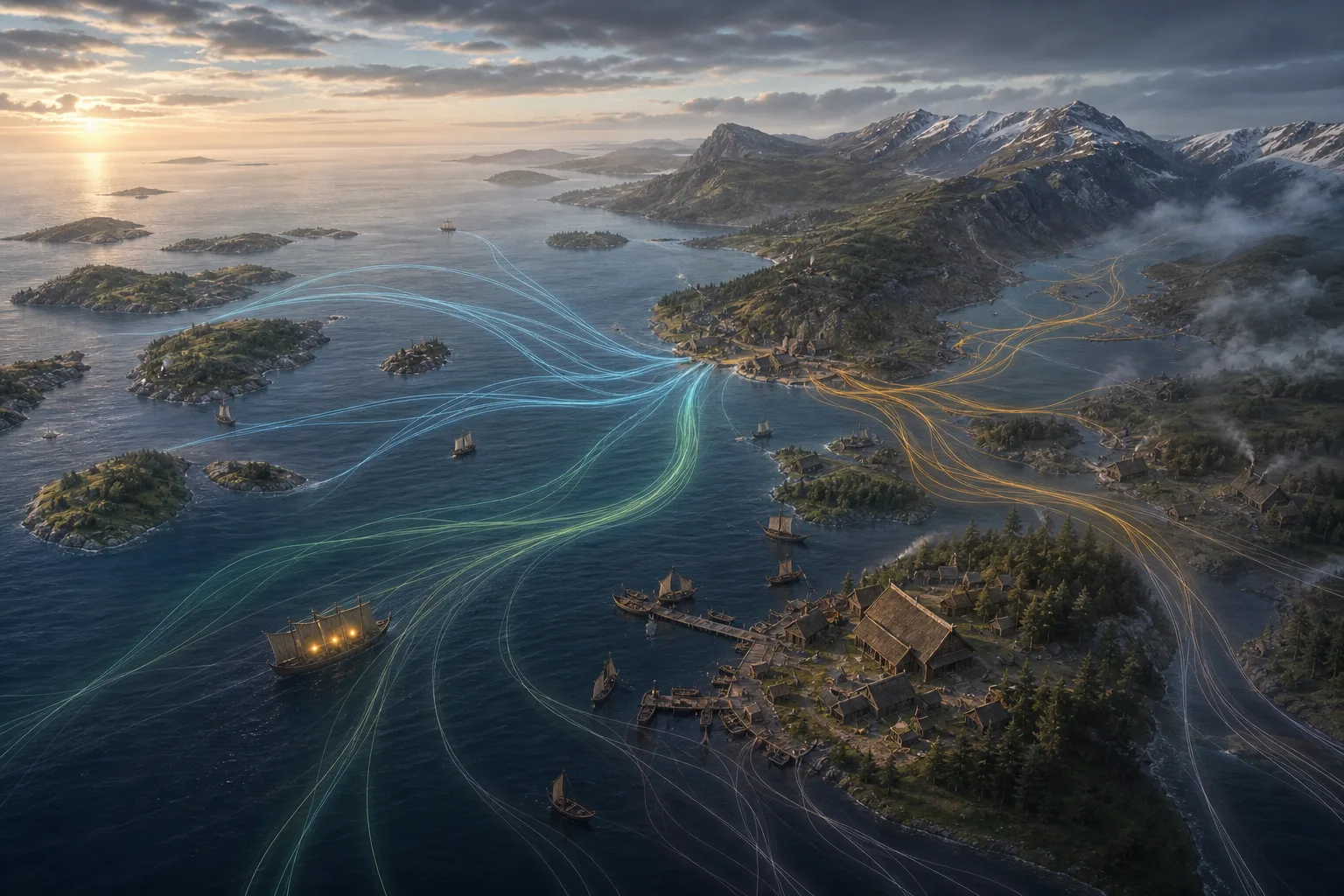
Editorial note: the hero and section artwork in this article was generated with AI as conceptual illustration. It does not reconstruct a sampled individual, reproduce a scientific figure, or show measured migration routes.


