Turkish DNA: Ancient Origins from Neolithic Anatolia to the Ottomans
Turkish ancestry through ancient DNA: the Anatolian farmer substrate, the Southern Arc results, Byzantine Anatolia, the modest Turkic layer and qpAdm.
Articles
87 articles on ancient-dna, ancient-DNA research written up for readers who want the evidence, not just the headline.
Ancient DNA is the evidence layer under everything on this site: excavated genomes, dated and published, that let a living person's file be compared against people rather than against constructs. These articles follow the research — new papers, new panels, newly sequenced individuals — and explain what each finding does and does not license you to conclude about your own ancestry.
What an ancient DNA test is
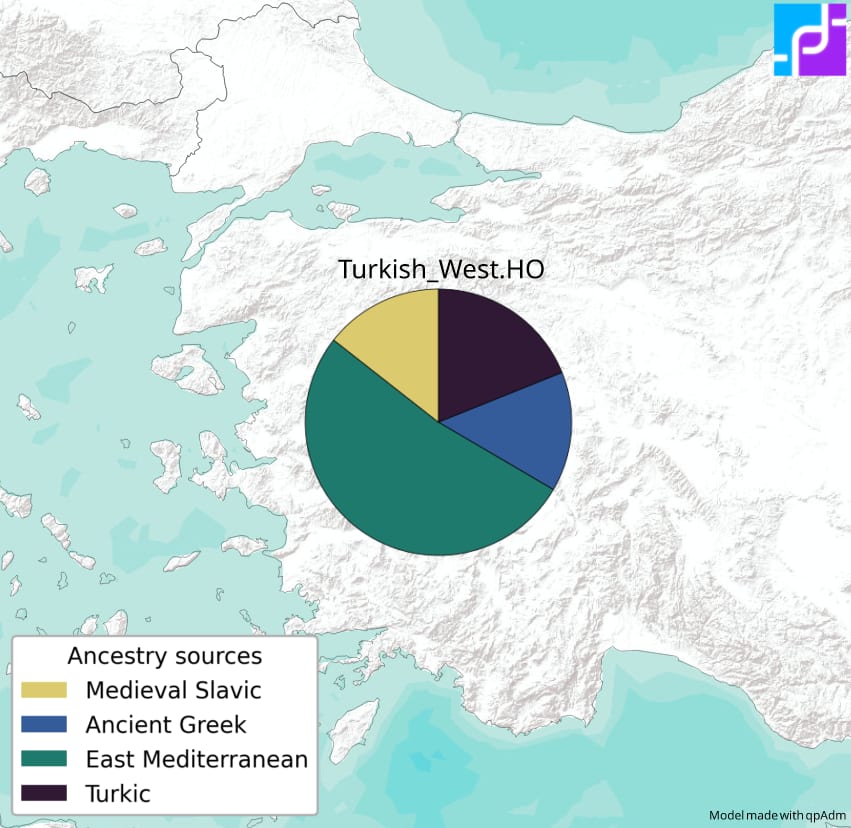
Turkish ancestry through ancient DNA: the Anatolian farmer substrate, the Southern Arc results, Byzantine Anatolia, the modest Turkic layer and qpAdm.

Amazigh and Maghrebi ancestry through ancient DNA: Taforalt, the Neolithic farmers, the Guanche genomes, Arab-era gene flow, the Saharan gradient and qpAdm.

Somali ancestry through ancient DNA: the East African Pastoral Neolithic, the Ethio-Somali component, Arabian contacts and how to model it with qpAdm.

Punjabi ancestry through ancient DNA: the Indus Periphery and Rakhigarhi genomes, AASI, the Steppe MLBA layer, the Swat Iron Age references and qpAdm.

What ancient genomes say about Pashtun ancestry: Iranian farmer, AASI and Steppe streams, the Swat valley references, and the legends DNA cannot confirm.

What genomes say about Bengali ancestry: a strong AASI share, a Southeast Asian layer from Austroasiatic and Tibeto-Burman speakers, and the gaps in the data.

What genomes say about Mexican and Latino ancestry: the peopling of the Americas, Indigenous Mexican structure, post-1519 admixture and diaspora variation.

What genomes say about African American ancestry: West and West Central African source regions, the European share and its sex bias, and the ancient DNA gap.

A new Science Advances study sequences the largest Jomon dataset yet: where Japan's ancient foragers came from, the cold-adaptation selection written in their genomes, and what their legacy means for reading Japanese ancestry.

A new 30-genome transect of southwestern England confirms the sharp Beaker-era turnover — and shows the genetically distinct newcomers burying their dead inside monuments built a millennium earlier by the people they replaced.

England has ancient DNA's best-measured migrations: a Beaker-era turnover, a mid-Bronze Age Celtic-era influx, the quantified Anglo-Saxon settlement and the Danelaw. What each layer left in English genomes, and how to read yours.

Egypt finally has ancient genomes: what the Old Kingdom and mummy-era samples show about ancient Egyptian ancestry, how the modern Nile gene pool differs, and how to read an Egyptian genome honestly.

Ancient DNA on the western Balkans: the Illyrian-era base, the measured Slavic-era arrival, why the world's highest I2a frequencies sit in Bosnia — and why the three nations' genomes overlap almost completely.

Ancient DNA on Bulgarian ancestry: the Thracian-era Balkan base, the Roman provincial centuries, the measured Slavic-era layer, the surprisingly thin Bulgar trace — and how to read a Bulgarian genome.

What ancient DNA says about Romanian ancestry: the Balkan deep stack, Dacians and the Roman province, the measured Slavic-era layer, highland continuity — and what the data cannot settle about the ethnogenesis debate.

Ancient DNA solved Hungary's founding paradox: the conquerors' genomes have been sequenced, and modern Hungarians barely carry them. The Carpathian Basin's layered story, and how to read a Hungarian genome.

Ukraine holds the Yamnaya homeland, the Trypillia mega-sites and the likeliest cradle of the Slavic expansion. What ancient DNA shows about Ukrainian ancestry, and how to read a Ukrainian genome.

Russian ancestry is a Slavic core laid over older northern and steppe worlds: what ancient DNA shows about the East Slavic expansion, the Uralic-related north, the steppe south, and how to read a Russian genome.

France's ancient-DNA transect runs from Ice Age refuges through Gaulish continuity to a nation of regional clines. What the samples show about French ancestry, why the Franks barely register, and how to read a French genome.

Denmark, Sweden and Norway share a genome written by two prehistoric turnovers and one famous exchange: the Viking Age imported as much ancestry as it exported. The ancient-DNA story, and how to read a Scandinavian genome.

What ancient DNA says about Scottish ancestry: the shared Beaker-descended base, the Pictish genomes and their local roots, the Gaelic-Irish kinship of the west, and the measured Norse layer in the isles.

The Netherlands sits at the heart of the Beaker world and the launch coast of the Anglo-Saxon migration. What ancient DNA shows about Dutch ancestry, the country's surprising internal cline, and how to read a Dutch genome.

Rome's ancient-DNA transect, the Iron Age base, the imperial eastern shift, why Italy holds Europe's largest internal genetic variation, and what Sardinia preserves. How to read an Italian genome, region by region.

What ancient DNA says about Greek ancestry: the Aegean's Neolithic base, Minoan and Mycenaean genomes, the classical and Byzantine continuum, the Slavic-era addition, and the measured continuity underneath. How to read a Greek genome.

Sicily's ancient-DNA record runs from island foragers through a late steppe arrival, Greek and Phoenician colonists, Roman, Arab and Norman centuries. What each layer actually left in Sicilian genomes, and how to read your own.

Iberia has the longest continuous ancient-DNA transect in Europe: foragers, farmers, a Beaker-era Y-chromosome revolution, Phoenicians and Romans, the Islamic centuries and their aftermath. What each layer left, and how to read an Iberian genome.

Ireland's ancient-DNA transect is one of Europe's cleanest: a Mesolithic baseline, a Neolithic of tomb-builders with a dynastic elite, a near-total Beaker-era turnover, and striking continuity since. The story, and how to read an Irish genome.

Germany is ancient DNA's best-sampled territory: the LBK farmers, the Corded Ware steppe arrival, Bell Beakers, and the Celtic–Germanic–Slavic interfaces all run through it. The layered story, and how to read a German genome.

Poland's ancient-DNA story has a twist most national histories lack: a documented population turnover in the first millennium CE. Goths and Wielbark, the early Slavic horizon, what modern Polish genomes show, and how to read your own.

Iran holds one of ancient DNA's founding populations. What the Zagros genomes changed, how the plateau's ancestry formed and persisted through empires, what modern Iranian samples show, and how to read your own results.

Ancient DNA gives Armenians one of West Asia's clearest stories: a Bronze Age blend of local Caucasus and Anatolian streams, a measured steppe pulse, and genetic isolation since roughly the end of the Bronze Age. The evidence, honestly read.

Georgia holds two of the most important genomes in West Eurasian prehistory. What Satsurblia and Kotias revealed, the Kura-Araxes and later layers, why Georgian ancestry is among Eurasia's most continuous, and how to read your own results.

Kurdish ancestry through the ancient-DNA lens: the Zagros Neolithic foundation, the layers that followed, what modern samples show about structure and neighbours, and how to read G25 and qpAdm results for a Kurdish genome.

What ancient DNA and modern genetic studies say about Assyrian ancestry: deep Mesopotamian roots, two millennia of documented endogamy, the missing ancient transect, and how to read G25 and qpAdm results for an Assyrian genome.

A calculator against modern populations answers 'who do I resemble today'; one against dated ancient samples answers 'which deep ancestries formed me'. Mixing up the two produces the classic misreadings.

A step-by-step qpAdm tutorial: check your raw file, merge it into AADR v66, choose sources and outgroups, run it in the browser or in R, and read the result.

What ancient genomes actually say about Jewish ancestry, why a consumer 'Ashkenazi Jewish' percentage answers a different question, and what a formal qpAdm model with a p-value shows for a Jewish genome.

Why Ashkenazi genomes read as their own category on consumer tests, what the medieval Erfurt genomes settled, and how a qpAdm model separates the Levantine and southern European halves of Ashkenazi ancestry.

What ancient DNA says about Sephardic ancestry across Turkey, the Balkans, North Africa and Iberia, why 'Sephardic' covers several different genetic histories, and how a qpAdm model separates the Levantine, Iberian and North African layers.

Why the Jewish communities of Mesopotamia, Persia and Kurdistan sit closest to the Bronze Age Levant, what the Iranian-related layer in their genomes is, and how a qpAdm model resolves a Mizrahi genome.

What ancient DNA says about the Yemenite Jewish community, the Himyarite question, and how a qpAdm model tests a Yemenite genome against the Canaanite and Arabian Peninsula sources.

What genome-wide and ancient DNA say about the Jewish communities of Dagestan, Azerbaijan, Georgia and Central Asia, their Persian-Jewish core and local admixture, and how a qpAdm model resolves them.

Who the Canaanites were genetically, who carries their ancestry today, and why the qpAdm source catalog now has a Canaanite (2000 - 1200 BC) population built from the Megiddo and Hazor genomes.

What a qpAdm ancestry test actually does with your raw DNA file, what the report contains, what the four tiers buy and what they don't, and how to tell a formal model from a percentage generator.

Global25 coordinates explained from scratch: what the 25 numbers are, where they come from, scaled versus unscaled, what you can compute from them, and the honest limits of a coordinate-based ancestry analysis.

What a 23andMe or AncestryDNA ethnicity estimate measures, what an ancient-DNA ancestry test measures instead, why the two disagree by design, and how to run the second one on the raw file you already have.

Who the Western Steppe Herders were, how steppe ancestry spread across Europe and Asia after 3000 BC, what a 'steppe percentage' actually measures, and how to estimate yours with qpAdm or Global25 from a raw DNA file.

Who Europe's Mesolithic hunter-gatherers were — Western, Eastern and Caucasus — how their ancestry survived farming and the steppe migrations, and how to measure your hunter-gatherer share from a raw DNA file.

Who the Anatolian Neolithic farmers were, how their ancestry spread across Europe from 6500 BC and became the largest component in most southern Europeans, what 'early European farmer' means in a model, and how to measure your share.

What a maternal (mtDNA) haplogroup is, how the tree is built, what H, U5, K, T2 and the other common branches tell you, why most chip kits resolve to a broad branch, and what a haplogroup can and cannot say about ancestry.

How to run qpAdm on your own genome after a published report — choosing sources and outgroups, reading a rejection, testing nested models, and downloading the EIGENSTRAT bundle to reproduce everything on your own machine.

What the Allen Ancient DNA Resource is, who curates it, what a version like v66 contains, the difference between the 1240K and Human Origins panels, and how the dataset becomes the reference behind an ancient-DNA ancestry analysis.

What it means to share a stretch of DNA with a person who died thousands of years ago, why such matches are identity by state rather than identity by descent, what the centimorgan figures mean, and why a shared segment is never proof of descent.

Notable Matches ranks your Global25 coordinates against 172 famous ancient individuals with published DNA — kings, mummies, warriors and Ice Age people. What a distance to one buried person means, and what it can never mean.

DNA from ancient Himera reveals a diverse 480 BCE Greek army, distant mercenaries, local soldiers and mobility across the Mediterranean.

The first whole genome from Old Kingdom Egypt reveals deep North African ancestry and an eastern Fertile Crescent connection—with major limits.

Ancient DNA reveals that Punic communities shared Phoenician culture but drew most sampled ancestry from Sicily, the Aegean and North Africa.

Ancient DNA traces Yamnaya ancestry to Caucasus–Lower Volga and Dnipro–Don populations before the great Bronze Age steppe expansion.

DNA from 102 prehistoric Aegeans traces migration into Crete and Greece, Mycenaean-era mobility, family burials and frequent cousin unions.

A 555-genome study traces large-scale Early Medieval migration associated with Slavic expansion, regional admixture and changing communities.

Ancient DNA connects some European Huns to Xiongnu elite lineages while revealing a highly diverse Carpathian Basin population.

Genomes from Ranis and Zlatý kůň date the shared Neanderthal admixture in ancestors of non-Africans to roughly 45,000–49,000 years ago.

DNA from Iron Age Britain reveals matrilocal communities, female-line descent and continuing migration across the English Channel.

A 258-genome study reveals migration, Roman provincial mobility and family life along southern Germany's frontier after imperial rule.

Ancient Etruscan DNA supports local Iron Age origins, genetic similarity to Latin neighbors and major ancestry shifts under imperial Rome.

Ancient DNA reconstructs Avar-period families, marriage networks and neighboring communities with different ancestry across Central Europe.

Fifteen ancient Rapanui genomes challenge a severe pre-European collapse and date Indigenous American-related ancestry to 1250–1430 CE.

DNA from two women at Takarkori reveals a deeply rooted North African lineage and suggests Saharan pastoralism spread mainly through culture.

DNA from 13 early Tarim Basin mummies reveals a genetically isolated local population that adopted dairy, crops and technologies from neighbors.

A 460-genome study reveals large North Sea migration, local integration and regional ancestry change in Early Medieval England.

A study of 15,836 ancient and modern West Eurasians finds hundreds of genes under strong directional selection over the past ten thousand years.

A 200,000-year-old molar from Denisova Cave yields a second high-quality Denisovan genome and reveals at least three distinct Denisovan groups.

Ancient proteins and mitochondrial DNA from dental calculus identify the near-complete Harbin cranium from northeastern China as a Denisovan.

Ten genomes from a Himalayan cave reveal a population that was half Tibetan-related and half North Indian-related, mixing from about 2800 years ago.

Yersinia pestis genomes from four Siberian hunter-gatherer cemeteries show lethal plague outbreaks millennia before cities, farming or rats.

Ancient genomes of Mycobacterium lepromatosis from Canada and Argentina show a second leprosy pathogen circulating in the Americas before contact.

238 ancient genomes from the Southern Cone reveal a deep central Argentina lineage that persisted for thousands of years with little inward migration.

Picuris Pueblo initiated a genomic study of its own ancestors, showing continuity across a millennium and a firm link to Chaco Canyon.

Ancient DNA from five Pompeii plaster casts overturns the family stories told about them for more than a century.

Genomes from an 11,000-year-old site near Beijing reveal an unknown deep northern East Asian lineage and 2,000 years of change at one place.

A 2026 ancient DNA study traces Albanian ancestry from Bronze and Iron Age West Balkan groups through Roman-era and medieval admixture.

Ancient Balkan DNA reveals Roman-era Anatolian mobility, mixed late-antique migrations and lasting ancestry linked to Slavic expansion.

A 2023 Science study analyzed 161 languages, dated the Indo-European root to about 8,120 years ago, and proposed a debated hybrid origin.

A 442-genome Viking study reveals regional Scandinavian ancestry, family expeditions, migration and Viking identities beyond genetic ancestry.

qpAdm modeling shows modern Anatolian Turks carrying ancestry from Neolithic farmers, Yamnaya, and later Iron Age to medieval populations, reflecting a complex mix of local and incoming ancestries.

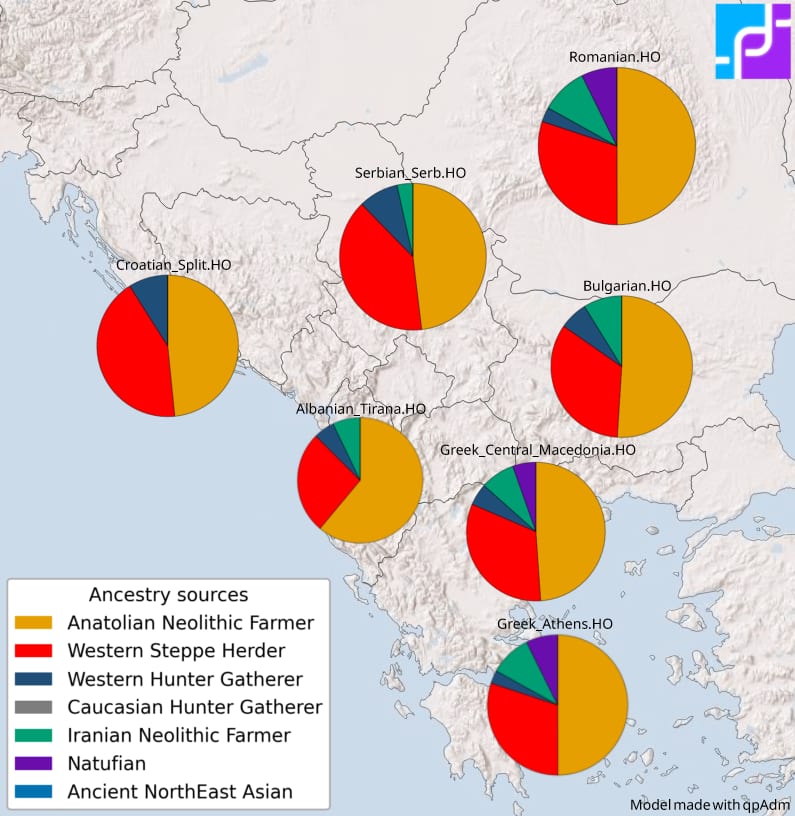
qpAdm modeling shows modern Balkan populations carry varying proportions of Neolithic farmer and Bronze Age steppe ancestry, reflecting long-term regional continuity.

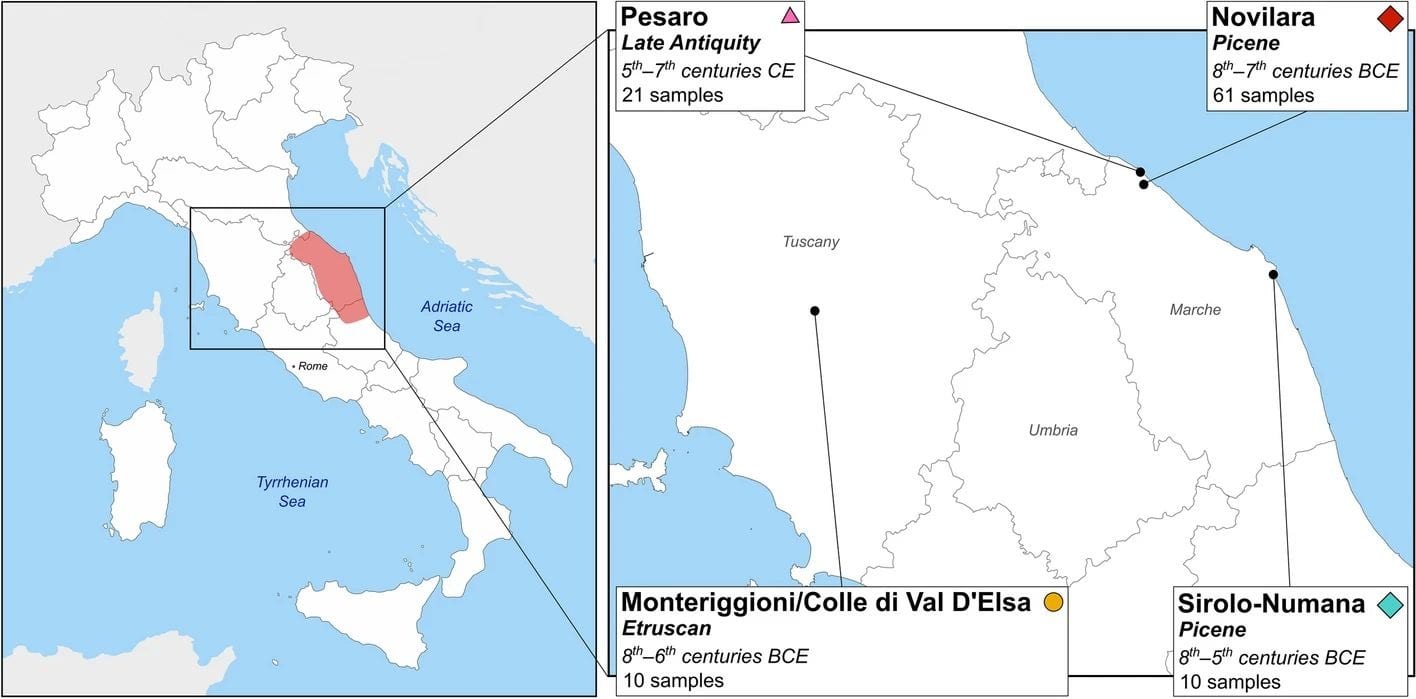
Recent ancient DNA research provides the first comprehensive view of the Picenes (Picentes), an Iron Age population of Central Italy along the Middle Adriatic coast. This study sheds light on their paternal lineages, ancestral composition, and genetic relationships with neighboring populations.