
Notable Matches · Historical figures
The Mongols of the Empire
The Mongols of the Empire (c. 1280-1440 CE · Tavan Khailaast, Delgerkhaan, Khentii Province, Mongolia): what the published ancient DNA shows, 4 sequenced genomes, and how close your own Global25 coordinates come. Free with every Ancestry Map.
The dossier
- Catalog tier
- Historical figures
- Period
- c. 1280-1440 CE
- Found
- Tavan Khailaast, Delgerkhaan, Khentii Province, Mongolia
- Sequenced genomes
- 4 (TK4-5.AG, TK4-2.AG, TK5-2.AG, TK5-8.AG)
Who they were
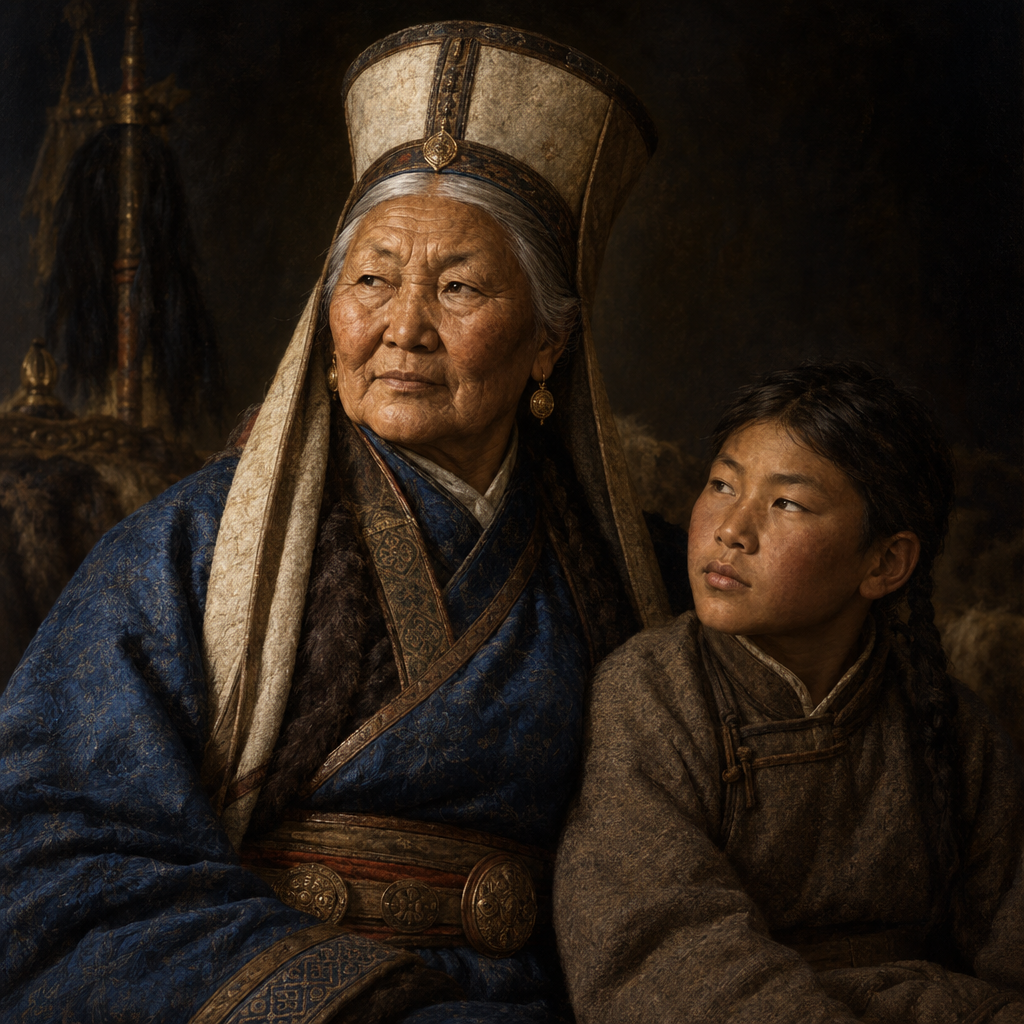
Khentii Province in eastern Mongolia is the homeland of the Borjigin, the clan into which Genghis Khan was born, and the burials at Tavan Khailaast near Delgerkhaan have been argued to belong to a Mongol elite lineage of the imperial age. Four people from that cemetery are gathered here: two men and a boy of thirteen to fifteen, all three carrying the paternal line C2b, and a woman past seventy who was the boy's mother. The boy was also a third-degree relative of both men, a small family caught in the pedigree. Their genomes model as essentially entirely Xianbei-related Ancient Northeast Asian, with no western Eurasian input at all, and the study found eastern Mongolia keeping that same genetic profile stable across a full millennium.
The genome-wide data behind this entry was published in Medieval genomes from eastern Mongolia share a stable genetic profile over a millennium.
How your distance is measured
Every Ancestry Map includes the free Notable Matches lens: your coordinates are compared to every sequenced member of every catalog entry, and the distance to the closest member is reported, a Euclidean distance in the same 25-dimensional space the Distance lens uses. Because these are a small group of real individuals, not a population average, distances naturally run larger than population distances. That is expected, not a poor result. And one thing is never claimed: a small distance means similar ancestry composition, not that the Mongols of the Empire are your ancestor. See how it looks in the live demo or read about Ancestry Map, the full Global25 report.
Questions
Who were the Mongols of the Empire?
The Mongols of the Empire (c. 1280-1440 CE, Tavan Khailaast, Delgerkhaan, Khentii Province, Mongolia) are one of the Historical figures entries in our Notable Matches catalog, represented by 4 sequenced ancient genomes published in the study "Medieval genomes from eastern Mongolia share a stable genetic profile over a millennium".
What does "matching" the Mongols of the Empire mean?
Your Global25 coordinates are compared to the entry's sequenced members and the distance to the closest one is reported, a Euclidean distance in the same 25-dimensional reference space the Distance lens uses. A notable entry is one person or one small burial group, not a population average, so distances naturally run larger than population distances.
Are they my ancestor?
No, and no DNA test can show that. A small distance means your genome sits near theirs in a shared reference space: similar ancestry composition, not descent. Ancestrify never claims a notable individual is your ancestor or relative.
How do I see my own distance to the Mongols of the Empire?
Notable Matches is a free lens on every Ancestry Map, never sold separately. Order Ancestry Map, our Global25 analysis (29.99 EUR), and your report ranks your coordinates against the full catalog, with a portrait, dossier and map for every entry. The public demo shows the lens with example data.
More from the catalog
The catalog holds every published entry across three tiers. Browse the full Notable Matches directory. Nearby entries:
The Swahili Merchants of Mtwapac. 1250-1600 CE
The Aba Clan1276-1450 CE
Grand Prince Dmitry Alexandrovich1250-1294 CE
Golden Horde Elite of the Jochi Khan Mausoleum13th-14th century CE
Prince Johannes Corvinus1473-1504 CE
Duke Béla of Macsó1245-1272 CE
The Ottoman-Era Villagers of Çapalıbağc. 1300-1650 CE
Prince Christophorus Corvinus1499-1505 CE
The Crusader-Era Burials of Sidonc. 1150-1290 CE
The Piast Dynasty12th-16th century CE
The Christians of Stratonikeiac. 1000-1400 CE
The Well-man of Sverresborgd. 1197 CE