
Notable Matches · Iconic discoveries
The Sky Caves of Mustang
The Sky Caves of Mustang (c. 400 BCE-700 CE · Samdzong and Mebrak, Mustang, Nepal): what the published ancient DNA shows, 12 sequenced genomes, and how close your own Global25 coordinates come. Free with every Ancestry Map.
The dossier
- Catalog tier
- Iconic discoveries
- Period
- c. 400 BCE-700 CE
- Found
- Samdzong and Mebrak, Mustang, Nepal
- Sequenced genomes
- 12 (S143_S173.AG.SG, M2113.AG.SG, S10_S13.AG, S8.AG.SG, S35.SG, M295.AG.SG, M63_M339_M359.AG, S18_S20_S21_S22.AG, S10.SG, M4681.AG, S41.SG, M4580.AG)
Who they were
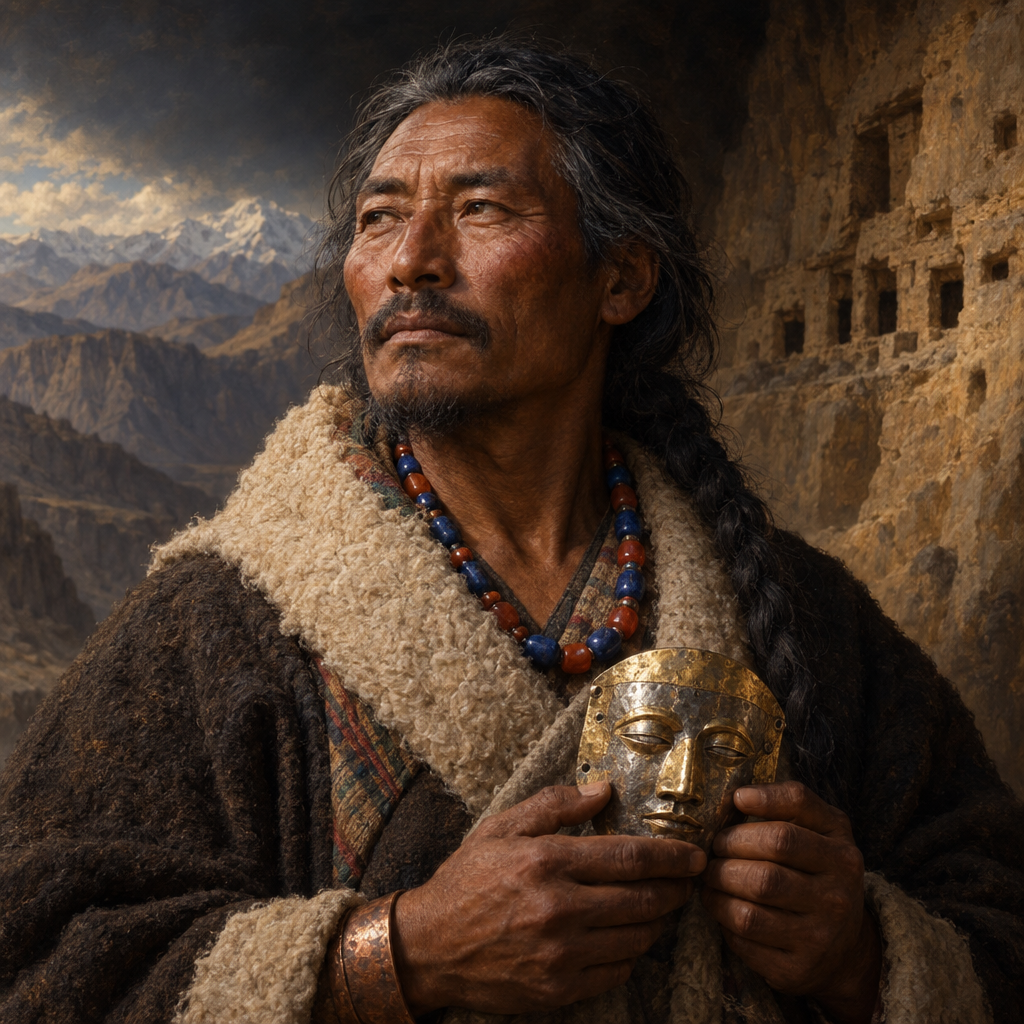
High in Nepal's Mustang district, above 3,000 metres, ten shaft tombs at Samdzong open onto a sheer cliff face. Inside lay scraps of metal and glass beads that had crossed the Himalaya, and a funerary mask of gold and silver that has become famous. At Mebrak, eight levels of burials survived beneath bird guano with their organic goods intact. Genomes from both sites show a population of high-altitude East Asian origin, stable across the centuries, with Tibetan-related ancestry present in the Himalayas by about 1420 BCE. The twelve here were laid to rest between the fourth century BCE and the seventh century CE. Village and descendant-community representatives were present during sampling, and the collections remain in village care.
The genome-wide data behind this entry was published in Ancient genomes from the Himalayas illuminate the genetic history of Tibetans and their Tibeto-Burman speaking neighbors.
How your distance is measured
Every Ancestry Map includes the free Notable Matches lens: your coordinates are compared to every sequenced member of every catalog entry, and the distance to the closest member is reported, a Euclidean distance in the same 25-dimensional space the Distance lens uses. Because these are a small group of real individuals, not a population average, distances naturally run larger than population distances. That is expected, not a poor result. And one thing is never claimed: a small distance means similar ancestry composition, not that the Sky Caves of Mustang are your ancestor. See how it looks in the live demo or read about Ancestry Map, the full Global25 report.
Questions
Who were the Sky Caves of Mustang?
The Sky Caves of Mustang (c. 400 BCE-700 CE, Samdzong and Mebrak, Mustang, Nepal) are one of the Iconic discoveries entries in our Notable Matches catalog, represented by 12 sequenced ancient genomes published in the study "Ancient genomes from the Himalayas illuminate the genetic history of Tibetans and their Tibeto-Burman speaking neighbors".
What does "matching" the Sky Caves of Mustang mean?
Your Global25 coordinates are compared to the entry's sequenced members and the distance to the closest one is reported, a Euclidean distance in the same 25-dimensional reference space the Distance lens uses. A notable entry is one person or one small burial group, not a population average, so distances naturally run larger than population distances.
Are they my ancestor?
No, and no DNA test can show that. A small distance means your genome sits near theirs in a shared reference space: similar ancestry composition, not descent. Ancestrify never claims a notable individual is your ancestor or relative.
How do I see my own distance to the Sky Caves of Mustang?
Notable Matches is a free lens on every Ancestry Map, never sold separately. Order Ancestry Map, our Global25 analysis (29.99 EUR), and your report ranks your coordinates against the full catalog, with a portrait, dossier and map for every entry. The public demo shows the lens with example data.
More from the catalog
The catalog holds every published entry across three tiers. Browse the full Notable Matches directory. Nearby entries:
The Hellenistic and Roman Lebanesec. 350 BCE-640 CE
The Romans of Viminacium1st-6th century CE
The People of Imperial Romec. 100-300 CE
The Victims of Pompeii79 CE
The People of Roman Sitifis1st-2nd century CE
The Bog Army of Alken Engec. 100 BCE-150 CE
The Romans of Docleac. 100-400 CE
The Sarmatians of the Lower Danubec. 100-400 CE
The Goths of the Vistulac. 100-400 CE
The Sarmatians of the Great Hungarian Plain1st-4th century CE
The Archaic Age Cubansc. 1200 BCE-1250 CE
The Log-Coffin People of Pang Maphac. 150-400 CE