
Notable Matches · Iconic discoveries
The Urartians
The Urartians (c. 850-600 BCE · Teishebaini (Karmir Blur), Yerevan, Armenia): what the published ancient DNA shows, 12 sequenced genomes, and how close your own Global25 coordinates come. Free with every Ancestry Map.
The dossier
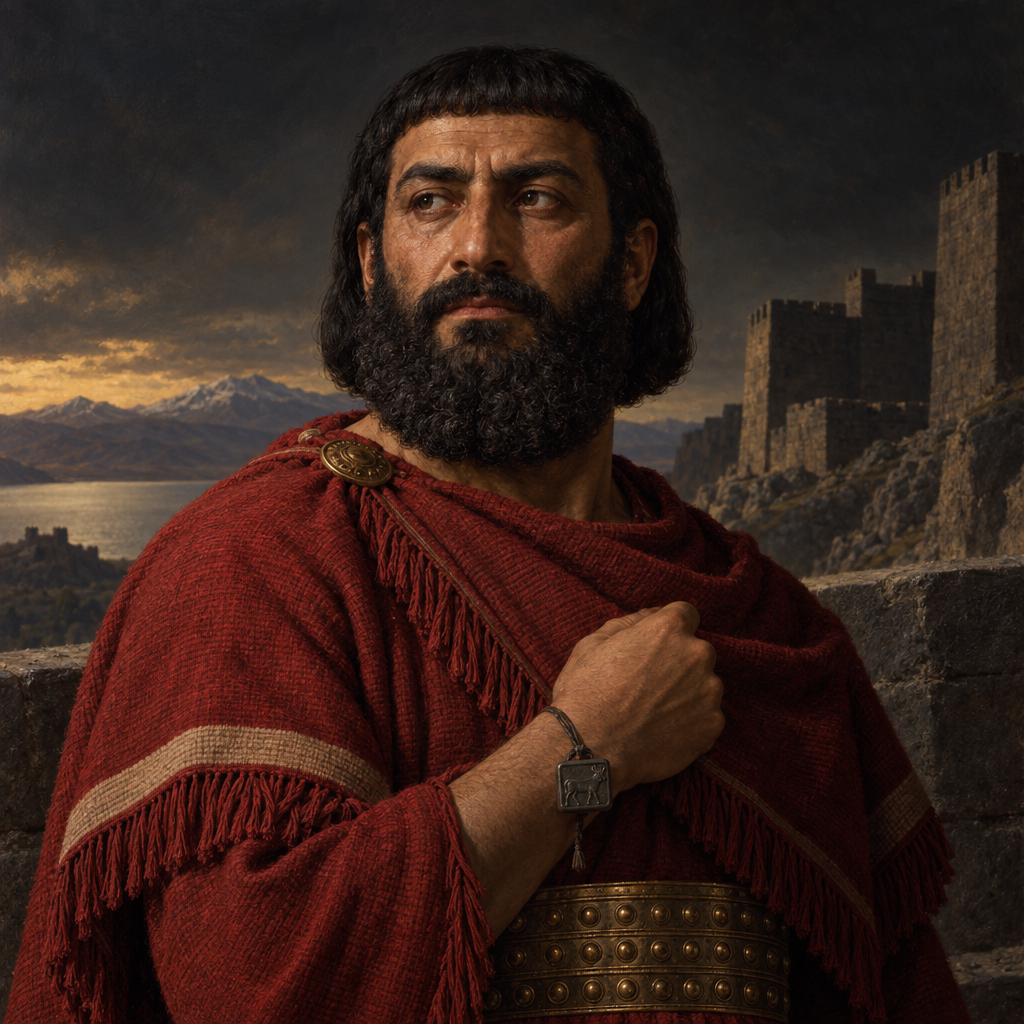
- Catalog tier
- Iconic discoveries
- Period
- c. 850-600 BCE
- Found
- Teishebaini (Karmir Blur), Yerevan, Armenia
- Sequenced genomes
- 12 (I16191.AG, I14054.AG, I14053.AG, I14765.AG, I14057.AG, I18160.AG, I18236.AG, I18237.AG, I18238.AG, I19613.AG, I14052.AG, I20577.AG)
Who they were
Urartu rose around Lake Van in the ninth century BCE under Sarduri I and ruled from its capital Tushpa until the kingdom fell in the 590s BCE. These twelve people come from both ends of that realm: the necropolis of Cavustepe, the fortress Sardurihinili that Sarduri II founded above the Van plain, and cemeteries in the northern provinces of what is now Armenia, where the local Lchashen-Metsamor culture lived under Urartian rule. Their genomes divide along the same line. The northern individuals carry a share of steppe ancestry and the R1b-Z2103 paternal lineage, while those from the Lake Van heartland lack it entirely. Among living peoples, modern Armenians are the closest match.
The genome-wide data behind this entry was published in A genetic probe into the ancient and medieval history of Southern Europe and West Asia.
How your distance is measured
Every Ancestry Map includes the free Notable Matches lens: your coordinates are compared to every sequenced member of every catalog entry, and the distance to the closest member is reported, a Euclidean distance in the same 25-dimensional space the Distance lens uses. Because these are a small group of real individuals, not a population average, distances naturally run larger than population distances. That is expected, not a poor result. And one thing is never claimed: a small distance means similar ancestry composition, not that the Urartians are your ancestor. See how it looks in the live demo or read about Ancestry Map, the full Global25 report.
Questions
Who were the Urartians?
The Urartians (c. 850-600 BCE, Teishebaini (Karmir Blur), Yerevan, Armenia) are one of the Iconic discoveries entries in our Notable Matches catalog, represented by 12 sequenced ancient genomes published in the study "A genetic probe into the ancient and medieval history of Southern Europe and West Asia".
What does "matching" the Urartians mean?
Your Global25 coordinates are compared to the entry's sequenced members and the distance to the closest one is reported, a Euclidean distance in the same 25-dimensional reference space the Distance lens uses. A notable entry is one person or one small burial group, not a population average, so distances naturally run larger than population distances.
Are they my ancestor?
No, and no DNA test can show that. A small distance means your genome sits near theirs in a shared reference space: similar ancestry composition, not descent. Ancestrify never claims a notable individual is your ancestor or relative.
How do I see my own distance to the Urartians?
Notable Matches is a free lens on every Ancestry Map, never sold separately. Order Ancestry Map, our Global25 analysis (29.99 EUR), and your report ranks your coordinates against the full catalog, with a portrait, dossier and map for every entry. The public demo shows the lens with example data.
More from the catalog
The catalog holds every published entry across three tiers. Browse the full Notable Matches directory. Nearby entries:
The Paeoniansc. 1200-300 BCE
The Picenes of Novilarac. 725-625 BCE
The Mummies of Abusir el-Meleqc. 775-560 BCE
The Illyrians of Dalmatiac. 1200-300 BCE
The Phoenicians of Achzivc. 900-400 BCE
The Koban Culturec. 800-400 BCE
The Phoenicians of Tharrosc. 700-470 BCE
The Phoenicians of Motyac. 670-450 BCE
The Illyrians of Montenegroc. 1600-300 BCE
The Salt Lords of Hallstattc. 750-400 BCE
The Lapita Voyagers of Teoumac. 950 BCE
The Etruscansc. 800-100 BCE