
Notable Matches · Historical figures
The Volga Bulgars
The Volga Bulgars (c. 850-1000 CE · Tankeevka cemetery, Spassky district, Tatarstan, Russia): what the published ancient DNA shows, 7 sequenced genomes, and how close your own Global25 coordinates come. Free with every Ancestry Map.
The dossier
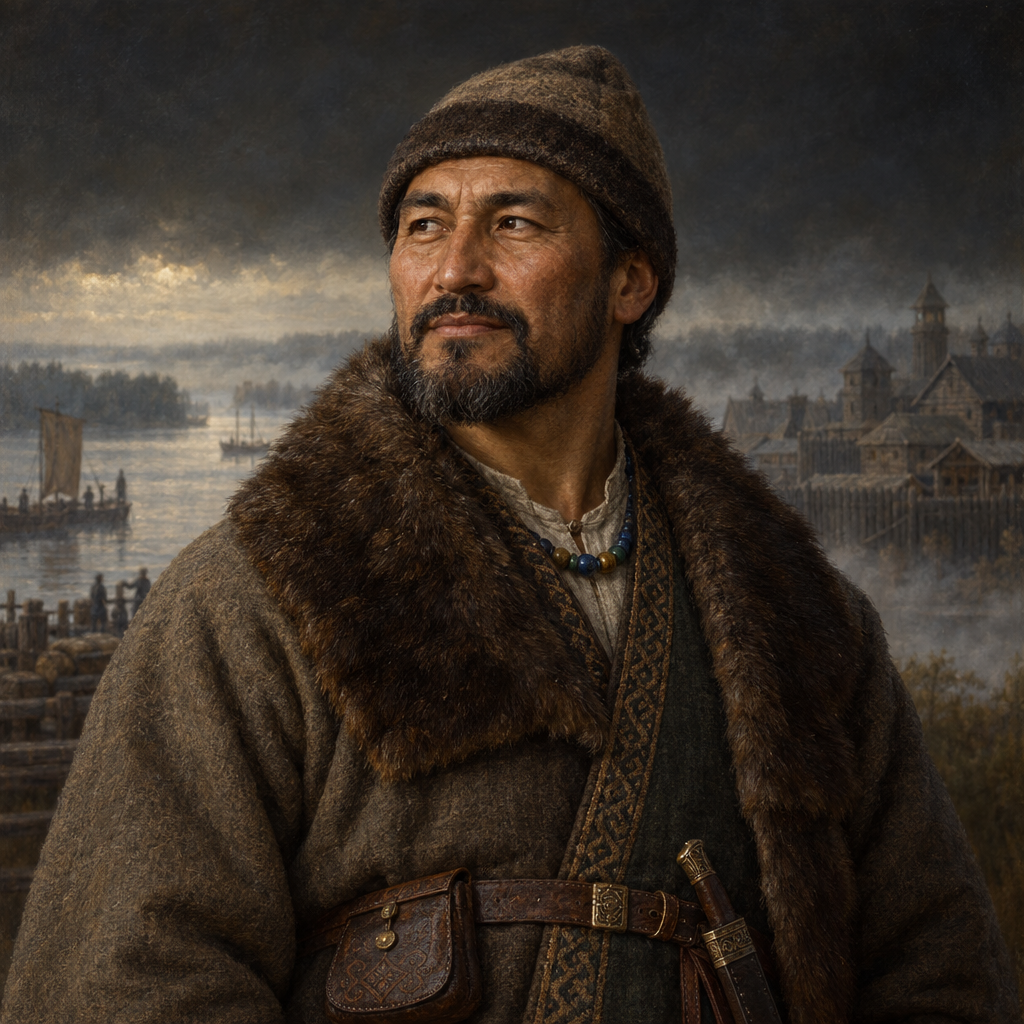
- Catalog tier
- Historical figures
- Period
- c. 850-1000 CE
- Found
- Tankeevka cemetery, Spassky district, Tatarstan, Russia
- Sequenced genomes
- 7 (I25527, I25528, I25532, I25529, I25526, I25534, I25533)
Who they were
Where the Kama meets the Volga, close to the later city of Bolgar, the cemetery of Tankeevka holds thousands of graves from the founding generations of Volga Bulgaria. Its people were living through the shift from steppe-nomadic life to settled Islamic urban life: the state adopted Islam in 922 CE and became the northernmost Muslim realm of the medieval world, one that Volga Tatars and Chuvash both trace their descent from. Seven people buried at Tankeevka between about 850 and 1000 are gathered here. One sampled man carried the paternal line Q2b and the maternal line B5b4, both eastern Eurasian, evidence that the founding Bulgars had arrived from the east. Another shares about 144 centimorgans of DNA with a tenth-century Hungarian conqueror buried at Szeged-Othalom, a kinship-level thread running from the Volga to the Carpathian Basin.
The genome-wide data behind this entry was published in Long shared haplotypes identify the southern Urals as a primary source for the 10th-century Hungarians.
How your distance is measured
Every Ancestry Map includes the free Notable Matches lens: your coordinates are compared to every sequenced member of every catalog entry, and the distance to the closest member is reported, a Euclidean distance in the same 25-dimensional space the Distance lens uses. Because these are a small group of real individuals, not a population average, distances naturally run larger than population distances. That is expected, not a poor result. And one thing is never claimed: a small distance means similar ancestry composition, not that the Volga Bulgars are your ancestor. See how it looks in the live demo or read about Ancestry Map, the full Global25 report.
Questions
Who were the Volga Bulgars?
The Volga Bulgars (c. 850-1000 CE, Tankeevka cemetery, Spassky district, Tatarstan, Russia) are one of the Historical figures entries in our Notable Matches catalog, represented by 7 sequenced ancient genomes published in the study "Long shared haplotypes identify the southern Urals as a primary source for the 10th-century Hungarians".
What does "matching" the Volga Bulgars mean?
Your Global25 coordinates are compared to the entry's sequenced members and the distance to the closest one is reported, a Euclidean distance in the same 25-dimensional reference space the Distance lens uses. A notable entry is one person or one small burial group, not a population average, so distances naturally run larger than population distances.
Are they my ancestor?
No, and no DNA test can show that. A small distance means your genome sits near theirs in a shared reference space: similar ancestry composition, not descent. Ancestrify never claims a notable individual is your ancestor or relative.
How do I see my own distance to the Volga Bulgars?
Notable Matches is a free lens on every Ancestry Map, never sold separately. Order Ancestry Map, our Global25 analysis (29.99 EUR), and your report ranks your coordinates against the full catalog, with a portrait, dossier and map for every entry. The public demo shows the lens with example data.
More from the catalog
The catalog holds every published entry across three tiers. Browse the full Notable Matches directory. Nearby entries:
The Birka Warrior Woman10th century CE
The Medieval Islanders of Soqotrac. 650-1150 CE
Bishop Teodomiro of Iria Flaviad. 847 CE
Saint Ladislaus I of Hungary1040-1095 CE
The Early Medieval Slavs of Velimc. 650-950 CE
Árpád Royals of the Székesfehérvár Basilica9th-12th century CE
The Elbe Slavs of Niederwünschc. 900-1200 CE
Prince Gleb Svyatoslavich1052-1078 CE
The Salme Ship Warriorsc. 750 CE
The Alans of the North Caucasusc. 350-1100 CE
The Chen Clan of the Tang Frontierearly 8th century CE
King Béla III of Hungary1148-1196 CE