
Ancestry populations · Hunter Gatherer and Neolithic Farmer
Levantine Neolithic Farmer
The Pre-Pottery Neolithic B villagers of the Levant, Natufian descendants with an Anatolian-related addition, among the first farmers anywhere. One of the 18 curated source populations in the Hunter Gatherer and Neolithic Farmer era of Ancient Ancestry, Ancestrify's qpAdm analysis.
Who they were
- Period
- 8800 to 6500 BC
- Era in the analysis
- Hunter Gatherer and Neolithic Farmer
- Region
- Southern Levant
- Role in the model
- Source (left) population, a reference qpAdm tests against
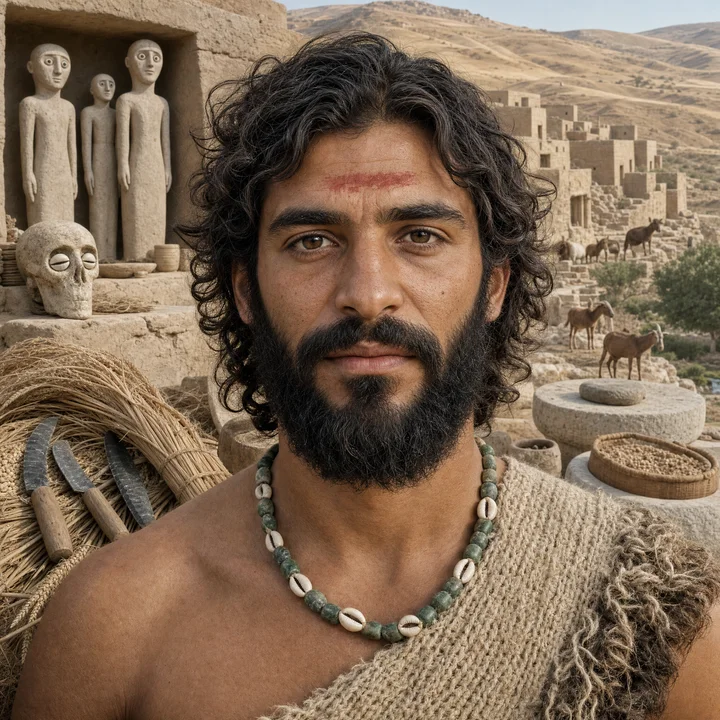
The Levantine Neolithic farmers are the Pre-Pottery Neolithic B villagers known above all from 'Ain Ghazal in the highlands of Jordan, one of the largest early farming settlements of the Near East, with its lime-plastered floors, its plastered skulls and its famous plaster statues. Their genomes show a population descended largely from the Epipalaeolithic Natufians of the same region, with an added Anatolian-related component that the Natufians themselves did not carry (Lazaridis et al. 2016). They were among the first people anywhere to live from cultivated wheat, barley and pulses and from herded goats and sheep.
This ancestry is the deep Levantine layer beneath everything that came later in the region. With the Iranian- and Caucasus-related ancestry that arrived from the Chalcolithic onwards it became the ancestry of the Bronze Age Canaanites, and through them of the Iron Age peoples of the Levant (Haber et al. 2017; Agranat-Tamir et al. 2020), and it remains a large part of the ancestry of present-day Levantine Arabs, Druze and Jewish communities. In the model it is the Levantine pole of the era, distinct from the Anatolian farmers to the north and the Iranian farmers to the east.
In Ancient Ancestry, Ancestrify's qpAdm analysis, Levantine Neolithic Farmer is a source in the "Hunter Gatherer and Neolithic Farmer" era. The report shows its weight with a standard error and a Z-score, so you can see not only how much of the model it carries but how confidently that share is separated from zero, and a model that cannot support it is rejected rather than published. It sits between the Natufian and the Anatolian Neolithic Farmer sources, and its weight is best read together with those two and with the Iranian Neolithic Farmer, which is what separates a Levantine deep ancestry from a Mesopotamian or Iranian one.
Y haplogroups E1b1b and T, and mtDNA K, R0a and T, are reported among these samples. A haplogroup alone is never evidence of a share.
In your reportArtwork is an AI-generated artistic interpretation informed by the archaeological record, not documentary evidence.The Pre-Pottery Neolithic B farmers of the Levant (c. 8800–6500 BC), known from 'Ain Ghazal in the Jordan highlands — among the world's first village farmers, descendants of the Natufians with added Anatolian-related ancestry. The deep-time Levantine source for customers with Jewish, Arab or broader Near-Eastern roots.
Where this population sits in the model
Ancient Ancestry, our qpAdm analysis, models your genome once per era. The Hunter Gatherer and Neolithic Farmer era has 18 curated source populations, and Levantine Neolithic Farmer is one of them: every candidate model for that era is a combination of these sources, tested against a fixed set of outgroup populations, and only a model that passes the statistical fit check is published, with a p-value and a standard error on every proportion.
A reference, not a verdict: every population on this page is a source the model tests your genome against, a well-sampled point in ancient genetic space that a mixture of ancestries can be expressed in terms of. A weight on it means your genome is well described as partly resembling those people; it is never a statement that they, specifically, were your ancestors, and a population that fits well is not the only one that could.
Read how qpAdm works on the Ancient Ancestry page, or the definitions in the glossary.
Model it yourself for free
The Ancestrify Lab runs in your browser, with no account. Paste a Global25 row into an admixture calculator that covers the Hunter Gatherer and Neolithic Farmer era, rank the closest ancient populations in the distance tool, or run f4, qpWave and qpAdm on the public panel in the AdmixTools 2 workbench. These are Global25 fits and exploratory statistics, not the formal qpAdm model of Ancient Ancestry.
Questions
Who were the Levantine Neolithic Farmer (8800 to 6500 BC)?
Levantine Neolithic Farmer is one of the 18 curated source populations in the Hunter Gatherer and Neolithic Farmer era of Ancient Ancestry, Ancestrify's qpAdm analysis: a group of published genomes pooled as a single reference the model can test your genome against. These are ancient individuals from one archaeological context wherever the record holds them, and present-day genomes standing in where it does not, which the description on this page says.
Does Levantine Neolithic Farmer in my result mean they were my ancestors?
No. A source population is a reference the model tests against, never a statement about who your ancestors were. A coefficient on this source means the ancestry those burials represent helps explain your genome to within statistical noise: similar ancestry composition, not descent from those individuals. Ancestrify never claims a population is your ancestor.
What does a Levantine Neolithic Farmer percentage in a qpAdm model mean?
qpAdm estimates the mixture proportions that best explain your genome as a combination of the chosen sources, given a fixed set of outgroup (right) populations, and reports a p-value for whether the model is statistically acceptable together with a standard error for every proportion. The percentage is that estimated share, with its uncertainty published beside it.
How do I get a qpAdm model that uses Levantine Neolithic Farmer?
Order Ancient Ancestry, Ancestrify's qpAdm analysis (€29.99, one-time), and upload the raw file you already have from a consumer test. Your genome is merged into the AADR reference panel and modelled across both eras; each era's model is built from that era's source populations, so a model for the Hunter Gatherer and Neolithic Farmer era draws on Levantine Neolithic Farmer where it improves the fit.
Can I model Levantine Neolithic Farmer ancestry for free first?
Yes. The Ancestrify Lab runs Global25 admixture calculators, a nearest-populations distance tool and an AdmixTools 2 workbench in your browser with no account, and several calculators cover the Hunter Gatherer and Neolithic Farmer era. Those are G25 fits, not formal qpAdm models. Ancient Ancestry, the paid analysis, is the one with a p-value.
More populations from the Hunter Gatherer and Neolithic Farmer era
Browse the full directory of source populations, or continue with another population from the same era:
Anatolian Neolithic Farmer8500 to 6000 BC
Ancestral South Indian10000 to 2000 BC
Caucasian Hunter Gatherer13000 to 7000 BC
Early European Farmer5500 to 4900 BC
East Asian Neolithic Farmer5000 to 2000 BC
Eastern Hunter Gatherer12000 to 5000 BC
Iberomaurusian15000 to 8000 BC
Iranian Neolithic Farmer8000 to 5000 BC
Native American15000 to 1500 BC
Natufian12000 to 8000 BC
North African Farmer5200 to 4000 BC
Northeast Asian6000 to 2000 BC
Sarazm Copper Age3700 to 3300 BC
Sub Saharan African
West African10000 to 1500 BC
Western Hunter Gatherer12000 to 6000 BC
Western Steppe Herder5000 to 2800 BC