
Ancestry populations · Hunter Gatherer and Neolithic Farmer
Western Hunter Gatherer
Mesolithic foragers of Western and Central Europe, descendants of the post-glacial recolonisers whose ancestry survives across the continent. One of the 48 curated source populations in the Hunter Gatherer and Neolithic Farmer era of Ancient Ancestry, Ancestrify's qpAdm analysis.
Who they were
- Period
- 12000 to 4000 BC
- Era in the analysis
- Hunter Gatherer and Neolithic Farmer
- Region
- Western and Central Europe
- Role in the model
- Source (left) population, a reference qpAdm tests against
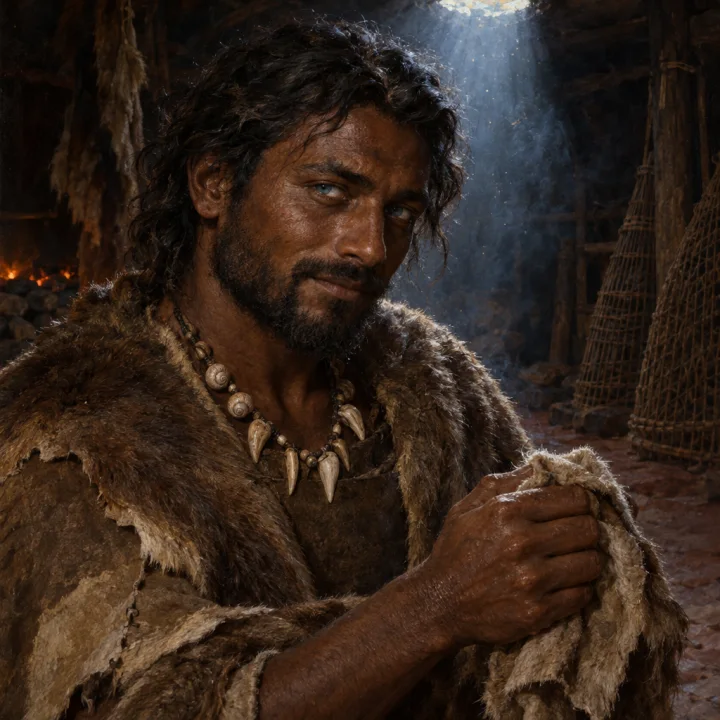
Western hunter-gatherers (WHG) are the Mesolithic foragers of Europe west of the Dnieper, defined by the genome of the Loschbour man from Luxembourg and sampled from Spain to Hungary and Britain (Lazaridis et al. 2014; Haak et al. 2015). They descend from the population that recolonised the continent after the last glacial maximum, associated with the Epigravettian of Italy and the Balkans, and had largely replaced the earlier Magdalenian-related foragers of the west by the end of the Ice Age (Posth et al. 2023). Their pigmentation genetics (dark skin with blue eyes at Loschbour and Cheddar Man) became one of ancient DNA's most widely reported findings.
WHG ancestry never disappeared. It was absorbed by the Neolithic farmers over the millennia after 6000 BC, rising again in the Middle Neolithic as farmer and forager populations mixed, and it survives today at its highest levels in the Baltic states and at modest levels across the whole continent. In the model it is the western end of a forager cline that runs through the Eastern Hunter Gatherer, and it is the source most sharply distinct from the Anatolian farmer.
In Ancient Ancestry, Ancestrify's qpAdm analysis, Western Hunter Gatherer is a source in the "Hunter Gatherer and Neolithic Farmer" era. The report shows its weight with a standard error and a Z-score, so you can see not only how much of the model it carries but how confidently that share is separated from zero, and a model that cannot support it is rejected rather than published. For most European genomes it carries a small but real weight, and the Z-score shows whether the model could separate that share from the forager ancestry already bundled in the steppe source.
Y haplogroup I2 and, less often, C1a2, and mtDNA U5b and U5a, are the usual lineages in these samples. A haplogroup alone is never evidence of a share.
In your reportArtwork is an AI-generated artistic interpretation informed by the archaeological record, not documentary evidence.Represents the Mesolithic forager populations of western, southern, and central Europe (c. 15,000–5,000 BCE) who recolonized the continent after the Last Glacial Maximum. Typified by specimens such as Loschbour from Luxembourg, WHGs were identified by Lazaridis et al. (2014) as one of three deeply differentiated ancestral populations contributing to modern Europeans. Their ancestry traces to the Villabruna cluster, likely originating in the Balkans and associated with Epigravettian and Azilian cultures. WHGs were largely replaced by successive expansions of Anatolian-derived Early European Farmers during the Neolithic, though residual WHG ancestry persists across Europe. The highest proportions of surviving WHG ancestry are found today in the eastern Baltic region.
Where this population sits in the model
Ancient Ancestry, our qpAdm analysis, models your genome once per era. The Hunter Gatherer and Neolithic Farmer era has 48 curated source populations, and Western Hunter Gatherer is one of them: every candidate model for that era is a combination of these sources, tested against a fixed set of outgroup populations, and only a model that passes the statistical fit check is published, with a p-value and a standard error on every proportion.
A reference, not a verdict: every population on this page is a source the model tests your genome against, a well-sampled point in ancient genetic space that a mixture of ancestries can be expressed in terms of. A weight on it means your genome is well described as partly resembling those people; it is never a statement that they, specifically, were your ancestors, and a population that fits well is not the only one that could.
Read how qpAdm works on the Ancient Ancestry page, or the definitions in the glossary.
Model it yourself for free
The Ancestrify Lab runs in your browser, with no account. Paste a Global25 row into an admixture calculator that covers the Hunter Gatherer and Neolithic Farmer era, rank the closest ancient populations in the distance tool, or run f4, qpWave and qpAdm on the public panel in the AdmixTools 2 workbench. These are Global25 fits and exploratory statistics, not the formal qpAdm model of Ancient Ancestry.
Questions
Who were the Western Hunter Gatherer (12000 to 4000 BC)?
Western Hunter Gatherer is one of the 48 curated source populations in the Hunter Gatherer and Neolithic Farmer era of Ancient Ancestry, Ancestrify's qpAdm analysis: a group of published genomes pooled as a single reference the model can test your genome against. These are ancient individuals from one archaeological context wherever the record holds them, and present-day genomes standing in where it does not, which the description on this page says.
Does Western Hunter Gatherer in my result mean they were my ancestors?
No. A source population is a reference the model tests against, never a statement about who your ancestors were. A coefficient on this source means the ancestry those burials represent helps explain your genome to within statistical noise: similar ancestry composition, not descent from those individuals. Ancestrify never claims a population is your ancestor.
What does a Western Hunter Gatherer percentage in a qpAdm model mean?
qpAdm estimates the mixture proportions that best explain your genome as a combination of the chosen sources, given a fixed set of outgroup (right) populations, and reports a p-value for whether the model is statistically acceptable together with a standard error for every proportion. The percentage is that estimated share, with its uncertainty published beside it.
How do I get a qpAdm model that uses Western Hunter Gatherer?
Order Ancient Ancestry, Ancestrify's qpAdm analysis (€29.99, one-time), and upload the raw file you already have from a consumer test. Your genome is merged into the AADR reference panel and modelled across both eras; each era's model is built from that era's source populations, so a model for the Hunter Gatherer and Neolithic Farmer era draws on Western Hunter Gatherer where it improves the fit.
Can I model Western Hunter Gatherer ancestry for free first?
Yes. The Ancestrify Lab runs Global25 admixture calculators, a nearest-populations distance tool and an AdmixTools 2 workbench in your browser with no account, and several calculators cover the Hunter Gatherer and Neolithic Farmer era. Those are G25 fits, not formal qpAdm models. Ancient Ancestry, the paid analysis, is the one with a p-value.
More populations from the Hunter Gatherer and Neolithic Farmer era
Browse the full directory of source populations, or continue with another population from the same era:
Anatolian Copper Age Farmer5500 to 2500 BC
Anatolian Neolithic Farmer8500 to 6000 BC
Ancestral South Indian10000 to 2000 BC
Ancient North Eurasian30000 to 15000 BC
Balkan Copper Age Farmer4500 to 3000 BC
British and Irish Neolithic Farmer4000 to 3000 BC
Carpathian Farmer5500 to 3000 BC
Caucasian Copper Age Farmer4500 to 2500 BC
Caucasian Hunter Gatherer13000 to 7000 BC
Caucasian Neolithic Farmer6000 to 5000 BC
Central Asian Copper Age Farmer3500 to 2500 BC
Central European Copper Age Farmer4500 to 2500 BC
Central European Neolithic Farmer4500 to 3000 BC
Cucuteni-Trypillia Farmer4500 to 3000 BC
Early European Farmer5500 to 4900 BC
East Asian Neolithic Farmer7500 to 2500 BC
East Asian Palaeolithic Hunter Gatherer37500 to 12500 BC
Eastern Hunter Gatherer12000 to 3500 BC
Eastern and Central African Hunter Gatherer13500 to 4000 BC
French Neolithic Farmer5000 to 3000 BC
Globular Amphora Farmer3000 to 2500 BC
Gravettian Hunter Gatherer34500 to 24000 BC
Iberian and French Farmer5000 to 2500 BC
Iberomaurusian15000 to 8000 BC
Initial Upper Palaeolithic Hunter Gatherer44000 to 38000 BC
Iranian Copper Age Farmer3500 to 2500 BC
Iranian Neolithic Farmer8000 to 5000 BC
Italian Copper Age Farmer3500 to 2500 BC
Italian Neolithic Farmer6000 to 5000 BC
Japanese and Korean Hunter Gatherer7000 to 4000 BC
Late Glacial Hunter Gatherer21500 to 12000 BC
Levantine Copper Age Farmer4000 to 3500 BC
Levantine Neolithic Farmer8800 to 6500 BC
Native American15000 to 1500 BC
Natufian12000 to 8000 BC
North African Neolithic Farmer6000 to 3700 BC
Northeast Asian Hunter Gatherer6000 to 2000 BC
Sarazm Copper Age3700 to 3300 BC
Sardinian and Sicilian Neolithic Farmer5500 to 3000 BC
Scandinavian Hunter Gatherer7500 to 3000 BC
Scandinavian Neolithic Farmer4000 to 2500 BC
Southern African Hunter Gatherer8500 to 3000 BC
Southern East Asian Neolithic Farmer9500 to 2500 BC
Sub Saharan African
West African10000 to 1500 BC
West Siberian Hunter Gatherer6500 to 3000 BC
Yamnaya5000 to 2800 BC