

Denisovans were named from a finger bone. For more than a decade the group has been known almost entirely from genetic and molecular evidence — a handful of fragments from one Siberian cave, plus a jaw from Tibet and a molar from Laos. One high-quality genome existed, from a woman who lived roughly 65,000 years ago. A 2025 report adds a second, from a man who lived about 200,000 years ago, and in doing so produces the oldest high-coverage genome yet reported for any member of the human family.
What that second genome buys is not simply age. Two high-quality genomes separated by 135,000 years let researchers see the Denisovans as a history rather than a point — a lineage with internal structure, replacements, and at least three distinct branches that contributed DNA to living people.
The report is the preprint A high-coverage genome from a 200,000-year-old Denisovan by Stéphane Peyrégne and colleagues at the Max Planck Institute for Evolutionary Anthropology. ⚠️ It was posted to bioRxiv in October 2025 and, at the time of writing, has not completed peer review — so its conclusions should be read as strong but provisional.
The short answer: a molar from Denisova Cave has yielded a second high-quality Denisovan genome, from a man who lived around 200,000 years ago. His group mixed with early Neanderthals and was later replaced by Denisovans who had mixed with later Neanderthals. Denisovans also received DNA from a hominin lineage that diverged before Denisovans and modern humans split. The two genomes together resolve at least three distinct Denisovan sources in present-day people. These are inferences from statistical models, not a complete census of a population.
Why a second genome matters more than a first#
A single high-coverage genome tells you what one individual carried. It cannot easily distinguish features of that person from features of their whole population, and it cannot show change through time at all.
With two genomes 135,000 years apart from the same cave, several questions become answerable. Was the later population descended from the earlier one? Did the composition of Denisovan ancestry in living people come from one source or several? Were there other hominins in the picture that neither genome descends from cleanly?
The answers reported are, in order: not straightforwardly, several, and yes.
| What one genome shows | What two genomes separated in time show |
|---|---|
| The variants one individual carried | Whether the later population descends from the earlier one |
| A single point on the family tree | Population turnover, replacement and structure |
| One source of introgression into modern humans | Several distinguishable sources |
| Archaic admixture as an undifferentiated signal | Which archaic group contributed which segments |
Replacement inside one cave#
The most immediately human result is that Denisova Cave's occupants were not one continuous population. The 200,000-year-old man belonged to a small Denisovan group that had mixed with early Neanderthals. That group was subsequently replaced by Denisovans carrying admixture from later Neanderthals — a different mixture with a different set of Neanderthal partners.
This is a familiar shape from the study of modern human prehistory, where population turnover within a single region is the rule rather than the exception. Seeing it inside an archaic group, at a single site, is new mainly because the evidence has never been good enough to look.
It also sharpens what "Denisovan" means. The word names a genetic clade defined originally by one individual. It does not name a single stable community, and the cave that gave the group its name held at least two of them.
A ghost older than the Denisovan–modern human split#
The second structural finding concerns something further back. The analysis reports that Denisovans received gene flow from hominins that diverged before the split between the ancestors of Denisovans and modern humans.
This is the pattern usually called superarchaic admixture: DNA entering a known lineage from a population that separated from the rest of the human family long before the groups we can name. No fossil is attached to it. It is detected as a component of the Denisovan genome that fits no known source — a statistical ghost, inferred from the shape of the data rather than excavated.
Hints of such a contribution had appeared in earlier work. What a 200,000-year-old high-coverage genome adds is resolution: with a much older Denisovan in hand, the deeply diverged component is easier to separate from everything that happened afterwards.
The interpretive caution here is the same as for any ghost population. "A lineage that diverged early" is a description of a signal, not an identification of a species. It may correspond to a hominin already known from fossils, to one not yet found, or to structure inside an ancestral population that a tree model represents as a separate branch.
Three Denisovan sources in living people#
The result with the widest reach concerns modern genomes. Denisovan ancestry in living populations has long been known to be uneven: highest in Papuans and other Oceanian populations, present at lower levels across East and South Asia, and effectively absent from West Eurasia and most of Africa. Earlier work had already suggested it was not all from one source.
With two high-quality Denisovan genomes, the analysis resolves contributions from at least three distinct Denisovan groups, and reports a specific and unexpected pattern:
- Oceanians and South Asians independently inherited DNA from a deeply diverged Denisovan population, one likely isolated in South Asia.
- East Asians do not share that component, carrying Denisovan ancestry from different sources.
The demographic reading offered is that the ancestors of Oceanians moved early through South Asia and met that isolated Denisovan population, while the ancestors of present-day South Asians arrived later and encountered its descendants separately. East Asian ancestors, on this model, arrived independently — perhaps by a more northerly route.
That is a claim about the peopling of Asia derived from archaic DNA rather than from modern population structure, which is what makes it interesting. Ancient genomes from Asia remain scarce; work such as the Ladakh genomes and the Donghulin individuals from northern China is only beginning to fill in the more recent layers.
What "high coverage" actually means#
The phrase does a lot of work in reports on this subject, and it is worth unpacking. Coverage is how many times, on average, each position in the genome was read. At low coverage — the norm for most ancient samples — many positions are seen once or not at all, and analyses have to work with genotype likelihoods rather than confident calls.
At the coverage reported here, roughly 23-fold, most positions are read many times over. That allows both chromosomes to be called at each site, which in turn allows the analyses this study depends on: estimating how genetically diverse the individual's population was, dating splits precisely, and separating overlapping archaic contributions from one another.
Only a handful of archaic individuals have ever been sequenced to this standard. Doing it on a 200,000-year-old sample is the technical achievement behind the biological result — and it is what makes the preprint status worth restating, since the methods are exactly the part peer review scrutinises hardest.
Limitations worth keeping in view#
| Limitation | Why it matters |
|---|---|
| This is a preprint | Conclusions and specific estimates may change during peer review. |
| Two genomes represent two individuals | Population-level inference rests on models, not on a sample of a community. |
| Almost all Denisovan material comes from one cave | Geographic coverage of the group is extremely thin. |
| Ghost lineages are inferred, not observed | "Deeply diverged hominin" describes a signal, not a named species. |
| Introgression dates carry wide intervals | Statements about "when" are ranges spanning millennia. |
| Modern reference panels are uneven | South and Southeast Asian sampling shapes what can be resolved. |
Frequently asked questions about the 200,000-year-old Denisovan genome#
How old is this genome compared with previous records?#
At around 200,000 years, it is roughly 80,000 years older than the previous oldest high-coverage genome, which came from a Neanderthal who lived about 120,000 years ago. Older DNA has been recovered in fragments and from sediments, but not at this quality.
Is the study peer-reviewed?#
Not yet. It was posted as a preprint on bioRxiv in October 2025. Preprints are a normal part of how this field communicates, but their findings have not been through external review.
Does this change how much Denisovan DNA people carry?#
Not the totals, which are well established — around 3–5% in Papuan and some Oceanian populations, and lower elsewhere in Asia. What changes is the resolution: that ancestry can now be assigned to at least three distinct Denisovan sources rather than treated as one.
What is a superarchaic population?#
A hominin lineage that split from the rest of the human family before the divergences we can name, and that is detected only as an unexplained component in another group's genome. No fossil has been matched to the contribution reported here.
Were Denisovans a separate species?#
That question is about how species are defined, not about the DNA. Denisovans, Neanderthals and modern humans were distinct lineages that nevertheless interbred and produced fertile offspring; the same is true of many groups classified as separate species elsewhere in biology. The genetic evidence describes divergence and gene flow, and the label is a naming convention placed on top of it.
Can a consumer DNA test tell me my Denisovan percentage?#
Some services report an archaic estimate, usually with wide error and based on limited reference data. Such a figure reflects a model, not a measurement, and it says nothing meaningful about a person's identity or origins. Our qpAdm explainer covers how ancestry proportions are modelled and what the uncertainty around them actually means.
Two points make a line#
Denisovan research has been shaped by scarcity. One good genome, a few teeth, a jaw from a plateau, a molar from a cave in Laos — enough to establish that the group existed and had contributed to living people, not enough to describe it as a population with a history.
A second high-quality genome, deep in time, converts a point into a line. It shows a group replaced within its own cave, receiving DNA from a lineage older than itself, and splitting into branches whose descendants met different waves of modern humans in different places. None of that was visible from one genome, and none of it required a new fossil — only a better one, read more completely.
The obvious next step is geographic. Everything high-quality still comes from a single Siberian site, while the Denisovan ancestry that matters most to living people appears to derive from populations further south, in regions where DNA rarely survives. The Harbin cranium's Denisovan identification shows one route around that problem: when DNA is unavailable, proteins sometimes are not.
Sources and further reading#
- Peyrégne, S., Massilani, D., Swiel, Y. et al. (2025). A high-coverage genome from a 200,000-year-old Denisovan. bioRxiv 2025.10.20.683404. Preprint — not peer-reviewed. DOI: 10.1101/2025.10.20.683404.
- Meyer, M., Kircher, M., Gansauge, M.-T. et al. (2012). A high-coverage genome sequence from an archaic Denisovan individual. Science 338, 222–226. DOI: 10.1126/science.1224344.
- Max Planck Institute for Evolutionary Anthropology, Department of Evolutionary Genetics: eva.mpg.de/genetics.
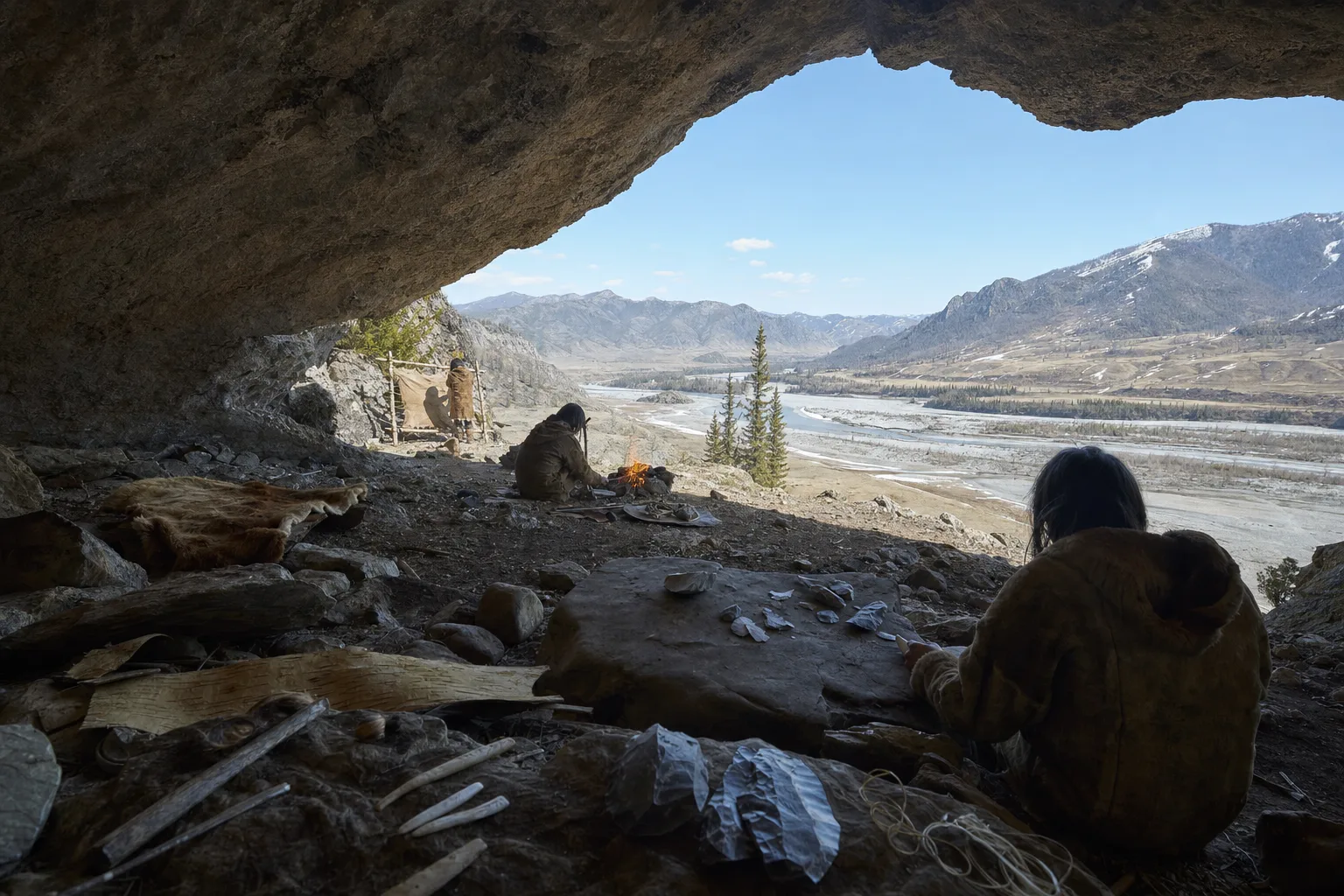
Editorial note: this article was written as a source-based synthesis and states explicitly where its primary source is a preprint rather than a peer-reviewed paper. Its hero and section artwork was generated with AI as an interpretive archaeological scene, not as scientific evidence.


