

The transition from foraging to farming happened independently in several parts of the world, and northern China is one of them. Millet was domesticated there, in a sequence that runs from the end of the last Ice Age through the early Holocene — and until recently, that sequence had almost no genetic evidence attached to it.
A 2026 study supplies some. It reports mitochondrial genomes from three individuals and genome-wide data from two, from the Donghulin site in western Beijing, dating to roughly 11,000 to 9,000 years ago. These are the earliest genomes yet associated with Neolithization in northern East Asia, and the older of them carries an ancestry that had never been sampled.
The evidence comes from Ancient genomes provide insight into the Paleolithic-to-Neolithic transition in northern East Asia in Current Biology.
The short answer: an individual known as DHL_M1, dating to about 11,000 years ago, represents a newly identified deep northern East Asian lineage that diverged early in the Late Pleistocene. Genetic change is visible at the same site across roughly 2,000 years of post-glacial warming, indicating that Neolithization in northern East Asia followed its own trajectory rather than a pattern imported from elsewhere. This rests on two genome-wide individuals, which is a small basis for population-scale inference.
Why the Paleolithic-to-Neolithic transition is hard to sample#
The end of the last glacial period reorganised human life almost everywhere. Warming climates changed which plants and animals were available; people responded with pottery, grinding equipment, more permanent settlement, and eventually cultivation.
Genetically, that period is poorly covered nearly everywhere. It sits at the far edge of good DNA preservation in temperate regions, populations were small, and the archaeological sites that document it are often shallow, disturbed or excavated long ago.
Northern East Asia has been particularly thin. The region's ancient genomic record is much better for the last five thousand years than for the ten thousand before that, which has meant reconstructing the origins of one of the world's independent agricultural centres largely from later populations working backwards.
Donghulin is valuable because it sits exactly in that gap. It is a transitional site — occupying the interval between Paleolithic and Neolithic ways of life, in the hills west of present-day Beijing — and it has now yielded genomes.
A lineage that split early and left no other trace#
The central genetic result concerns DHL_M1, the individual dating to around 11,000 years ago. Analysis places them on a newly discovered deep northern East Asian lineage that diverged early in the Late Pleistocene — that is, well before the end of the Ice Age, and separately from the lineages that dominate the region's later record.
"Deep" here means the split is old relative to the diversity known from northern East Asia. "Newly discovered" means no previously sequenced individual, ancient or modern, represents that branch.
The pattern is by now familiar wherever a region gets its first early-Holocene genomes: the populations present at the transition are not simply earlier versions of the populations present later. They are branches, some of which contributed to what followed and some of which apparently did not. The central Argentina lineage and the Green Sahara individuals are the same shape of result on other continents.
| What was assumed | What Donghulin shows |
|---|---|
| Later northern East Asian ancestry extends smoothly backwards | An early-Holocene individual sits on a lineage that diverged much earlier |
| The transition involved one continuous population | Genetic composition at one site changed over ~2,000 years |
| Neolithization followed a shared Eurasian pattern | The regional trajectory has its own structure |
Two thousand years at one place#
The second finding is about change rather than origins. The individuals span roughly 11,000 to 9,000 years ago, and the study identifies genetic change at Donghulin across that interval — a period of post-glacial warming.
Detecting change at a single site is a different kind of evidence from comparing distant regions. It removes the geographic confound: whatever moved, moved into or out of this specific place, rather than being an artefact of comparing populations hundreds of kilometres apart.
Two thousand years is roughly eighty generations. Over that span, warming climates altered vegetation and the distribution of animals, and the beginnings of cultivation would have changed how communities used the landscape. That people at one location were not genetically static across it is unsurprising in retrospect and had never been demonstrated.
The caution is severe here, and the paper is clear about it: genome-wide data come from two individuals. A change between two people can reflect population-level movement — or the ordinary variation between any two members of a structured population. The mitochondrial genomes from a third individual add a maternal-lineage perspective, but mitochondrial DNA traces one line only and cannot describe overall ancestry.
What "a unique trajectory" means#
The paper's conclusion is that northern East Asia followed a unique Paleolithic-to-Neolithic trajectory — not a local instance of a pan-Eurasian process.
That claim rests on the two results together. If the population present at the transition sat on a deep, previously unsampled branch, then the region's Neolithic did not begin with people closely related to those who began it elsewhere. And if composition changed at a single site across the transition, then the process was not simply continuity in place either.
There is a broader point underneath. Millet farming in northern China, rice farming in the Yangtze basin, and the West Asian cereal package are independent domestication events, and there is no reason to expect their demographic histories to rhyme. In West Eurasia, the spread of farming was accompanied by a large movement of people out of Anatolia — a pattern so well documented that it became the default expectation. Donghulin suggests the default should not be exported.
How this fits the later northern East Asian picture#
The genetic landscape of northern East Asia over the last several thousand years is comparatively well described. Ancient genomes from the region resolve a broad structure with poles associated with the Amur River basin to the northeast and the Yellow River basin to the south, and much of the later population history involves gradients and mixtures between ancestries of those kinds, alongside movement into and out of the steppe and the Tibetan Plateau.
Donghulin sits before nearly all of that. An individual on a lineage that diverged in the Late Pleistocene is not straightforwardly an early member of either pole — which is the substance of calling the lineage deep. Whether it contributed appreciably to later populations, and if so where, is not something two individuals can determine.
That question is the obvious next one, and it is the reason early-Holocene sampling matters disproportionately. Later genomes describe the outcome of the region's population history in detail; they cannot show what was there before the mixing began. Filling in the millennia between the last glacial maximum and the well-covered Neolithic is what would connect the two, and Donghulin is currently one of very few anchors in that interval.
Limitations#
| Limitation | Why it matters |
|---|---|
| Two genome-wide individuals | Population-scale inference from two people is inherently fragile. |
| One site | Donghulin's history need not represent northern East Asia. |
| Comparative data are scarce | The region has few early-Holocene genomes to compare against. |
| A deep lineage is a relative statement | It is deep with respect to currently sampled diversity. |
| Change between two individuals is ambiguous | It may reflect movement or ordinary within-population variation. |
| Genomes do not carry subsistence | Nothing here shows whether these people cultivated anything. |
Frequently asked questions about the Donghulin genomes#
How many individuals were sequenced?#
Mitochondrial genomes were reported from three individuals and genome-wide data from two, from the Donghulin site in western Beijing, dating to roughly 11,000 to 9,000 years ago.
What is DHL_M1?#
The designation for the roughly 11,000-year-old individual who represents a newly identified deep northern East Asian lineage — one that diverged early in the Late Pleistocene and had not previously been sampled.
Does this show who domesticated millet?#
No. The genomes describe ancestry, not subsistence. Whether these particular individuals cultivated plants is an archaeological question, addressed by the site's material record rather than by DNA.
Why does a 2,000-year change at one site matter?#
Because it isolates change in time from change in space. Comparing distant regions confounds the two; comparing successive individuals at one location does not.
How does this compare with the Neolithic in Europe?#
In West Eurasia, farming spread with a large movement of people out of Anatolia. The northern East Asian record does not show that pattern, which is part of why the authors describe the region's trajectory as distinct.
Are these the oldest genomes from East Asia?#
No — older individuals have been sequenced from the region. They are the earliest genomes associated with the Neolithization process in northern East Asia specifically, which is what makes them informative about that transition.
Small numbers, real information#
Two genome-wide individuals is a thin dataset by the standards of a field that now routinely publishes hundreds at a time. It is worth being explicit that the population-scale conclusions here are correspondingly provisional.
They are also not nothing. A previously unsampled deep lineage is a discovery that two individuals can genuinely support, because it is a statement about where they sit on a tree rather than about frequencies in a population. And the region has so little early-Holocene data that two well-dated individuals from a securely transitional site materially change what can be said.
What the study mainly establishes is that the expectation was wrong. Northern East Asia's early Holocene was not a smooth backward extension of its later genetic landscape; there were branches there that did not obviously persist. As more sites in the region yield genomes, the shape of that landscape should come into focus — and on this evidence it will not look like the European one.
Sources and further reading#
- Zhang, G., Zhao, C., Wang, T. et al. (2026). Ancient genomes provide insight into the Paleolithic-to-Neolithic transition in northern East Asia. Current Biology 36, 1399–1409.e7. DOI: 10.1016/j.cub.2026.02.004.
- He, G., Wang, M. et al. (2025). Ancient genomes give insight into 160,000 years of East Asian population dynamics and biological adaptation. Genome Biology 26, 420.
- Institute of Vertebrate Paleontology and Paleoanthropology, Chinese Academy of Sciences — the molecular palaeoanthropology group behind this and related East Asian ancient-DNA work.
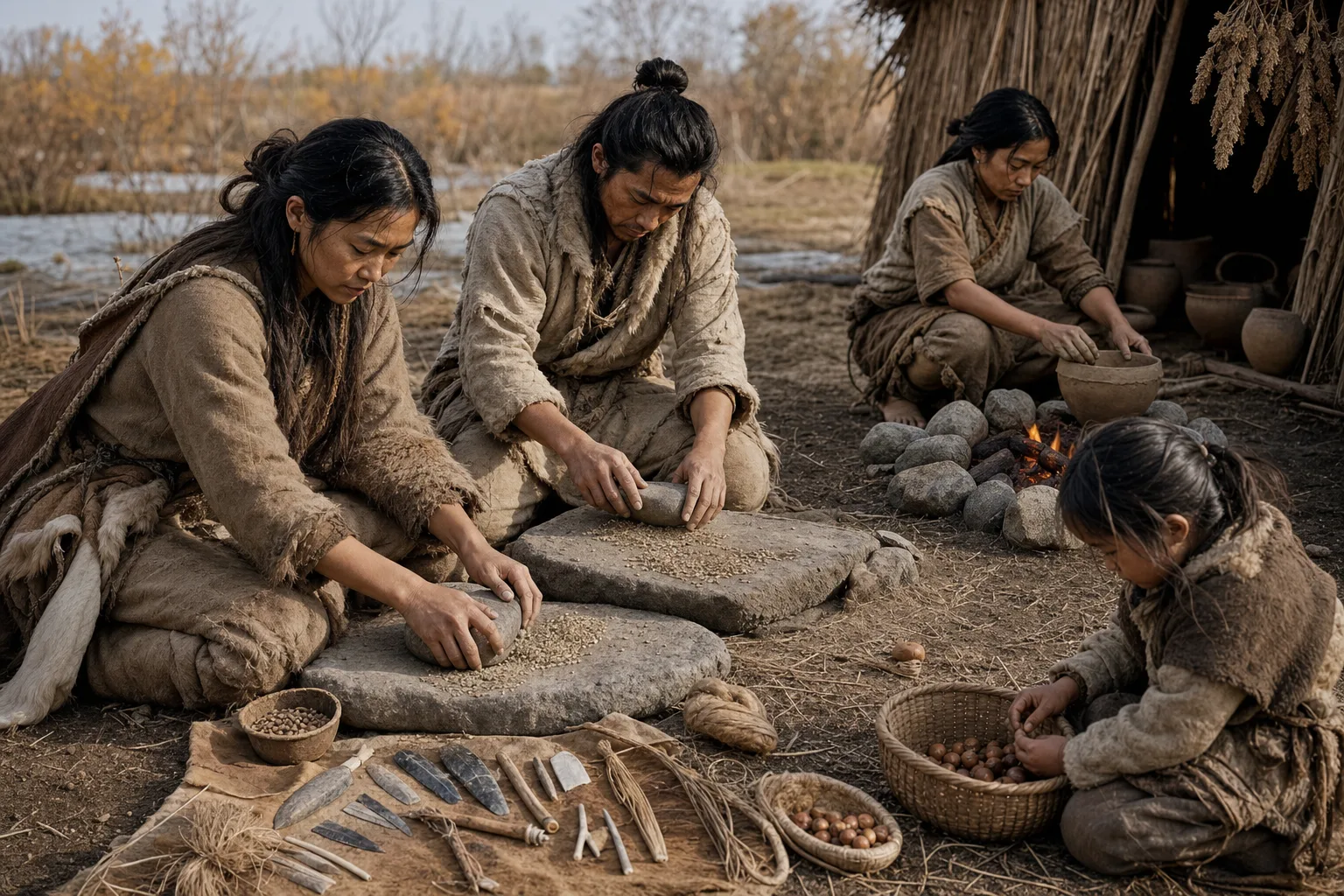
Editorial note: this article was written as a source-based synthesis and states the sample-size limits of its population-scale conclusions explicitly. Its hero and section artwork was generated with AI as an interpretive archaeological scene, not as scientific evidence.


