

For most of the time ancient DNA has existed as a field, it has answered questions about who moved where. A 2026 study asks a different one: which parts of the genome were being pushed in a consistent direction by natural selection, and when. Working with time-series data from 15,836 West Eurasians, the authors report that hundreds of variants rose steadily in frequency over the past ten millennia — and that the pace picked up after farming began.
The result does not describe a species suddenly becoming better. It describes populations adapting to conditions that had changed: new food, new pathogens, new densities of people, new latitudes and new light. Selection is a local, contingent process, and the study's own framing is careful about how far its measurements can be read.
The evidence comes from the Nature paper Ancient DNA reveals pervasive directional selection across West Eurasia, which assembled genome-wide data from 15,836 individuals, 10,016 of them newly reported, and estimated selection coefficients at 9.7 million variants.
The short answer: by tracking allele frequencies through time rather than comparing present-day populations, the authors detect many hundreds of variants under strong directional selection in the last ten thousand years, concentrated in immunity, diet, pigmentation and metabolism. Classic complete sweeps stay rare; what dominates is steady, incomplete change. These are statistical trends in sampled populations, not statements about individuals, nations or the worth of any trait.
Why time-series data changes the question#
Most searches for selection in the human genome work from present-day variation. They look for the footprints a rising variant leaves behind — a region of unusually low diversity, a haplotype that is longer than its frequency should allow. Those signatures are real, but they are indirect and they blur time.
Ancient DNA offers something better in principle: the frequency of an allele at several points in the past, measured directly. The difficulty is that frequencies move for many reasons other than fitness. A migration can raise an allele's frequency across a whole region in a few generations without any advantage at all, and the Yamnaya-related steppe expansion did exactly that to large parts of the European gene pool.
The authors' method is built around that problem. Rather than asking whether a frequency changed, it asks whether it changed consistently in the same direction across time, in a way that population structure and migration do not readily explain. A one-off jump caused by newcomers arriving looks different from a sustained climb over four thousand years.
| Approach | What it detects | Main weakness |
|---|---|---|
| Present-day sweep scans | Regions with reduced diversity around a risen variant | Cannot date the change; blind to incomplete selection |
| Comparing two ancient time points | A frequency difference | Migration and drift produce the same signal |
| Directional time-series testing | A sustained trend across many time points | Needs large, well-dated samples in one region |
That last requirement is why this is a West Eurasian study. It is the only part of the world where ancient sampling is currently dense enough, and the paper is explicit that the geography is a limit rather than a claim about where human evolution happened.
What the strongest signals are about#
The genes that emerge most clearly are the ones a historian of the Neolithic would predict. Immunity leads: variants in and around the major histocompatibility complex, and in genes involved in the inflammatory response, move persistently. Living beside cattle, sheep and pigs in permanent settlements changed the pathogen environment more than any other single feature of the farming transition — and the ancient plague strains now known from Late Neolithic Siberia are a reminder that some of those pathogens are older than the villages usually blamed for them.
Diet is the second theme. Lactase persistence is the textbook case, and its trajectory in these data is a long, slow rise that reaches high frequency only late — millennia after dairying is visible archaeologically. Variants affecting the metabolism of fatty acids and vitamin D also move, consistent with a shift from a broad foraged diet to one built on cereals and milk.
Pigmentation is the third. Alleles associated with lighter skin and hair rise across West Eurasia over the same window, in a pattern that is regional rather than uniform. The Green Sahara genomes and other work outside Europe make the same point from the other side: pigmentation variants track local light and diet, not any ranking of populations.
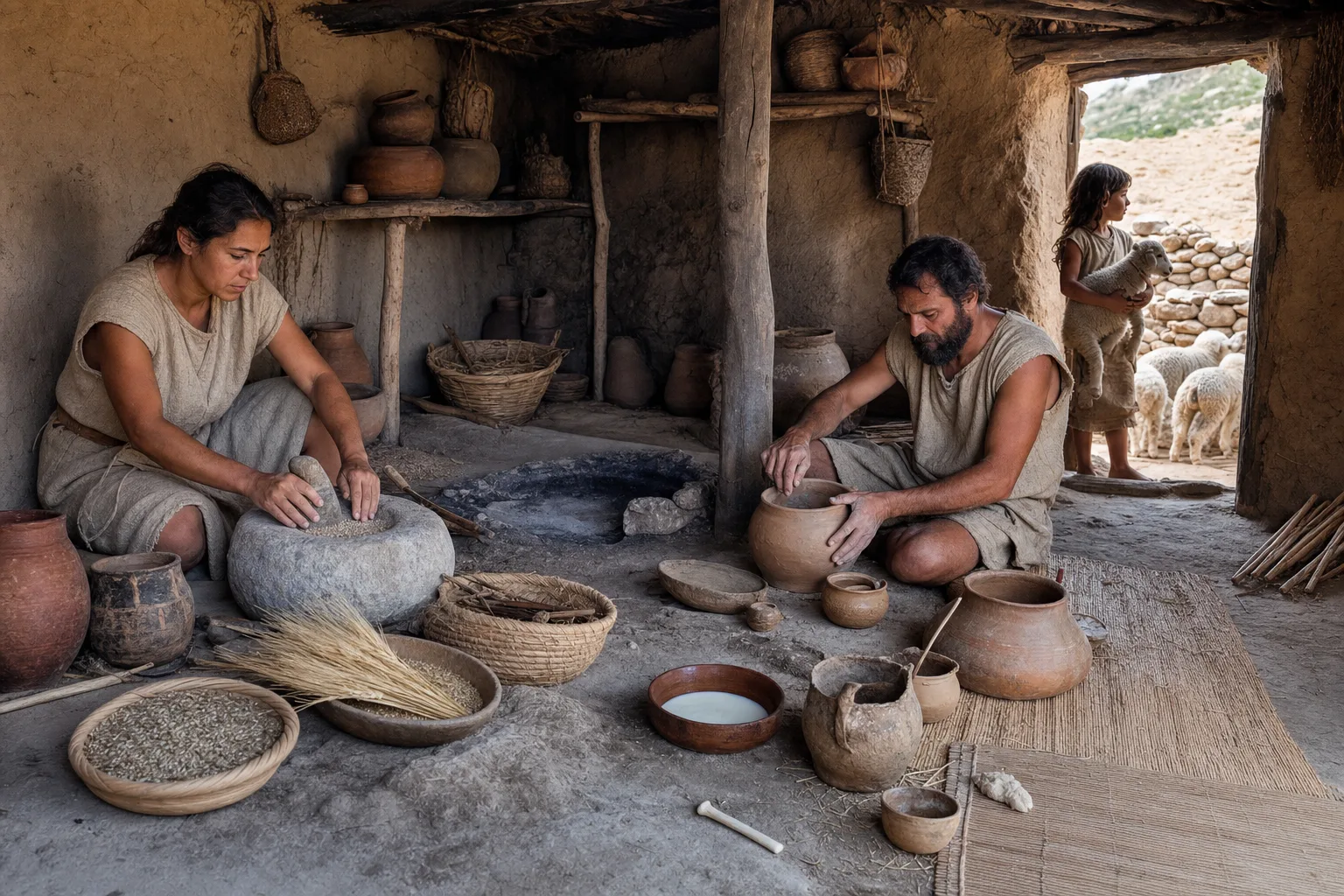
Sweeps are rare; incomplete change is everywhere#
One of the study's more interesting results is a negative one. The classic hard sweep — a beneficial mutation carried all the way to fixation, erasing diversity around it — remains rare, consistent with earlier work on longer evolutionary timescales.
What the time series shows instead is a great deal of movement that never finishes. Alleles climb from 10% to 30%, or from 40% to 70%, and stop. That is what selection usually looks like when the pressure is moderate, the environment keeps changing, or the variant is one of hundreds contributing to the same trait.
The practical consequence is that most of this signal is invisible to sweep scans. A variant that rose steadily but never came close to fixation leaves almost no footprint in present-day haplotype structure. The reason the field kept concluding that recent human selection was modest may simply be that it was looking with the wrong instrument.
The polygenic results, and how to read them#
The paper also examines combinations of alleles: sets of variants that, in present-day biobank data, jointly predict a complex trait. Over the studied period, some of these combinations shift by roughly one standard deviation of modern variation. The authors report decreases in predicted body fat and in predicted schizophrenia risk, and increases in measures associated with cognitive performance.
Those sentences need their context, and the paper supplies it in the abstract itself: the effects were measured in industrialised societies, and it remains unclear how they relate to phenotypes that were adaptive in the past. That is not a formality. Several well-documented problems sit between a polygenic score and any claim about ancient people:
- Portability. A score fitted in one modern population loses accuracy when applied to another, and loses more when applied across thousands of years. Environment, population structure and the correlation between variants all change.
- Prediction is not measurement. The study measures allele frequencies. It does not measure body fat, health or ability in anyone who lived in the Neolithic, because no such measurements exist.
- The trait a variant predicts today need not be the trait it affected then. A variant associated with educational attainment in a modern survey is associated with a modern outcome shaped by schooling systems that did not exist.
- Selection acts on whole organisms in specific settings. A change in a score says nothing about why it changed, and least of all that any group was becoming superior to another.
Read carefully, the polygenic section is a statement about the genome's architecture — how Darwinian pressure distributes itself across many small-effect variants — rather than a story about human improvement. Read carelessly, it is exactly the kind of result that gets misused, which is why the authors' caveat belongs beside the finding every time it is quoted.
Why farming accelerated things#
The study places the acceleration after the Neolithic transition, and the mechanism is not mysterious. Farming changed almost every selective pressure at once:
- Diet narrowed and became starchier, putting new demands on digestion and micronutrient handling.
- Population density rose, and with it the transmission of infectious disease.
- Animals moved indoors, creating a standing reservoir of zoonotic pathogens.
- Populations grew, which supplies more mutations and lets selection act more efficiently.
- People spread into new latitudes, changing light exposure and vitamin D synthesis.
Larger populations matter for a technical reason as well as a biological one. In a small population, chance dominates and a slightly advantageous variant is easily lost. As effective population size grows, selection becomes more able to distinguish small differences — so the same pressure produces a clearer trend.
What the study cannot tell you#
| Limitation | Why it matters |
|---|---|
| The sample is West Eurasian | The findings describe that region's history, not a universal human trajectory. |
| Ancient sampling is uneven in time and place | Gaps can hide reversals or make a regional trend look continental. |
| Selection coefficients are model-dependent | They rest on assumptions about population size, structure and gene flow. |
| Migration cannot be fully separated from selection | The method reduces the confound; it does not eliminate it. |
| Polygenic scores were trained on modern people | Their meaning in ancient populations is genuinely unknown. |
| A trend is not a mechanism | Knowing an allele rose does not establish which pressure raised it. |
Frequently asked questions about ancient DNA and natural selection#
Does this mean humans are still evolving?#
Yes, in the ordinary biological sense: allele frequencies in human populations have changed measurably in the last ten thousand years and there is no reason to think the process stopped. That is a statement about frequencies, not about progress or direction.
How many ancient people were studied?#
The analysis covers 15,836 West Eurasians, of whom 10,016 carry newly reported data, alongside previously published ancient genomes and present-day reference samples. Selection coefficients were estimated at 9.7 million variants.
Which genes showed the strongest signals?#
Immune-related regions dominate, followed by variants involved in diet and metabolism — including lactase persistence and fatty-acid processing — and in pigmentation. These are the systems most directly exposed to the changes farming brought.
Does the study show one population became more intelligent than another?#
No, and it does not attempt to. It reports shifts in polygenic scores built from modern biobank data, and states explicitly that how those scores relate to past phenotypes is unclear. The results cannot support comparisons between populations, ancient or modern.
Why do so few variants show classic sweeps?#
Because most selection in this period appears to have been moderate and incomplete. Variants rose substantially without reaching fixation, which is the pattern expected when many genes contribute to a trait and the environment keeps shifting.
Can a consumer DNA test tell me whether I carry these variants?#
Some are genotyped by common arrays, and lactase persistence in particular is widely reported. But carrying a variant that rose in frequency thousands of years ago says nothing about your ancestry's purity, superiority or destiny — it is one of millions of positions in a genome whose history is overwhelmingly one of mixture.
A different use for the same genomes#
The archive of ancient genomes was built to answer questions about migration, and it answered them: the Neolithic expansion, the steppe expansion, the repeated mixtures that produced present-day populations. This study demonstrates that the same archive can be read along a second axis — not who arrived, but what changed in the people who stayed.
That reading is harder, because the confounds are worse and the biology is less forgiving of shortcuts. It is also less finished. The West Eurasian record is dense enough to support this analysis today; most of the world's is not, and the picture will look different when it is. What the paper establishes is that the method works and the signal is there in quantity — the past ten thousand years were not, genetically speaking, a quiet period.
If you want to see how the migration side of the same evidence is modelled, our qpAdm explainer walks through how ancestry proportions are estimated from these datasets, and how far such models can honestly be pushed.
Sources and further reading#
- Akbari, A., Perry, A., Barton, A. R. et al. (2026). Ancient DNA reveals pervasive directional selection across West Eurasia. Nature 654, 419–428. DOI: 10.1038/s41586-026-10358-1.
- Reich Lab publications and dataset releases: reich.hms.harvard.edu/publications.
- Allen Ancient DNA Resource, the curated compilation from which much of this study's comparative data is drawn.
Editorial note: this article was written as a source-based synthesis and reviewed for the distinction between measured allele frequencies and claims about ancient phenotypes. Its hero and section artwork was generated with AI as an interpretive archaeological scene, not as scientific evidence.


