

The first whole genome recovered from an ancient Egyptian who lived near the beginning of the Old Kingdom shows a combination of deep North African-related ancestry and ancestry connected to the eastern Fertile Crescent. In the study's best-fitting statistical model, about 77.6% of the man's ancestry was represented by Middle Neolithic people from Morocco and 22.4% by Neolithic people from Mesopotamia.
That result is direct evidence that movement between Egypt and western Asia involved people as well as objects. It is not a genetic portrait of every ancient Egyptian. The entire Old Kingdom conclusion rests on one man, buried at Nuwayrat in Middle Egypt between 2855 and 2570 BCE, and both model sources are older proxies from distant regions rather than his literal parents or grandparents.
Published in Nature in 2025, Whole-genome ancestry of an Old Kingdom Egyptian is important for another reason: hot conditions usually destroy ancient DNA. Recovering a 2.02×-coverage genome from this individual demonstrates that meaningful whole-genome research is possible for early Dynastic Egypt.
The short answer: this man was genetically closest to available North African and West Asian comparisons. His genome supports long-standing biological connections across North Africa and with the eastern Fertile Crescent, but one unusually preserved individual cannot define the ancestry, appearance, or identity of a civilization that lasted thousands of years.
Who was the man from Nuwayrat?#
Nuwayrat is a cemetery near Beni Hasan, about 265 kilometres south of Cairo. Three independent radiocarbon measurements placed the individual between 2855 and 2570 calibrated BCE, overlapping the transition from Egypt's Early Dynastic era into the Old Kingdom. Archaeological assessments associated his burial with the Third or Fourth Dynasty.
The body had been placed in a large ceramic vessel inside a rock-cut tomb. That treatment was relatively high status at the cemetery and may also have helped protect his remains. Researchers sampled seven permanent teeth, prepared single-stranded DNA libraries, and deeply sequenced the two libraries with the best preservation. The final genome reached 2.02× average coverage after 8.3 billion paired sequence reads were generated.
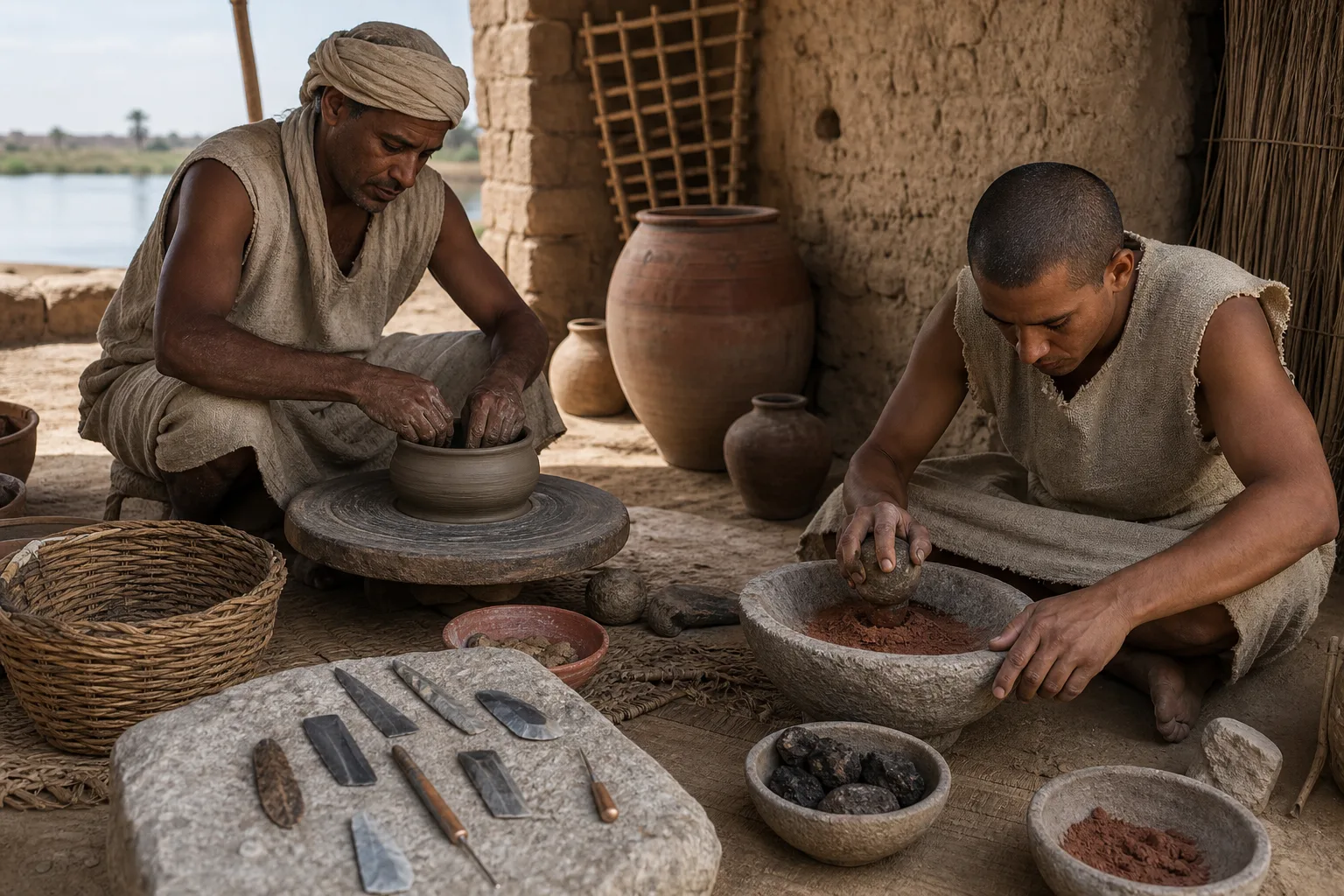
Osteological evidence adds a rare personal dimension. He was genetically and skeletally male, probably between 44 and 64 years old, and approximately 157–161 centimetres tall. He had heavily worn teeth, widespread osteoarthritis, and skeletal markers of repetitive physical labour. The authors note that these patterns are compatible with pottery work, but this remains circumstantial—not a recovered job title.
Isotope measurements from a tooth were consistent with childhood in the hot, dry Nile Valley and a mixed diet that included terrestrial animal protein, wheat, and barley. This makes him locally raised according to the tested signals even though part of his deeper ancestry was related to populations far to Egypt's east.
What did his genome reveal?#
The researchers compared the Nuwayrat genome with 805 ancient and 3,233 present-day people. In principal component and clustering analyses, he showed his closest broad affinities to North African and West Asian populations. His maternal haplogroup was I/N1a1b2 and his paternal lineage was E1b1b1b2b~, both found today across parts of North Africa and West Asia. Those two uniparental markers trace only one maternal and one paternal line; the autosomal genome provides the broader ancestry picture.
Using qpAdm ancestry modelling, the team tested 13 possible source populations that predated him. Every one-source model failed. One two-source model passed the study's statistical threshold:
| Statistical source proxy | Model estimate |
|---|---|
| Middle Neolithic Morocco, Skhirat-Rouazi | 77.6% ± 3.8% |
| Neolithic Mesopotamia | 22.4% ± 3.8% |
These percentages are estimates within a particular model. “Middle Neolithic Morocco” is the closest available proxy for a North African-related ancestry that probably existed much more widely, including in still-unsampled parts of the Nile Valley. “Neolithic Mesopotamia” identifies an eastern Fertile Crescent-related affinity; it does not prove that a recent ancestor traveled directly from the place now called Iraq.
The date of the admixture could not be reliably estimated. It might relate to movements accompanying the spread of farming many millennia earlier, later Predynastic exchange, or ancestry carried through an unsampled intermediate population in the Levant. The study explicitly could not exclude that last route.
Why the Fertile Crescent connection matters#
Egypt was never environmentally or culturally sealed off. Domesticated plants and animals spread from western Asia, and exchange networks moved materials and technologies through the eastern Mediterranean, Red Sea, Sinai, and Nile Valley. By the late fourth millennium BCE, Mesopotamian influences appeared in Egyptian imagery and technologies, including the pottery wheel, while Egypt developed its own distinctive state and writing system.
The genome shows that at least some of this connected history included human ancestry. It does not show that Egyptian civilization was imported from Mesopotamia, nor that cultural innovations must travel with mass migration. An ancestry component can enter a population through repeated small-scale movement over long periods.
This distinction resembles the opposite pattern found in the Punic Mediterranean, where Phoenician culture spread widely with surprisingly little sampled Levantine ancestry. Genes, languages, technologies, and political systems each have their own routes.
Does the Moroccan proxy mean he was Moroccan?#
No. Modern national identities did not exist, and the proxy individuals lived at Skhirat-Rouazi roughly 1,500 years before the Nuwayrat man and more than 3,000 kilometres away. Their genomes help represent an ancestry branch because comparable prehistoric Egyptian genomes are not yet available.
The study's accepted models consistently required ancestry related to those Middle Neolithic Moroccans. The researchers interpret this as evidence of a shared North African ancestry that may have extended across the continent. But the Moroccan group was itself genetically mixed, carrying ancestry related to older Iberomaurusian North Africans and Neolithic Levantines. Similarity can therefore reflect a complicated chain of shared ancestry, not a simple west-to-east migration.
The newly described Green Sahara genomes from Takarkori reinforce how incomplete the reference map remains. Ancient North Africa contained deeply divergent populations for which only a handful of genomes survive. As more Nile Valley and Saharan people are sequenced, the best-fitting labels and percentages may change.
What the genome says about later Egyptians#
The authors also compared the Nuwayrat man with two previously published people from Abusir el-Meleq dated to Egypt's Third Intermediate Period, roughly 787–544 BCE. A model of complete continuity from Nuwayrat to those later individuals was rejected. Accepted models required a large Bronze Age Levant-related contribution; one example estimated 64.5% ± 5.6%.
That comparison suggests substantial population change between the early Dynastic and later periods, but its foundation is only three ancient individuals from two places separated by around two thousand years. It cannot identify a single historical episode responsible for the difference. The Middle and New Kingdoms, Hyksos period, Late Bronze Age upheavals, trade, enslavement, imperial rule, and ordinary mobility all fall within or near that enormous gap.
The paper also modeled present-day Egyptians, finding considerable heterogeneity and multiple ancient source affinities. About 20% of the modern genomes did not fit the reported model. These exploratory comparisons should not be turned into a claim that the Nuwayrat man was the sole or exact ancestor of modern Egyptians.
Can DNA reconstruct his appearance?#
The study's genotype-based prediction favoured brown eyes, brown hair, and dark-to-black skin pigmentation, with a lower probability of intermediate skin colour. The authors explicitly caution that phenotype prediction is less certain in underrepresented populations. Ancient DNA coverage, the choice of prediction system, and limited reference data all matter.
This estimate concerns one person. Ancient Egyptians lived across a long north–south landscape and thousands of years of migration and social change. Neither his predicted appearance nor any artistic reconstruction can stand in for the population of Old Kingdom Egypt. Tomb paintings also follow cultural conventions rather than operating as modern colour photographs.
Why preservation is part of the discovery#
Egypt is famous for mummification, but heat accelerates DNA degradation and preservation treatments can introduce additional problems. Before this study, nuclear data from ancient Egypt consisted chiefly of targeted markers from three much later individuals. The Nuwayrat team's combination of cementum-rich tooth sampling, single-stranded library preparation, contamination controls, fragment selection, and extensive sequencing made the early genome possible.
Five of seven libraries showed damage patterns characteristic of ancient DNA and nuclear or mitochondrial contamination estimates between 0% and 3%. Two contaminated libraries were excluded. Only a small fraction of all reads mapped to the human genome, illustrating the enormous effort required to obtain moderate coverage.
The pot burial may have created a protective microenvironment, but that explanation remains a hypothesis. Future researchers will need to learn which Egyptian sites and burial types preserve DNA without privileging unusual high-status contexts.
What this study cannot establish#
| Limitation | Why it matters |
|---|---|
| One Old Kingdom individual | The genome cannot represent all regions, classes, or centuries of ancient Egypt. |
| Nuwayrat is one Middle Egyptian cemetery | Upper Egypt, the Delta, oases, and frontier communities may have differed. |
| Source groups are distant proxies | Model labels are not literal birthplaces or modern ethnic identities. |
| Admixture could not be dated | Several Neolithic and later migration scenarios remain possible. |
| Phenotype prediction has reference bias | Appearance estimates are probabilistic and individual-specific. |
| Later comparisons include only two ancient people | The timing and causes of Egyptian population change remain unresolved. |
Most importantly, the genome cannot reveal his language, religious beliefs, legal status, personal identity, or whether he considered ancestry socially meaningful. Archaeology provides the burial setting; osteology suggests aspects of his life; isotopes describe childhood environment and diet; genetics estimates biological relationships. No single source replaces the others.
Frequently asked questions about Old Kingdom Egyptian DNA#
Is this the first ancient Egyptian DNA ever recovered?#
No. Earlier studies recovered mitochondrial or targeted nuclear data from later Egyptian individuals. It is the first published whole genome from ancient Egypt and the earliest genome-wide individual from the Dynastic period.
How old is the Old Kingdom Egyptian genome?#
The Nuwayrat man was directly dated to 2855–2570 calibrated BCE, about 4,600–4,900 years ago. The interval bridges the end of the Early Dynastic period and beginning of the Old Kingdom.
Was he mostly North African?#
In the best-fitting qpAdm model, 77.6% of his ancestry was represented by a Middle Neolithic Moroccan proxy. This means deep genetic affinity within North Africa, not that he belonged to a modern nationality or recently migrated from Morocco.
Did Mesopotamians create ancient Egyptian civilization?#
The study does not support that conclusion. It detected about 22.4% ancestry related to a Neolithic Mesopotamian proxy in one Egyptian man. The timing, route, and social scale of that ancestry remain uncertain.
Was the Nuwayrat man a potter?#
Possibly, but not demonstrably. His skeleton recorded prolonged repetitive labour compatible with movements depicted for potters, while his pot burial had relatively high status. DNA cannot identify occupation.
Does his genome describe modern Egyptians?#
No. Present-day Egyptians reflect additional millennia of regional continuity and migration and are genetically diverse. The paper's modern models are population-level comparisons, not personal ancestry formulas.
A first genome, not a final answer#
The Nuwayrat genome changes the evidence available for early Egyptian history. It makes a biological connection between the Nile Valley, wider North Africa, and the eastern Fertile Crescent visible in a period previously known mainly through archaeology. It also shows that whole-genome sequencing in Egypt is achievable.
Its greatest value may be the questions it opens. Were similar ancestry profiles common from the Delta to Upper Egypt? Did ports, craft centres, farms, and royal sites differ? When did eastern Fertile Crescent-related ancestry arrive? Only a geographically and socially broader set of ancient Egyptians can answer them.
Primary sources and data#
- Adeline Morez Jacobs et al. (2025). Whole-genome ancestry of an Old Kingdom Egyptian. Nature 644, 714–721. DOI: 10.1038/s41586-025-09195-5.
- Schuenemann, V. J. et al. (2017). Ancient Egyptian mummy genomes suggest an increase of Sub-Saharan African ancestry in post-Roman periods. Nature Communications 8, 15694.
- Sequence data for NUE001: European Nucleotide Archive PRJEB88328.
Editorial note: the hero and section artwork in this article was generated with AI as a realistic archaeological interpretation. It does not reconstruct the Nuwayrat man's face, reproduce the study's figures, or constitute evidence about his occupation or appearance.


