

South Asia is one of the largest gaps in the ancient DNA record. The region holds around a quarter of the world's population and a deep archaeological sequence, and yet the number of published ancient genomes from it is small enough to list. Heat and monsoon humidity destroy DNA; the few successes have come from unusually dry or high places.
A 2026 study adds ten genomes from one such place: Old Lady Spider Cave, at 4,000 metres in Ladakh, in the Indian Himalaya. The individuals date to about 1,500 years before present, and what they carry is an ancestry profile that is rare in South Asia today — roughly half Tibetan-related and half North Indian-related, in a group genetically homogeneous enough to look like one community rather than a crossroads.
The evidence comes from Ancient genomes from Ladakh reveal 2800-year-old admixture between Tibetans and South Asians in Science Advances, reporting genome-wide data for 10 individuals.
The short answer: ten individuals from a Himalayan cave at 4,000 metres, dated to roughly 1,500 years ago, carry ancestry modelled as about 50% from a population resembling present-day North Indians and about 50% from one genetically similar to ancient Tibetans. The lengths of the inherited segments place the start of that mixture at least 50 generations earlier — around 2800 years ago. These are statistical proxies for source populations, not the literal ancestors themselves.
Why the Himalaya, and why now#
Ancient DNA survives best where it is cold and dry, and stays that way. That is why the discipline's map is so lopsided: Siberia, northern Europe, the Andes and high plateaus are over-represented, while South and Southeast Asia are close to blank.
Ladakh sits in the rain shadow north of the main Himalayan range. It is a high-altitude desert — cold, arid, and at 4,000 metres in this case, well above the elevations at which organic material usually decays quickly. Those are close to ideal preservation conditions, in a region that is otherwise inaccessible to the method.
The location is not only a preservation convenience. Ladakh lies where the Tibetan Plateau, the Indian subcontinent and Central Asia meet. A population sampled there is positioned to record contact between worlds that ancient DNA has, until now, had to study separately.
What "50–50" actually means#
The individuals are modelled as an approximately equal mixture of two sources:
| Modelled source | Proxy used | Roughly |
|---|---|---|
| South Asian component | A population well approximated by present-day North Indians | ~50% |
| Highland component | A population genetically similar to ancient Tibetans | ~50% |
Two clarifications keep that table honest.
First, these are proxies. Modelling an ancient group as "50% present-day North Indian-related" does not mean living North Indians were their ancestors; it means present-day North Indians are the best available stand-in for a source population that has not been sampled directly. The same caution applies to every ancestry model built this way — our qpAdm explainer sets out why a fitting model is not the same as a proven pedigree.
Second, "South Asian ancestry" is itself a mixture with a long history behind it, involving ancient Iranian-related farmers, Indigenous South Asian hunter-gatherer-related ancestry, and steppe-related ancestry that arrived in the Bronze Age. A single proxy label compresses all of that into one term.
Dating a mixture from the length of its pieces#
The most technically interesting part of the study is how it dates the admixture without any sample from the moment it happened.
When two populations mix, the first generation carries whole chromosomes from each side. Recombination then cuts those chromosomes a little more finely every generation. After ten generations the ancestry segments are long; after a hundred they are short. Measure the distribution of segment lengths in a genome and you can estimate how many generations have passed since the mixing began.
Applied to the Ladakh individuals, that calculation places the start of admixture at at least 50 generations before they lived — around 2800 years before present, given their date of roughly 1,500 BP.
The method has real limits. It assumes a reasonably simple mixture history; continuous gene flow over centuries yields a different segment-length distribution from a single pulse, and disentangling the two requires more data than ten genomes provide. "At least 50 generations" is therefore a lower bound rather than a date.
What it does establish is that this was not recent contact. By the time these people were buried, their two ancestries had been recombining for the better part of a millennium.
A homogeneous group, not a frontier mix#
The individuals are described as genetically homogeneous. That is worth pausing on, because it is not what a naive picture of a mountain crossroads would predict.
A trading corridor where two populations meet and mingle produces a cline: individuals scattered along a gradient, some more like one source, some more like the other. What the Ladakh sample shows instead is a set of people who all carry roughly the same proportions — the signature of a population that formed from a mixture and then reproduced within itself for many generations.
In other words, this was a community with its own history, not a snapshot of two groups in the act of meeting. The mixture happened, a population resulted, and that population persisted long enough to become genetically uniform.
Whether it has living descendants is a separate question. The paper describes this ancestry signature as rare in South Asians today, which suggests that this specific combination either did not spread widely or was substantially diluted by later gene flow. Ten individuals from one cave cannot settle it.
What high-altitude ancestry usually implies#
Populations of the Tibetan Plateau are one of the best-documented cases of human adaptation to extreme environments. Variants at the EPAS1 locus — famously introgressed from Denisovans, as the Denisovan genome work has helped to trace — moderate the physiological response to low oxygen, and are at high frequency in Tibetan populations and rare elsewhere.
A group at 4,000 metres carrying about half Tibetan-related ancestry would be expected to carry such variants at appreciable frequency, and the biological logic is straightforward: an unadapted population living permanently at that altitude faces measurably worse reproductive outcomes.
The caution is that ten low-to-moderate-coverage ancient genomes are a thin basis for allele-frequency claims about adaptation. Detecting selection needs the kind of time-series depth described in the West Eurasian selection study — thousands of individuals across millennia — and South Asia has nothing remotely comparable yet.
The Himalaya as a corridor, not a wall#
Mountain ranges are conventionally described as barriers, and at 4,000 metres the description is not unreasonable — the physiological cost of living at that elevation is real, and the passes are seasonal.
The genomes argue for a more useful framing. A population that is half Tibetan-related and half South Asian-related did not form despite the mountains; it formed in them, in a place reachable from both sides. Ladakh sits on routes that connected the Tibetan Plateau, Kashmir, the Punjab plains and, further north, the Tarim Basin and the Central Asian oases — the world that produced the Tarim mummies and its own surprising genetic isolation.
High valleys work as corridors in a specific way: movement through them is constrained to a few routes, which concentrates contact at particular places rather than preventing it. That is consistent with what these genomes show — sustained mixture at one location, followed by a long period of local reproduction, rather than either free flow or complete isolation.
The historical layers above this are well documented. Buddhism reached the western Himalaya from the south and later from Tibet; the region's languages, architecture and material culture record repeated exchange in both directions. What was missing was evidence for how deep that pattern went. On this evidence, at least to around 2800 years ago.
Limitations#
| Limitation | Why it matters |
|---|---|
| Ten individuals from one site | A single community cannot represent a region or a period. |
| Sources are proxies | "North Indian-related" and "ancient Tibetan-related" name models, not ancestors. |
| The admixture date is a lower bound | Continuous gene flow would push the true start earlier. |
| South Asian ancient sampling is minimal | There is little to compare these genomes against. |
| No direct descendants identified | The signature is rare today; whether it persisted is unresolved. |
| Genetics is not ethnicity | These labels describe statistical ancestry, not identity, language or culture. |
Frequently asked questions about the Ladakh genomes#
How many individuals were sequenced?#
Genome-wide data were generated for ten individuals from Old Lady Spider Cave, at about 4,000 metres in Ladakh, dating to roughly 1,500 years before present.
What ancestry did they carry?#
Approximately 50% from a population well proxied by present-day North Indians and approximately 50% from a population genetically similar to ancient Tibetans — a combination that is uncommon in South Asia today.
When did the two populations mix?#
Segment-length analysis indicates the mixture began at least 50 generations before these individuals lived, placing its start around 2800 years before present. That is a minimum estimate.
Do people in Ladakh today descend from them?#
The study does not establish that. The ancestry signature is described as rare among present-day South Asians, and ten genomes from one cave cannot trace continuity to living communities.
Why is ancient DNA so scarce in South Asia?#
Heat and humidity destroy DNA quickly. Almost every South Asian ancient genome published so far comes from an unusually dry or high-altitude context, which is exactly what makes a Himalayan cave at 4,000 metres valuable.
Does this say anything about caste or modern communities?#
No. The study reports the ancestry of ten people who lived roughly 1,500 years ago, using statistical proxies. It makes no claims about present-day social groups, and ancestry models are not evidence about them.
One cave, and the size of the gap#
The most striking thing about this study is how much it adds relative to how little it contains. Ten genomes from one Himalayan cave meaningfully change what is known about population history in a region of nearly two billion people — which is a measure of how empty the map still is.
The specific findings are worth stating plainly: a high-altitude community, half Tibetan-related and half South Asian-related, formed by a mixture that began close to three thousand years ago and had settled into a homogeneous population by the time these individuals were buried. That is a real history, recovered from a place where the method usually fails.
It is also a template. The successes in this region so far — this cave, and other dry or elevated sites — share a preservation profile rather than an archaeological one. As sampling follows that profile across the Himalaya, Central Asia and the Tibetan Plateau, the currently blank interior of the Asian map should start to fill in, one improbable site at a time.
Sources and further reading#
- Patterson, N., Mushrif-Tripathy, V., Devers, Q. et al. (2026). Ancient genomes from Ladakh reveal 2800-year-old admixture between Tibetans and South Asians. Science Advances 12, eaeb3636. DOI: 10.1126/sciadv.aeb3636.
- Preprint version: Ancient genomes from Ladakh reveal 2800-year-old mixture between Tibetans and South Asians, bioRxiv (2026).
- Reich Lab publications: reich.hms.harvard.edu/publications.
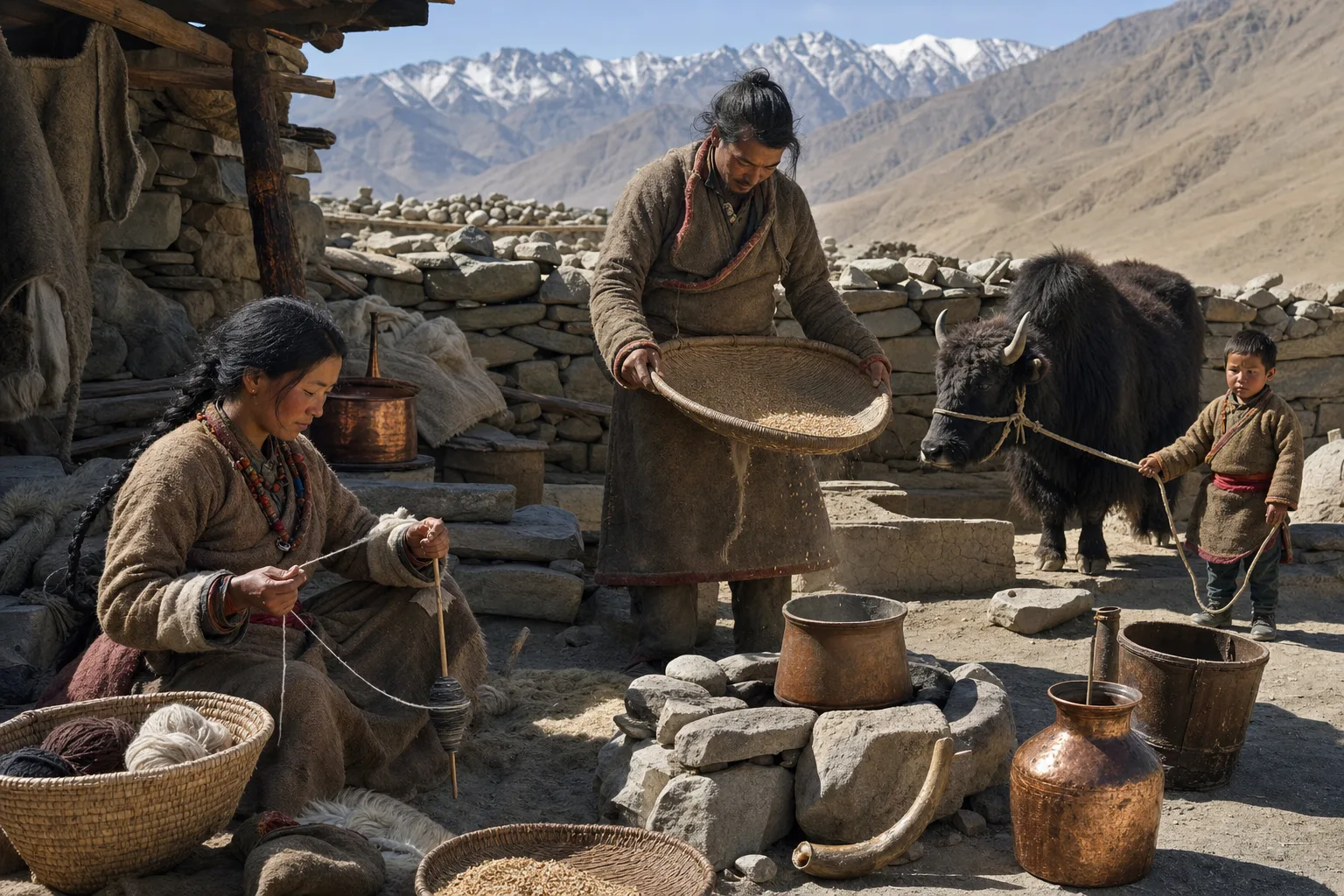
Editorial note: this article was written as a source-based synthesis and distinguishes modelled proxy populations from literal ancestors throughout. Its hero and section artwork was generated with AI as an interpretive archaeological scene, not as scientific evidence.


