
Notable Matches · Iconic discoveries
The Peoples of Tierra del Fuego
The Peoples of Tierra del Fuego (c. 1250-1900 CE · Tierra del Fuego, Argentina): what the published ancient DNA shows, 12 sequenced genomes, and how close your own Global25 coordinates come. Free with every Ancestry Map.
The dossier
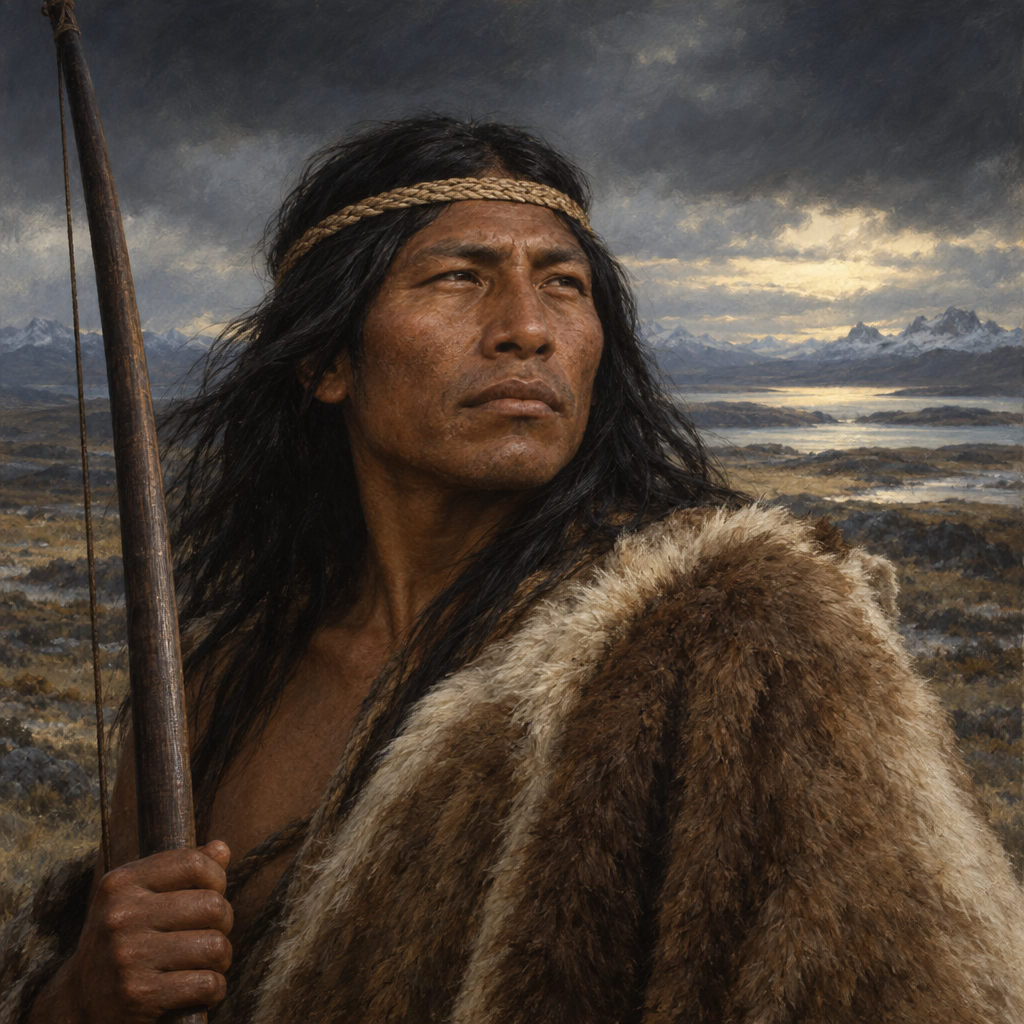
- Catalog tier
- Iconic discoveries
- Period
- c. 1250-1900 CE
- Found
- Tierra del Fuego, Argentina
- Sequenced genomes
- 12 (I12359.AG, I12354.AG, I12943.AG, I12941.AG, I12358.AG, Yaghan895.SG, I12363.AG, I12356.AG, Yaghan894.SG, I12357.AG, I12366.AG, I12367.AG)
Who they were
At the southern tip of the Americas, three peoples made their lives on the wind-scoured islands of Tierra del Fuego. The Selk'nam hunted guanaco across the northern grasslands; the Yamana lived from canoes along the Beagle Channel, foraging from the sea; the Haush of the Mitre Peninsula had no canoes yet carry 10 to 45 percent Yamana-related ancestry, a sign of long exchange. Every maternal lineage among them belongs to haplogroups C or D. The twelve here rest at Rio Grande, Caleta Falsa, Almanza and nearby places. The Selk'nam suffered genocide between the 1880s and the early 1900s; their people endure, and these ancestors are recorded in remembrance, after more than thirty years of meetings with Patagonian communities.
The genome-wide data behind this entry was published in A Paleogenomic Reconstruction of the Deep Population History of the Andes.
How your distance is measured
Every Ancestry Map includes the free Notable Matches lens: your coordinates are compared to every sequenced member of every catalog entry, and the distance to the closest member is reported, a Euclidean distance in the same 25-dimensional space the Distance lens uses. Because these are a small group of real individuals, not a population average, distances naturally run larger than population distances. That is expected, not a poor result. And one thing is never claimed: a small distance means similar ancestry composition, not that the Peoples of Tierra del Fuego are your ancestor. See how it looks in the live demo or read about Ancestry Map, the full Global25 report.
Questions
Who were the Peoples of Tierra del Fuego?
The Peoples of Tierra del Fuego (c. 1250-1900 CE, Tierra del Fuego, Argentina) are one of the Iconic discoveries entries in our Notable Matches catalog, represented by 12 sequenced ancient genomes published in the study "A Paleogenomic Reconstruction of the Deep Population History of the Andes".
What does "matching" the Peoples of Tierra del Fuego mean?
Your Global25 coordinates are compared to the entry's sequenced members and the distance to the closest one is reported, a Euclidean distance in the same 25-dimensional reference space the Distance lens uses. A notable entry is one person or one small burial group, not a population average, so distances naturally run larger than population distances.
Are they my ancestor?
No, and no DNA test can show that. A small distance means your genome sits near theirs in a shared reference space: similar ancestry composition, not descent. Ancestrify never claims a notable individual is your ancestor or relative.
How do I see my own distance to the Peoples of Tierra del Fuego?
Notable Matches is a free lens on every Ancestry Map, never sold separately. Order Ancestry Map, our Global25 analysis (29.99 EUR), and your report ranks your coordinates against the full catalog, with a portrait, dossier and map for every entry. The public demo shows the lens with example data.
More from the catalog
The catalog holds every published entry across three tiers. Browse the full Notable Matches directory. Nearby entries:
The Albanians of Arbëriac. 1400-1700 CE
The Roma of Barçc. 1500-1700 CE
The Coastal Papuans of Nebirac. 1400-1800 CE
The Chincha Lordsc. 1325-1615 CE
The Retainers of Machu Picchuc. 1420-1530 CE
The Latte Builders of the Marianasc. 1250-1650 CE
The Chumash of Santa Rosa Islandc. 1250-1450 CE
The Black Death Londonersc. 1330-1360 CE
The Jews of Tàrrega1348 CE
The Jews of Medieval Erfurtc. 1270-1400 CE
The Medieval Bosnians13th-15th century CE
The Christians of Norman Segestac. 1120-1320 CE