
Notable Matches · Iconic discoveries
The Tiwanaku of the Akapana
The Tiwanaku of the Akapana (c. 870-1150 CE · Akapana, Tiwanaku, Ingavi, La Paz, Bolivia): what the published ancient DNA shows, 7 sequenced genomes, and how close your own Global25 coordinates come. Free with every Ancestry Map.
The dossier
- Catalog tier
- Iconic discoveries
- Period
- c. 870-1150 CE
- Found
- Akapana, Tiwanaku, Ingavi, La Paz, Bolivia
- Sequenced genomes
- 7 (TW027.SG, TW060.SG, TW020.SG, TW061, TW097.SG, TW004.SG, TW008.SG)
Who they were
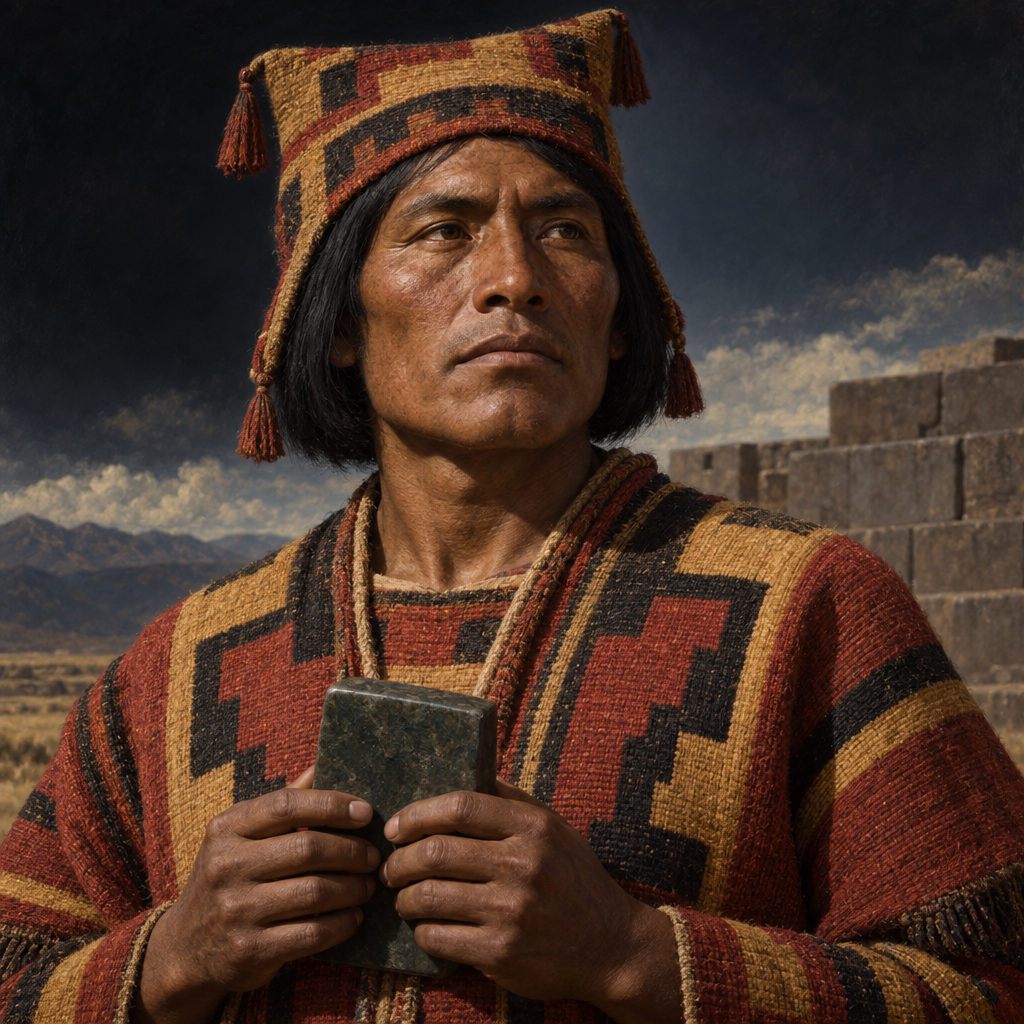
Tiwanaku, on the high plain south of Lake Titicaca, was the ceremonial heart of a great Andean state, and the Akapana its largest monument: a stepped platform some seventeen metres high whose base held deposits of human and animal offerings. Genomes from those offerings showed that nearly all of them carried unmixed Titicaca-basin ancestry and cluster around 950 CE, just as Tiwanaku's power began to wane. The ritual core as a whole was more varied, including people of Amazon-related ancestry, yet the basin's gene pool stayed stable for over 1,200 years through political upheaval. These seven come from the Akapana and from nearby Lukurmata; one was an infant, remembered here gently. The findings were returned to the local community.
The genome-wide data behind this entry was published in Ancient genomes reveal long-range influence of the pre-Columbian culture and site of Tiwanaku.
How your distance is measured
Every Ancestry Map includes the free Notable Matches lens: your coordinates are compared to every sequenced member of every catalog entry, and the distance to the closest member is reported, a Euclidean distance in the same 25-dimensional space the Distance lens uses. Because these are a small group of real individuals, not a population average, distances naturally run larger than population distances. That is expected, not a poor result. And one thing is never claimed: a small distance means similar ancestry composition, not that the Tiwanaku of the Akapana are your ancestor. See how it looks in the live demo or read about Ancestry Map, the full Global25 report.
Questions
Who were the Tiwanaku of the Akapana?
The Tiwanaku of the Akapana (c. 870-1150 CE, Akapana, Tiwanaku, Ingavi, La Paz, Bolivia) are one of the Iconic discoveries entries in our Notable Matches catalog, represented by 7 sequenced ancient genomes published in the study "Ancient genomes reveal long-range influence of the pre-Columbian culture and site of Tiwanaku".
What does "matching" the Tiwanaku of the Akapana mean?
Your Global25 coordinates are compared to the entry's sequenced members and the distance to the closest one is reported, a Euclidean distance in the same 25-dimensional reference space the Distance lens uses. A notable entry is one person or one small burial group, not a population average, so distances naturally run larger than population distances.
Are they my ancestor?
No, and no DNA test can show that. A small distance means your genome sits near theirs in a shared reference space: similar ancestry composition, not descent. Ancestrify never claims a notable individual is your ancestor or relative.
How do I see my own distance to the Tiwanaku of the Akapana?
Notable Matches is a free lens on every Ancestry Map, never sold separately. Order Ancestry Map, our Global25 analysis (29.99 EUR), and your report ranks your coordinates against the full catalog, with a portrait, dossier and map for every entry. The public demo shows the lens with example data.
More from the catalog
The catalog holds every published entry across three tiers. Browse the full Notable Matches directory. Nearby entries:
The Medieval Docleansc. 800-1100 CE
The Gaels of Kilteasheenc. 700-1300 CE
The Muslims of Segestac. 870-1170 CE
The Christians of Sigtunac. 900-1050 CE
The Taíno Woman of Preacher's Cavec. 950 CE
The Vikingsc. 750-1050 CE
The Settlers of Icelandc. 870-1100 CE
The Hungarian Conquerors10th century CE
The Ancient Puerto Ricansc. 550-1350 CE
The Norse of Greenlandc. 950-1400 CE
The Guanchesc. 300-1500 CE
The Ceramic Age Islanders of Hispaniolac. 250-1500 CE