

Ancient DNA confirms that the transformation of post-Roman England involved large-scale migration across the North Sea, not only a small warrior elite imposing its culture on local Britons. In the study's Early Medieval sample from eastern England, an average of 76 ± 2% of ancestry was modeled from continental northern European-related sources, with some individuals carrying entirely local or entirely continental profiles.
The migration included women and men, continued over centuries, and produced different outcomes from one cemetery to another. Local Romano-British descendants remained present, mixed families formed within a few generations, and southern England also received ancestry connected to western continental Europe. “Anglo-Saxon” therefore describes a changing historical culture, not a single genetic type.
The evidence comes from the 2022 Nature paper The Anglo-Saxon migration and the formation of the early English gene pool. Researchers analyzed 460 medieval genomes, including 278 people from England, alongside burial archaeology and thousands of ancient and present-day comparisons.
The short answer: migration from the coastal zone spanning the northern Netherlands, northern Germany, and Denmark profoundly reshaped eastern and central England after Roman rule. But ancestry varied by region, locals and migrants intermarried, and later movements reduced and complicated that early continental signal in present-day English populations.
Why was Anglo-Saxon migration so controversial?#
Roman administration in Britain ended in the early fifth century. Over the following centuries, lowland England saw new settlement forms, building styles, burial rites, objects, farming practices, and West Germanic languages. Brooches, wrist clasps, animal art, cremation urns, and sunken-featured buildings had parallels around the North Sea.
Older histories described an invasion by Angles, Saxons, and Jutes that displaced much of the Romano-British population. From the late twentieth century, many archaeologists favored smaller elite groups whose power and culture persuaded local people to adopt a new language and identity. Sparse written sources—especially Bede and the later Anglo-Saxon Chronicle—could support several readings.
Present-day DNA produced estimates ranging from limited contribution to near-complete male-line turnover, but modern populations have experienced another 1,500 years of movement. Ancient DNA makes it possible to compare people living before, during, and after the transition.
What did the 460-genome study analyze?#
Researchers sampled 494 people from 37 sites in England, Ireland, the Netherlands, Germany, and Denmark, dating from approximately 200 to 1300 CE. After DNA quality filtering and removal of duplicates, 460 individuals remained:
| Region | Individuals with usable genome-wide data |
|---|---|
| England | 278 |
| Ireland and continental Europe | 182 |
| Total | 460 |
The English sites were concentrated in the south and east and mostly dated between 450 and 850 CE. Important cemeteries included Apple Down, Dover Buckland, Eastry, Ely, Hatherdene Close, Lakenheath, Oakington, Polhill, Sedgeford, and West Heslerton.
Most libraries were enriched at about 1.24 million informative SNPs. Forty were shotgun-sequenced as low-coverage whole genomes at a mean depth of 0.9×. The team also used 4,336 previously published ancient genomes and more than 10,000 present-day European comparisons.
This scale is unprecedented for the period, but geography remains uneven. Eastern England and furnished inhumation cemeteries are much better represented than western Britain, Wales, Scotland, and communities that cremated their dead.
A major ancestry shift after Roman rule#
Bronze and Iron Age people from Britain and Ireland clustered genetically with present-day western British and Irish populations in the study's principal-component analysis. Most Early Medieval people from northern Germany, Denmark, and the Netherlands formed a neighboring but distinguishable continental northern European cluster.
Early Medieval English individuals filled the whole range between them. Some resembled pre-migration British populations; others resembled continental North Sea groups; many were admixed. Before the Middle Ages, the study's continental northern European component averaged about 1% in British Iron Age samples. It rose to 15% in seven Roman-period people, six of them from cosmopolitan York, and then increased sharply after 400 CE.
Using present-day proxy groups, the sampled Early Medieval English population averaged 76 ± 2% continental northern European-related ancestry. Using ancient Lower Saxony as the incoming source and Iron or Roman Age England as the local source, qpAdm produced a higher mean of 86 ± 2%.
Those are alternative statistical estimates, not contradictory measurements of a literal ethnic substance. The ancient sources, modern sources, and modeling assumptions differ. Both support a demographic contribution far too large for a tiny ruling elite to explain on its own.
The migration was regional and continuous#
Continental ancestry was highest in eastern and central England, lower in the south and southwest, and absent from the one analyzed Irish site. Variation was also large within cemeteries.
At Hatherdene Close in Cambridgeshire, 17 individuals averaged about 70% continental northern European-related ancestry. Eight carried profiles modeled as entirely continental, while three had little or none. A single community could therefore include recent migrants, descendants of local Britons, and people whose parents or grandparents came from both backgrounds.
The source region was not one modern country. Genetically similar ancient groups extended from the northern Netherlands through Lower Saxony and Schleswig-Holstein into Denmark, forming a broad North Sea and western Baltic continuum. A geographic algorithm placed likely sources across this region as far north as southern Sweden but could not resolve precise tribal homelands.
The movement also lasted longer than a single fifth-century invasion. Continental-related individuals appear in later Roman contexts, while middle-Saxon sites such as Sedgeford document arrivals as late as the eighth century. Later Scandinavian movement merges into the Viking Age genomic history, making the North Sea a long-lived corridor rather than a one-time crossing.
Women and men both crossed the North Sea#
Autosomal, X-chromosome, mitochondrial, and Y-chromosome analyses found no significant overall sex bias. The migrants included women as well as men, challenging scenarios centered only on male warbands.
Paternal-line change was substantial. Y-chromosome lineages I1-M253 and R1a-M420 were absent from the study's Bronze, Iron, and Roman Age British and Irish samples but appeared in more than one-third of Early Medieval English men. Altogether, paternal lineages absent from the earlier samples made up at least 73 ± 4% of the Early Medieval set.
Mitochondrial and X-chromosome evidence changed in parallel, supporting movement by both sexes. Because the earlier comparison groups and cemeteries are finite, subtle sex bias cannot be excluded. The finding is no significant imbalance—not mathematical proof that identical numbers migrated.
Grave goods did not define a biological people#
People with more than 50% continental-related ancestry were statistically more likely to have grave goods, but the pattern was driven mainly by women. Continental-ancestry women more often received objects, particularly brooches, than women with predominantly local ancestry.
Men told a different story. A man's probability of burial with weapons did not significantly track ancestry. At Updown Eastry, a man with almost entirely local western British and Irish-related ancestry received a prominent seax burial under a barrow. At Oakington, a richly furnished woman with a cow burial, silvered disc brooches, and a chatelaine had about 60% local-related ancestry.
These exceptions are not noise; they show that social participation crossed ancestry boundaries. Objects could mark gender, role, family status, local custom, or identity without being genetic labels.
At Apple Down, burial orientation and cemetery location showed a modest association with ancestry, suggesting that some communities recognized differences. Other sites did not. Integration was locally negotiated rather than governed by one “Anglo-Saxon” rule.
A family at Dover records integration#
The Dover Buckland cemetery preserved a pedigree spanning at least three generations. Its earlier sampled members carried unadmixed continental ancestry. A woman with unadmixed local British-related ancestry then joined the family, and her two daughters had mixed ancestry. Another local contribution produced grandchildren close to a 50:50 model.
Weapons, beads, pins, and brooches appeared on both sides of the pedigree and after admixture. The family makes an abstract percentage tangible: migration and population change occurred through partnerships, children, and changing households.
The study cannot reveal whether the woman considered herself Briton, whether the family spoke one or several languages, or how neighbors described them. It shows biological integration, not the words people used for it.
A third ancestry source complicates the picture#
Some southern English genomes did not fit a simple mixture of local British and northern continental sources. They carried additional ancestry related to Iron Age France, especially at Apple Down, Eastry, Dover Buckland, and Rookery Hill. At some sites this component reached up to 51%.
This fits archaeological connections between Kent, Sussex, and Frankish regions. It may represent movement from western Germany, Belgium, or France during and after the primary North Sea migration.
Present-day English populations required a three-source model in the paper. Depending on region, estimates ranged from:
- 25–47% Early Medieval continental-northern-European-like ancestry.
- 11–57% Late Iron Age England-like ancestry.
- 14–43% Iron Age France-like ancestry.
These figures are model-dependent regional averages, not personal consumer-test results. The French-related source could include ancestry already present but poorly sampled in Roman southern Britain. Later medieval mobility, including Norman and other cross-Channel movement, also complicates its date.
The safest conclusion is that the unusually high continental ancestry in Early Medieval eastern England was later diluted and supplemented. Modern English ancestry is not a frozen snapshot of an “Anglo-Saxon percentage.”
What did migration mean for language and identity?#
Large family migration offers a plausible demographic setting for the spread of West Germanic speech and the development of Old English. A small elite may still have mattered politically, but it is no longer a sufficient population model.
Language did not follow ancestry mechanically. Local descendants could adopt the newcomers' language; continental families could preserve regional dialects or become bilingual; Christian institutions later introduced Latin literacy. Place names of Celtic and Latin origin survived within transformed landscapes.
“Anglo-Saxon” is therefore most useful as a historical label for particular cultures, polities, and periods. It cannot be diagnosed by a haplogroup. The earlier Iron Age Britain kinship study shows that Britain was already regionally varied and connected to the continent before Rome arrived.
Important limitations#
| Limitation | Why it matters |
|---|---|
| Eastern and southern England dominate | The study cannot give an equally detailed history for western Britain, Wales, or Scotland. |
| Cremation reduces available DNA | Some continental and English communities are underrepresented. |
| Source populations overlap genetically | Northern Netherlands, Germany, and Denmark cannot always be separated. |
| Two models give 76% and 86% averages | Ancestry estimates depend on chosen ancient or present-day proxies. |
| Roman southern Britain is sparsely sampled | Some France-related ancestry may predate the modeled migration. |
| DNA cannot reveal language or identity | “Anglo-Saxon” remains an archaeological and historical category. |
Frequently asked questions#
Was Anglo-Saxon England created by mass migration?#
Large-scale migration was a major factor, especially in eastern and central England. The data do not support a model involving only a tiny male elite, although local adoption and political change also mattered.
How many genomes were studied?#
The main dataset contained 460 medieval genomes, including 278 from England and 182 from Ireland and continental Europe. Thousands of additional published ancient genomes served as comparisons.
What does the 76% estimate mean?#
It is the average continental northern European-related component in the sampled Early Medieval English population under one model. It varies by site and individual and is not a fixed percentage for all historical or modern English people.
Were local Britons replaced completely?#
No. People with mostly local ancestry remained in cemeteries, mixed families formed, and regional estimates varied. The genetic change was large without being total or uniform.
Did women migrate too?#
Yes. The study found no significant sex bias across autosomal and uniparental evidence. Women with continental ancestry were also prominent in furnished burials.
Can a DNA test prove someone is Anglo-Saxon?#
No. There is no exclusive Anglo-Saxon marker, and modern ancestry has been reshaped by later migrations. Consumer estimates cannot establish membership in an Early Medieval community.
Migration, integration, and a new England#
The genomes settle the scale question more clearly than the identity question. Thousands of people and families must have crossed the North Sea over generations, dramatically changing ancestry in eastern England. Local Britons did not vanish, and neither artifacts nor weapons divided migrants cleanly from their descendants and neighbors.
Early English society formed through regional migration, mixed households, selective cultural difference, and later continental connections. That history is more substantial than elite takeover and more complicated than replacement—a demographic transformation carried by people, not a timeless genetic nation.
Primary sources and further reading#
- Gretzinger, J. et al. (2022). The Anglo-Saxon migration and the formation of the early English gene pool. Nature 610, 112–119. DOI: 10.1038/s41586-022-05247-2.
- Schiffels, S. et al. (2016). Iron Age and Anglo-Saxon genomes from East England reveal British migration history. Nature Communications 7, 10408.
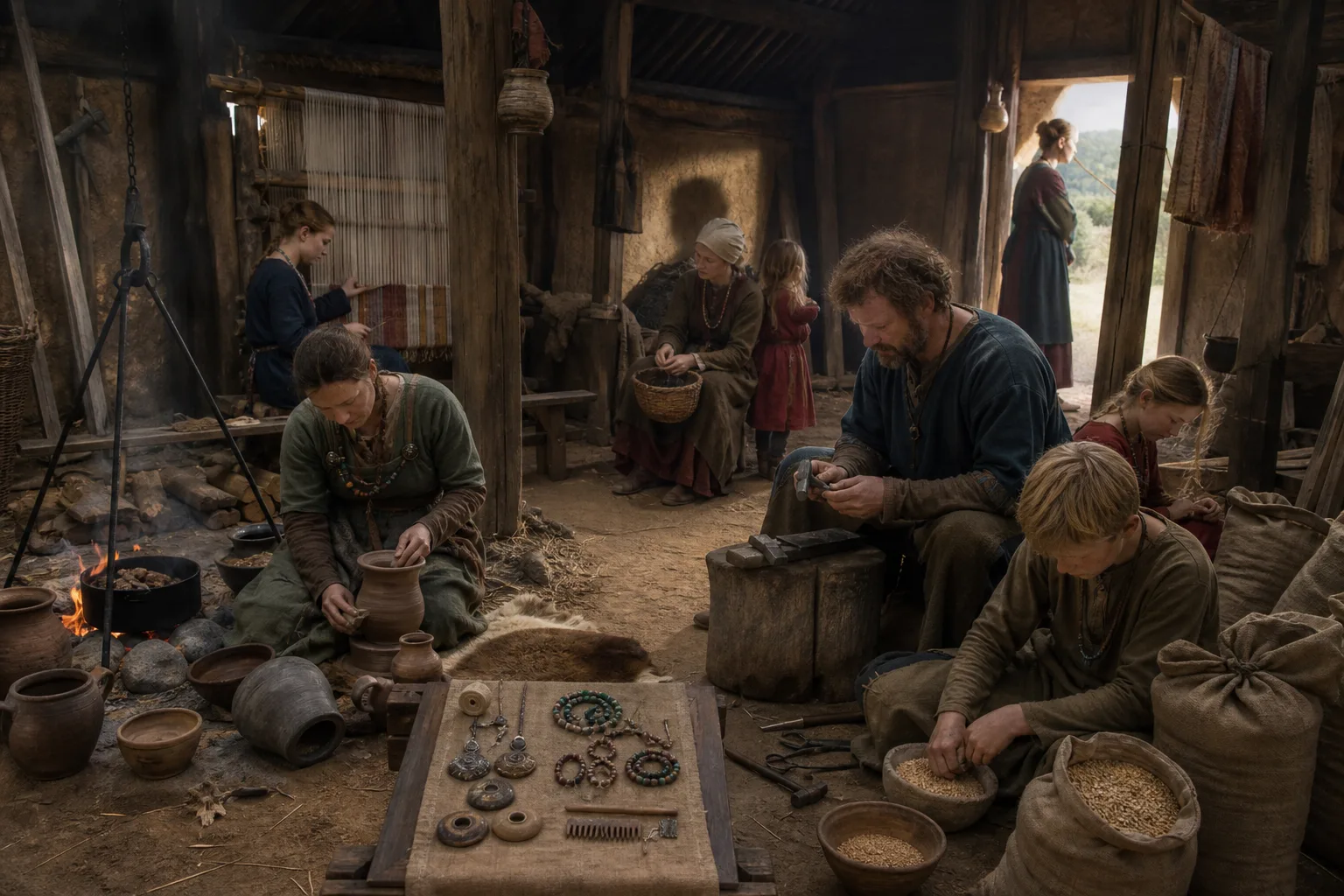
Editorial note: this article was written as an evidence-led synthesis of the cited research. Its hero and section artwork was generated with AI as a realistic but conceptual archaeological scene; it does not reproduce a scientific figure, portray an excavated person or provide documentary evidence.


