

DNA from two women buried in the Green Sahara reveals a deeply rooted and previously unknown North African ancestry lineage. The women lived at Takarkori in present-day southwestern Libya roughly 7,000 years ago, when lakes, rivers, grasslands, and herds occupied land that is desert today. Their genomes were closely related to much older North African foragers and contained only a small modeled contribution from the Levant.
That pattern suggests pastoralism reached their community mainly through the spread of knowledge and domestic animals rather than a large replacement by incoming Levantine herders. It also found no substantial gene flow into these two individuals from sampled sub-Saharan populations during the African Humid Period.
The evidence is extraordinary—but tiny. The 2025 Nature study Ancient DNA from the Green Sahara reveals ancestral North African lineage reports only two adult women, and one genome is much lower coverage than the other. Their ancestry cannot stand in for everyone who crossed an enormous Sahara over thousands of humid years.
The short answer: the two Takarkori pastoralists derived most of their modeled ancestry—93% in one fitted graph—from a deeply divergent North African lineage, with about 7% from an ancient Levantine-related source. Their people appear to have adopted herding without large-scale population replacement. The percentages describe one statistical model for two individuals, not fixed racial categories or the ancestry of all Saharans.
When and why was the Sahara green?#
The African Humid Period lasted broadly from around 14,500 to 5,000 years before present. Changes in Earth's orbit strengthened African monsoons, turning much of the Sahara into a mosaic of savanna, woodland, river systems, wetlands, and permanent lakes. The transformation was neither equally wet everywhere nor perfectly continuous.
Pollen, ancient lake deposits, animal bones, tools, ceramics, and rock art record people hunting, fishing, gathering, and later herding cattle, sheep, and goats. As aridity returned, water and pasture contracted, encouraging movement toward the Sahel, Nile Valley, Maghreb, and remaining oases.
This ecological corridor has long raised a demographic question. Did wetter conditions enable major gene flow between northern and sub-Saharan Africa? And when livestock spread from northeastern Africa into the central Sahara, did incoming herders replace local foragers, or did local communities adopt pastoral life?
Ancient DNA could address both questions, but heat usually destroys it. The Takarkori remains provide the first genome-wide evidence from people who lived in the central Sahara during this green interval.
The Takarkori rock shelter and its people#
Takarkori lies in the Tadrart Acacus Mountains of southwestern Libya. Archaeological deposits record Late Acacus hunter-gatherer-fishers from around 10,200 calibrated years before present and Pastoral Neolithic occupation from roughly 8,300 to 4,200 years ago.
Excavators found 15 human burials deep within the shelter. Many belonged to women of reproductive age, children, and juveniles; strontium isotope measurements generally supported local origins. Organic preservation was exceptional enough to retain woven baskets, plant remains, and naturally mummified bodies alongside ceramics and herding evidence.
Researchers selected two naturally mummified adult women from the Middle Pastoral period:
| Individual | Direct calibrated date | Informative SNPs recovered |
|---|---|---|
| TKH001 | 7,158–6,796 years before present | 881,765 |
| TKH009 | 6,555–6,281 years before present | 23,317 |
DNA came from a tooth root for TKH001 and fibula fragments for TKH009. Endogenous human DNA was extremely low—between 0.085% and 1.363%—so the team used targeted capture panels rather than whole-genome shotgun sequencing. Both samples carried characteristic ancient-DNA damage and low contamination.
Because TKH009 had far fewer markers, the researchers merged the two women for several population analyses and explicitly caution that most signals are probably driven by TKH001. This imbalance is central to interpreting the paper.
A North African ancestry lineage hidden by poor preservation#
The Takarkori women occupied a distinctive position in genetic comparisons. They shared the most genetic drift with ancient people from northwestern Africa, especially:
- Approximately 15,000-year-old foragers from Taforalt Cave in Morocco.
- An Epipalaeolithic individual from Ifri Ouberrid.
- Early Neolithic people from Ifri n'Amr o'Moussa.
Those northwestern groups had already suggested long-term population continuity in the Maghreb. Takarkori extends a related ancestry far into the central Sahara, implying that it may once have been geographically widespread.
An automated admixture graph modeled 93% of Takarkori ancestry from a previously unsampled North African branch and 7% from a deeply ancient Levantine-related source. Admixture graphs are hypotheses constrained by selected populations; other unsampled groups could change the topology or estimates. The robust point is that most ancestry was not represented by incoming Neolithic Levantine herders.
The Takarkori branch also helped improve models of Taforalt ancestry. In one qpAdm model, Taforalt was represented as 60.8% ± 1.8% Natufian-related and 39.2% ± 1.8% Takarkori-related ancestry. This does not make the later Takarkori women literal ancestors of older Taforalt people. Their genomes serve as the best available representative of a deeper shared lineage.
Did Saharan herding spread through cultural exchange?#
Domestic livestock originated outside Africa and reached northeastern Africa before spreading into the central Sahara around 8,300 years ago. If that movement had involved large-scale replacement by Levantine-related herders, the Takarkori pastoralists should carry much more ancestry related to those incoming populations.
Instead, their modeled Levantine-related contribution was small. The researchers therefore argue that pastoralism spread primarily through cultural diffusion into a locally rooted North African population. People could learn animal management, exchange livestock, intermarry occasionally, and reorganize their economy without being demographically replaced.
Archaeology supports a gradual process. Early pastoral material culture at Takarkori combined continuity and change, while existing hunter-gatherer communities had already developed greater sedentism, pottery, basketry, and bone and wooden tools. Pastoralism was not simply a ready-made package delivered to passive recipients.
This resembles the broader lesson from Punic communities around the Mediterranean: culture and technology can move much farther than the average ancestry of their original carriers. It also contrasts with cases where population movement made a larger demographic contribution, such as first-millennium migrations in the Balkans.
What about movement across the Green Sahara?#
The genomes did not show substantial additional affinity to the sampled sub-Saharan African groups. Takarkori and Taforalt appeared similarly distant from those lineages. This suggests limited detectable south-to-north gene flow into the ancestors of these two women during the African Humid Period.
That conclusion should remain precisely bounded. It does not mean the Sahara formed an impassable biological barrier, nor that people never moved between north and south. Archaeology documents exchange and mobility, and present-day Sahelian populations preserve complex ancestry histories. The ancient comparison set is incomplete, while two women from one rock shelter may belong to a community that was more isolated than others.
The study also found increased Takarkori-related affinity in a less-admixed subset of present-day Fulani and other Sahelian or West African populations. This is compatible with later southward movement of central Saharan pastoralists as aridity intensified. It is a population-level signal, not proof of a direct line from the two sampled women to every present-day pastoral group.
Why Neanderthal ancestry helped resolve the model#
All well-studied ancient populations outside Africa carry Neanderthal-derived DNA. In Africa, smaller amounts can mark gene flow from populations whose ancestors had left the continent and later returned.
Using a capture panel designed for archaic ancestry, the researchers estimated about 0.15% Neanderthal ancestry in the higher-coverage Takarkori genome. That was:
- Much lower than the approximately 1.4–2.36% estimated for many populations outside Africa.
- Lower than the 0.6–0.9% measured in Taforalt and other Neolithic Moroccan groups.
- Higher than the absence detected in the ancient and present-day sub-Saharan comparisons used by the study.
The small signal supports limited gene flow from an out-of-Africa-related source, consistent with the modeled 7% Levantine contribution. The dates of that admixture were highly uncertain. It could have been ancient and need not correspond to the arrival of pastoralism.
The women's maternal lineage#
Both women carried a basal branch of mitochondrial haplogroup N, one of the deepest maternal lineages associated with populations related to the expansion outside Africa. The study estimated its split around 61,343 years ago, with a broad 95% interval of 54,408–69,046 years.
Mitochondrial DNA is one inherited line, not a summary of whole ancestry. Population splits can also predate or postdate a surviving mitochondrial branch because lineages sort unpredictably through generations. The basal N result is intriguing evidence of deep structure, but it does not label the entire Takarkori population as Eurasian or non-African.
The autosomal results instead place their majority ancestry on a deeply divergent African branch closely related to the lineage leading toward populations outside Africa. Human population history near the out-of-Africa split was not a clean continental fork; it contained structure, isolation, and later contact.
Connections to ancient Egypt and the wider north#
The Takarkori result fills one point in a largely blank ancient genomic map. More than a millennium later, the Nuwayrat genome from Old Kingdom Egypt was best modeled with a majority ancestry represented by Middle Neolithic Moroccans plus an eastern Fertile Crescent-related contribution. The two studies use different people, periods, coverage, and reference sets, so their percentages are not directly comparable.
Together they demonstrate that prehistoric North Africa contained both deep regional continuity and connections with western Asia. Neither supports a single timeless “North African genome.” Climate repeatedly redrew corridors, and later farming, maritime exchange, empire, and trans-Saharan mobility added new layers.
The study's most important limitations#
| Limitation | Why it matters |
|---|---|
| Only two adult women | They cannot represent all Green Sahara populations, sexes, or occupations. |
| One genome has only 23,317 SNPs | Merged analyses are driven mostly by TKH001. |
| One site in southwestern Libya | Other lakes, mountains, and migration corridors may have different histories. |
| Different capture panels were used | The individuals are not measured identically across every analysis. |
| Admixture sources are incomplete | The 93%/7% graph is one model, not a final ancestry formula. |
| Pastoralism spans millennia | Two Middle Pastoral burials cannot describe its entire spread. |
Natural mummification does not guarantee that these women were a random community sample. Their age, sex, burial location, and social roles may have influenced preservation and inclusion. Future genomes from earlier foragers, first herders, and later Saharan communities are essential.
Frequently asked questions about Green Sahara DNA#
Who lived in the Green Sahara 7,000 years ago?#
At Takarkori, the two sampled women belonged mostly to a deeply rooted North African ancestry lineage related to older foragers from Morocco. Many other Saharan communities remain genetically unsampled.
How many ancient genomes were recovered?#
Two individuals yielded genome-wide capture data. TKH001 had 881,765 informative SNPs; TKH009 had 23,317, so the first woman drives much of the combined analysis.
Did the women come from sub-Saharan Africa?#
The study found no substantial additional affinity to sampled sub-Saharan lineages. Their majority ancestry belonged to a distinct North African branch. That finding should not be generalized to every Saharan population.
Were they related to Middle Eastern farmers?#
One admixture graph estimated about 7% ancestry from a deeply ancient Levantine source. The small contribution may predate pastoralism and does not identify a recent migrant ancestor.
Did migrants bring cattle herding to the Sahara?#
Livestock ultimately arrived through connections with northeastern Africa, but the Takarkori genomes suggest local people adopted pastoralism mainly through cultural transmission rather than large-scale replacement.
Are the Takarkori women ancestors of modern Fulani people?#
Some present-day Fulani and Sahelian groups show increased affinity to Takarkori-related ancestry, compatible with later southward movement. The data do not establish direct descent from these two individuals.
Two genomes open a vast prehistoric landscape#
The Takarkori women reveal a North African lineage that had remained nearly invisible because the Sahara preserves DNA so poorly. Their genomes show long regional roots, limited ancestry from outside Africa, and a pastoral economy that could spread through cultural adoption.
The study's power comes with an equally important warning. Two individuals can disprove the idea that no such ancestry existed, but they cannot map an entire continent. The next discoveries may reveal neighboring communities with very different histories—and that diversity is likely the real story of the Green Sahara.
Primary sources and data#
- Salem, N. et al. (2025). Ancient DNA from the Green Sahara reveals ancestral North African lineage. Nature 641, 144–150. DOI: 10.1038/s41586-025-08793-7.
- Vai, S. et al. (2019). Ancestral mitochondrial N lineage from the Neolithic “green” Sahara. Scientific Reports 9, 3530.
- Genome-wide sequencing data: European Nucleotide Archive PRJEB84057.
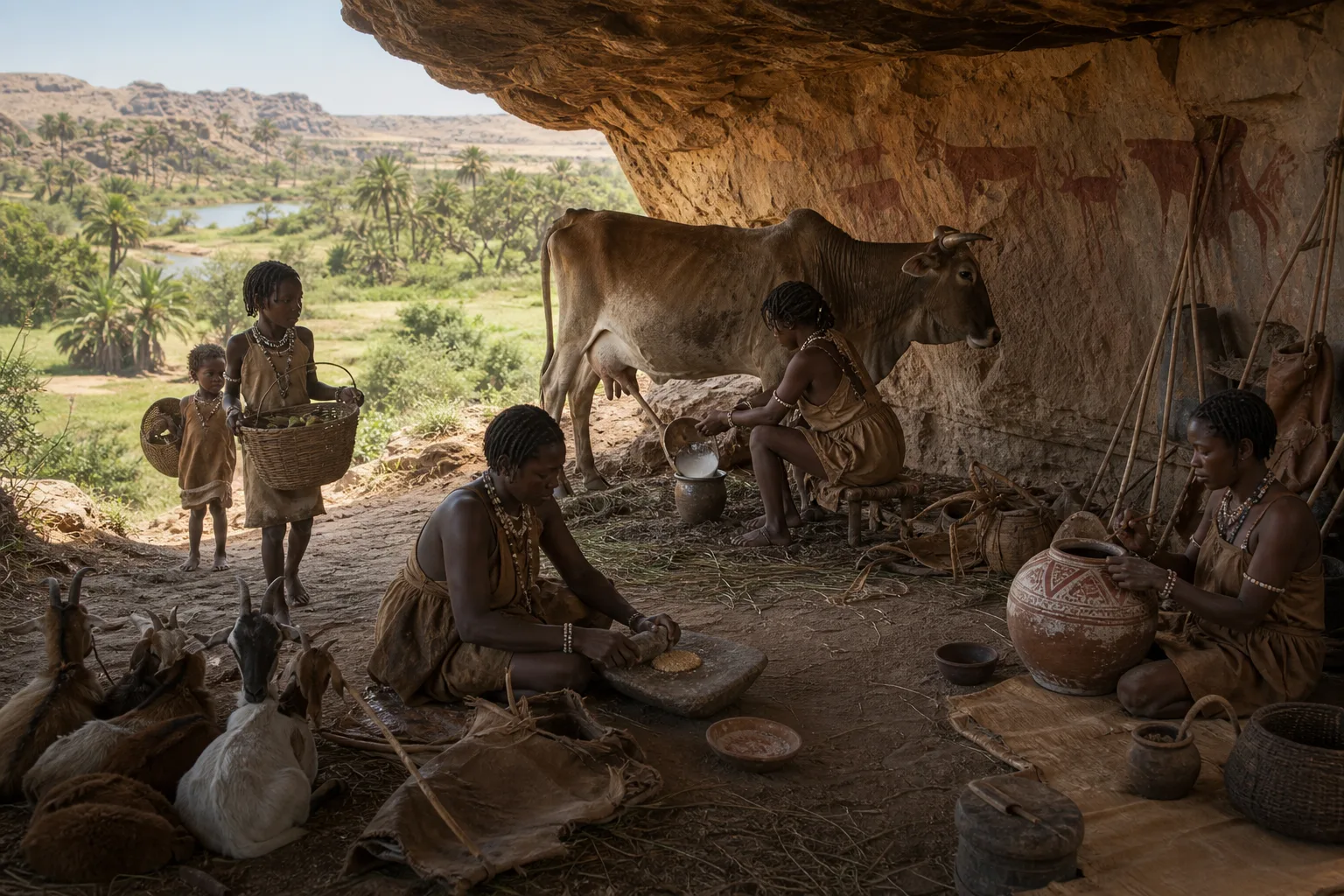
Editorial note: the hero and section artwork in this article was generated with AI as a realistic archaeological interpretation. It does not reconstruct either Takarkori woman, reproduce the study's figures, or treat imagined clothing and artifacts as genetic evidence.


