

Yamnaya ancestry did not appear fully formed on the Pontic–Caspian steppe. A major 2025 ancient-DNA study traces most of it to people living between the Caucasus and the lower Volga, whose descendants moved west and mixed with hunter-gatherer-related communities around the Dnipro and Don. From that changing population landscape, ancestors of the Yamnaya emerged by about 4000 BCE and expanded dramatically after roughly 3300 BCE.
The result replaces the familiar shorthand that Yamnaya people were simply a fifty-fifty mixture of “eastern hunter-gatherers” and “Caucasus hunter-gatherers.” With many more genomes from previously undersampled regions, the evidence now resolves several populations, movements and stages of mixture. It also makes an important distinction: DNA can reconstruct population history, but it cannot directly identify the language spoken by any excavated person.
The main evidence comes from the Nature paper The genetic origin of the Indo-Europeans, which assembled data from 435 ancient individuals. A companion Nature study, A genomic history of the North Pontic Region from the Neolithic to the Bronze Age, added genome-wide data from 81 people, 76 newly reported, from present-day Ukraine and Moldova.
The short answer: about four-fifths of modeled Yamnaya ancestry came through a Caucasus–Lower Volga-related population. After some of those people moved west, they mixed with local Dnipro–Don hunter-gatherer-related groups and helped form Serednii Stih populations. A genetically Yamnaya-like person at Mykhailivka, dated to 3635–3383 BCE, bridges part of the interval before the better-known expansion. These are statistical population models, not biological ethnic labels or a complete account of Yamnaya culture.
Who were the Yamnaya?#
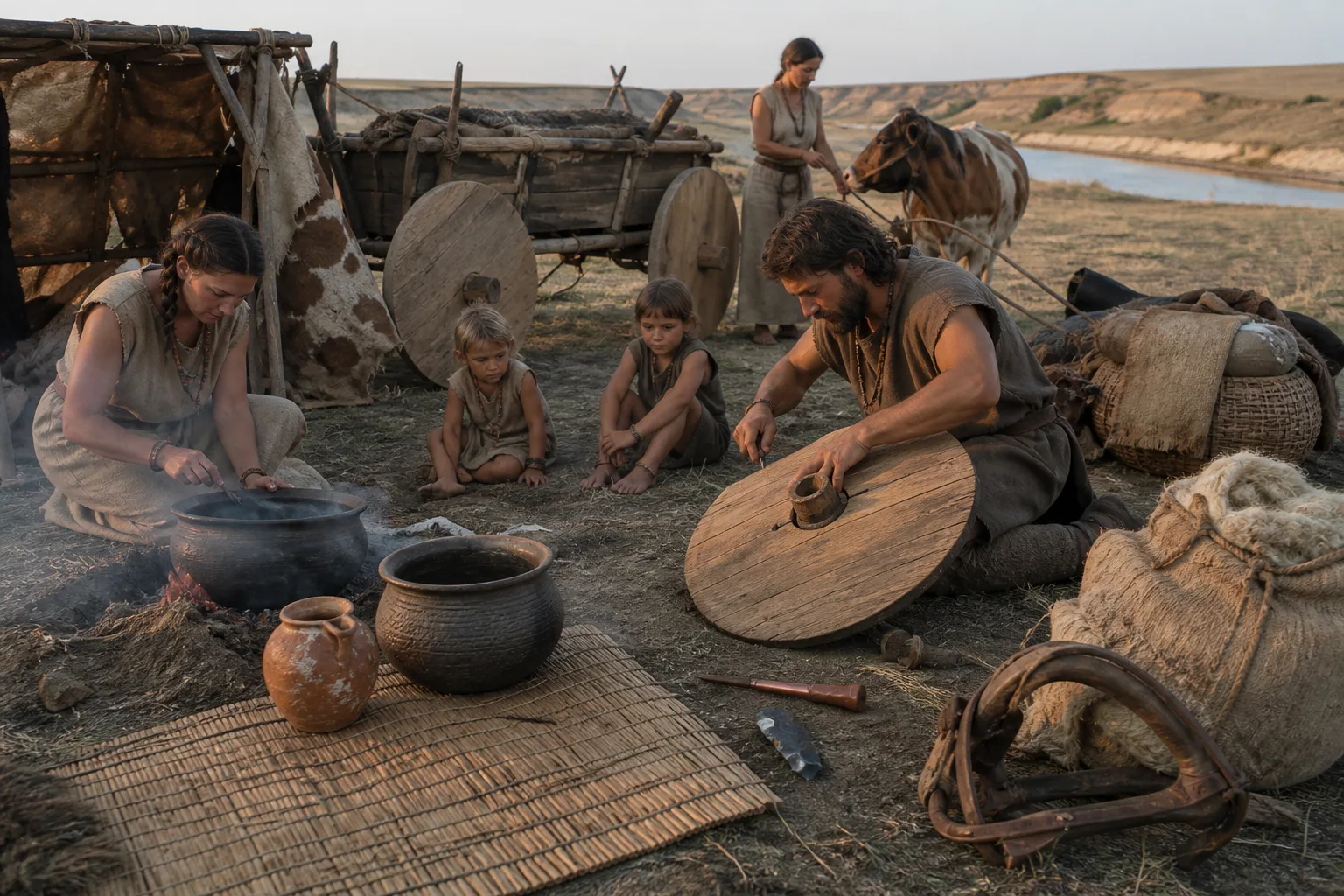
“Yamnaya,” also written Yamna, names an archaeological complex that appeared around 3300 BCE across the grasslands north of the Black and Caspian seas. Its name comes from characteristic pit graves, often placed beneath earthen burial mounds known as kurgans. Mobile herding, wagons, cattle and sheep, regional exchange, and new funerary practices all formed part of a world that extended across an enormous landscape.
By about 3000 BCE, Yamnaya-associated groups ranged from Hungary to Kazakhstan. Their descendants and closely related steppe populations contributed substantial ancestry to later communities in Europe and parts of Central and South Asia. That expansion was historically consequential, but “Yamnaya” remains an archaeological classification. It does not mean that every person buried in a Yamnaya context had identical ancestry, status or identity.
Earlier genetic work could see that Yamnaya genomes combined ancestry related to eastern European foragers and populations south of the steppe. It could not securely locate the intermediate communities that created this profile. The 2025 papers focus on that missing prehistory.
The three genetic clines before Yamnaya#
The main study describes three clines—gradients created by repeated gene flow rather than three sealed populations.
| Genetic pattern | How the study interprets it |
|---|---|
| Caucasus–Lower Volga, or CLV, cline | A gradient from a Caucasus Neolithic-related southern end to a lower-Volga northern end, rich in Caucasus hunter-gatherer-related ancestry |
| Volga cline | CLV-related people mixed with populations farther upriver carrying more eastern hunter-gatherer-related ancestry |
| Dnipro cline | CLV-related people moved west and mixed with Ukraine Neolithic hunter-gatherer-related populations around the Dnipro and Don |
These labels summarize patterns among sampled genomes. They are not the names that people used for themselves. Nor are the endpoints unmixed ancestors: each proxy represents its own longer history.
The CLV cline is especially important because people related to it contributed approximately 80% of Core Yamnaya ancestry in the authors' models. Bidirectional exchange also produced intermediate groups in the north Caucasus and steppe, including people associated with Maikop contexts and Remontnoye. The region was a network, not a one-way migration corridor.
From CLV movement to Serednii Stih#
When CLV-related groups moved toward the Dnipro and Don, they encountered communities with ancestry related to Neolithic hunter-gatherers of Ukraine. Their descendants fall along the Dnipro cline and include people associated with Serednii Stih, an Eneolithic archaeological tradition that preceded Yamnaya in parts of the steppe.
The study places the formation of direct Yamnaya ancestors at about 4000 BCE, followed by rapid demographic growth between approximately 3750 and 3350 BCE. This sequence matters. It shows a long formation process before the highly visible Yamnaya horizon, rather than a population materializing suddenly when kurgans and standardized burial customs spread.
The companion North Pontic paper strengthens that bridge. One individual from Mykhailivka in Ukraine, dated to 3635–3383 BCE, formed a genetic clade with later Yamnaya in the authors' tests. Mykhailivka also preserves archaeological continuity across the Eneolithic–Bronze Age transition, making the lower Dnipro a plausible center within the wider formation zone.
That is not the same as identifying one village as “the birthplace” of all Yamnaya people. Preservation and sampling remain uneven, and a formation zone can include multiple communities connected over generations.
What the North Pontic genomes add#
The companion study describes several overlapping movements of CLV-related ancestry into the North Pontic region. One stream mixed with Trypillian farming communities to form people associated with the Usatove culture around 4500 BCE. Another interacted more strongly with local forager-related groups and helped form the Serednii Stih population. A later Yamnaya expansion carried an already consolidated ancestry profile over a far wider area.
These movements did not simply replace everyone they encountered. Each wave incorporated outsiders to different degrees. Even during the Yamnaya expansion, some individuals in northwestern parts of the region carried additional ancestry related to nearby farming populations. The genetic signal is therefore a strong expansion with local variation, not a continent-wide population of clones.
This pattern resembles a recurring lesson from ancient Balkan population history: migration can be substantial without erasing every preceding lineage, and material culture can spread through both people and social adoption.
Did Yamnaya people speak Proto-Indo-European?#
The authors propose a linguistic interpretation, but genomes do not contain languages. Their model links the broad CLV network to an ancestral Indo-Anatolian stage and the later Yamnaya-related expansion to most non-Anatolian branches of Indo-European. The proposal partly rests on detecting CLV-related ancestry in Bronze Age central Anatolia, where Hittite and other Anatolian languages were later recorded, despite the absence of the full Core Yamnaya profile there.
This is a multidisciplinary hypothesis combining genetics, archaeology and historical linguistics. It is not a DNA test for Proto-Indo-European. Language can spread with limited ancestry change, shift after conquest or exchange, and disappear without a genetic population disappearing. The evidence also cannot tell which language any specific CLV, Serednii Stih or Yamnaya individual spoke.
Our companion article on the Indo-European hybrid hypothesis examines why linguistic family trees and ancient genomes address related but different questions.
How researchers modeled the ancestry#
The papers use multiple complementary approaches:
- Principal-component analysis visualized broad genetic gradients among ancient people.
- qpAdm tested whether target groups could be modeled from proposed ancestry sources; our qpAdm explainer describes how such models work.
- f-statistics measured excess allele sharing and tested relationships among groups.
- Identity-by-descent analysis detected long inherited DNA segments linking some people across regions.
- Radiocarbon dates and archaeological contexts placed genetic changes in time.
- Y-chromosome and mitochondrial lineages supplied narrower paternal and maternal perspectives.
No single method proves a migration route. A plausible reconstruction depends on compatible chronology, geography, archaeology and several genetic tests. Even then, source populations are the closest sampled proxies, not necessarily the exact communities that contributed ancestry.
What Yamnaya ancestry means today#
Many present-day Europeans and some populations farther east carry ancestry ultimately connected to Bronze Age steppe expansions. That does not make a modern person “Yamnaya” in a cultural sense. More than five thousand years of later migration and recombination separate present-day genomes from the sampled communities.
Consumer ancestry estimates may label a statistical component “steppe” or “Yamnaya.” Such percentages depend on the company's reference panel and model. They cannot identify a single Yamnaya ancestor, reconstruct a tribal identity or show that one modern population is genetically pure. Every ancient population in this story was itself the outcome of older movements and mixtures.
Limitations of the new origin model#
| Limitation | Why it matters |
|---|---|
| Ancient sampling remains geographically uneven | Unsampled communities may alter the inferred formation zone or ancestry proportions. |
| CLV and other sources are statistical proxies | A successful model does not prove the exact sampled group was the direct ancestor. |
| Dates cover ranges | Population formation unfolded over generations, not at a single precise year. |
| Archaeological labels and genomes are different evidence | A burial classified as Yamnaya does not automatically establish identity or language. |
| Linguistic conclusions require external assumptions | DNA tracks biological descent, not vocabulary, grammar or self-identification. |
| Population averages hide individuals | Some Yamnaya-associated people had additional local ancestry or different life histories. |
Frequently asked questions about Yamnaya DNA#
Where did Yamnaya ancestry originate?#
The 2025 model traces most Core Yamnaya ancestry to Caucasus–Lower Volga-related people. Their westward-moving descendants mixed with Dnipro–Don hunter-gatherer-related communities before Yamnaya formation.
How many ancient people were included?#
The main Nature study assembled ancient DNA from 435 individuals. Its companion North Pontic study reported 81 genomes from the region, including 76 newly published individuals.
Were Yamnaya people genetically homogeneous?#
Core Yamnaya genomes cluster tightly across a huge area, showing a major expansion. However, individuals and regional groups sometimes carried additional local ancestry, so homogeneous does not mean identical.
Is steppe ancestry the same as Yamnaya ancestry?#
Not always. “Steppe ancestry” is a broad modeling term that may refer to Yamnaya or related later groups. The exact reference and period must be stated.
Did the study prove the origin of Indo-European languages?#
No. It supplies genetic evidence compatible with a proposed linguistic history. Language assignment remains an inference that must be evaluated with archaeology and linguistics.
Can modern DNA reveal a Yamnaya identity?#
No. Modern genomes may retain ancestry related to steppe populations, but Yamnaya was a prehistoric archaeological world, not a percentage that establishes modern ethnicity or personal identity.
A more detailed origin story for the steppe expansion#
The new genomes shift the Yamnaya story backward. Before the famous westward and eastward migrations were centuries of movement between the lower Volga, north Caucasus, Dnipro and Don. CLV-related migrants, local foragers and neighboring farmers formed new communities whose ancestry and social practices eventually traveled across Eurasia.
That reconstruction is more informative than a simple two-color ancestry chart. It also remains provisional: every ancient-DNA map reflects the people successfully sampled so far. The durable finding is not genetic purity, but repeated contact—mixture created the population that later became one of the most influential migration sources of the Bronze Age.
Sources and further reading#
- Lazaridis, I., Patterson, N., Anthony, D. et al. (2025). The genetic origin of the Indo-Europeans. Nature 639, 132–142. DOI: 10.1038/s41586-024-08531-5.
- Nikitin, A. G., Lazaridis, I., Patterson, N. et al. (2025). A genomic history of the North Pontic Region from the Neolithic to the Bronze Age. Nature 639, 126–132. DOI: 10.1038/s41586-024-08372-2.
- Ancient sequence data: European Nucleotide Archive PRJEB81467 and PRJEB81468.
Editorial note: this article was written as a source-based synthesis and reviewed for distinctions among ancestry, archaeology, language and identity. Its hero and section artwork was generated with AI as an interpretive archaeological scene, not as scientific evidence.


