

Ancient DNA shows that Minoan- and Mycenaean-era communities were shaped by several migrations, sustained Aegean connections, and marriage practices that often joined biological relatives. The first farmers on Crete shared ancestry with other Neolithic Aegeans. Later, ancestry related to Anatolia and the Iran/Caucasus region reached the islands and mainland. By the Middle and Late Bronze Age, ancestry connected to central and eastern Europe appeared on the Greek mainland and gradually entered Crete.
The same genomes reveal intimate social history. A Late Bronze Age infant grave at Mygdalia held children and grandchildren of one couple, while long runs of homozygosity indicate that close-cousin unions were unusually frequent in several sampled communities. These patterns were neither universal nor constant across the Aegean.
The evidence comes from the 2023 Nature Ecology & Evolution study Ancient DNA reveals admixture history and endogamy in the prehistoric Aegean. Researchers generated genome-wide data from 102 people spanning the Neolithic, Bronze Age, and one Iron Age context in Crete, mainland Greece, and the Aegean islands.
The short answer: Minoans and Mycenaeans did not belong to two sealed biological populations. Their sampled communities shared deep Aegean farmer ancestry but experienced different waves of gene flow. Genetic relatives often shared collective tombs, and some communities repeatedly arranged unions between cousins. DNA describes biological ancestry and kinship; it cannot determine whether an individual called themselves Minoan, Mycenaean, or anything else.
What did the Aegean study sample?#
The team produced new genome-wide data from 102 ancient individuals:
| Archaeological period | Newly analyzed individuals |
|---|---|
| Neolithic | 6 |
| Bronze Age | 95 |
| Iron Age | 1 |
Sixty-six of the 102 came from Crete, giving the island the richest time transect. Sites included Aposelemis, Hagios Charalambos, Chania, and Krousonas on Crete; Nea Styra on Euboea; Lazarides on Aegina; and Late Bronze Age mainland contexts at Aidonia, Glyka Nera, Mygdalia, and Tiryns, among others. Forty-three skeletons received new direct radiocarbon dates.
The researchers initially sampled 385 skeletal elements assigned to 357 people. Preservation, authenticity, and contamination filters reduced that starting pool to the 102 reported genomes. DNA libraries were enriched for approximately 1.23 million ancestry-informative SNPs and co-analyzed with previously published Aegean individuals.
This is a large increase over earlier datasets, but it is not a census. Collective tombs can overrepresent particular families, while differences in burial and preservation select who enters the dataset. “Minoan” and “Mycenaean” are archaeological-cultural labels covering multiple sites and centuries, not genetic clusters defined by the study.
The first Cretan farmers belonged to a wider Aegean world#
Six Neolithic people from Aposelemis on Crete clustered genetically with early farmers from western Anatolia and the Aegean. The result supports a shared early farming gene pool across the sea rather than an isolated Cretan origin.
These people lived in the late seventh to early sixth millennia BCE, around a millennium after the earliest Neolithic settlement at Knossos. Their genomes cannot identify the precise route or number of the island's first settlers. They do show that early Cretan farming communities were biologically connected to the expansion of farming populations around the Aegean.
Genetic diversity within the Aposelemis group was low. The authors considered several explanations, including a small population, relatives in the burial sample, or a longer bottleneck. Low coverage prevents a definitive reconstruction. As with Neolithic ancestry in the Balkans, farming likely spread through varying combinations of population movement, local participation, and cultural exchange.
Eastern ancestry reached Crete and the mainland in different ways#
By the Late Neolithic and Early Bronze Age, many Aegean genomes shifted toward ancestry related to early populations from Iran, the Caucasus, and Anatolia. The shift was not uniform. Five men buried together at Nea Styra carried substantially different proportions of Iranian-related ancestry, showing that mixing could be visible within one grave and generation.
Formal models gave different best proxies by region:
- A southern mainland and island group was compatible with roughly 28% additional ancestry represented by Eneolithic/Bronze Age southern Caucasus populations.
- Early/Middle Bronze Age Crete was better represented by ancestry from Late Chalcolithic/Early Bronze Age Anatolia, plus a small modeled Iranian Neolithic-related contribution.
- Admixture dating for Late Neolithic/Early Bronze Age mainland and island individuals averaged around 4300 ± 250 BCE, but variation suggested continuing arrivals and mixing rather than one event.
The source labels are statistical. They do not establish that a named historical people invaded, nor that an individual traveled directly from the Caucasus. The likely migrants may have come through intermediate Aegean or Anatolian populations that are sparsely sampled.
Northern-related ancestry appeared later#
Middle and Late Bronze Age people on the mainland carried additional affinity to populations connected with central/eastern Europe and the western Eurasian steppe. In southern mainland groups, the study's models averaged about 22.3% western Eurasian steppe-related ancestry. Two Middle Bronze Age individuals from Logkas in northern Greece had much higher estimates of 43–55%.
The exact geographical source could not be isolated. Models using several central or eastern European groups fit, and ancient sampling remains uneven. The study therefore supports movement from a broadly northern direction without identifying one archaeological culture as the sole source.
Some tests were consistent with male-biased admixture: men carried less western Eurasian steppe-related ancestry on their X chromosomes than on most autosomes. Yet only four of 30 sampled males after the sixteenth century BCE carried R1b1a1b Y lineages. Most male lines remained J or G/G2, which had deep histories in Anatolian, Aegean, Caucasus, and Near Eastern farming populations. Migration did not erase earlier paternal diversity.
How Mycenaean-era ancestry reached Crete#
Late Bronze Age Crete shows a gradual, highly uneven increase in western Eurasian steppe-related ancestry from the seventeenth to twelfth centuries BCE. The earliest sampled Cretans in this phase had little or none, while some of the youngest carried the highest levels. At Chania alone, individuals living within roughly three centuries spanned much of the full range.
This is consistent with repeated mixing during the period when mainland Mycenaean cultural and political influence intensified on Crete. Mainland Late Bronze Age populations were an adequate source for the incoming ancestry in formal models, especially for the most northern-shifted Cretan group. Some more distant sources also fit because the available populations were genetically similar for the tested statistics.
The data do not prove a single invasion or identify the political circumstances of each migrant. Archaeological destructions, administrative change, trade, marriage, military movement, and ordinary relocation may all have contributed. The genetic transition unfolded across centuries, which argues against reducing it to one dramatic episode.
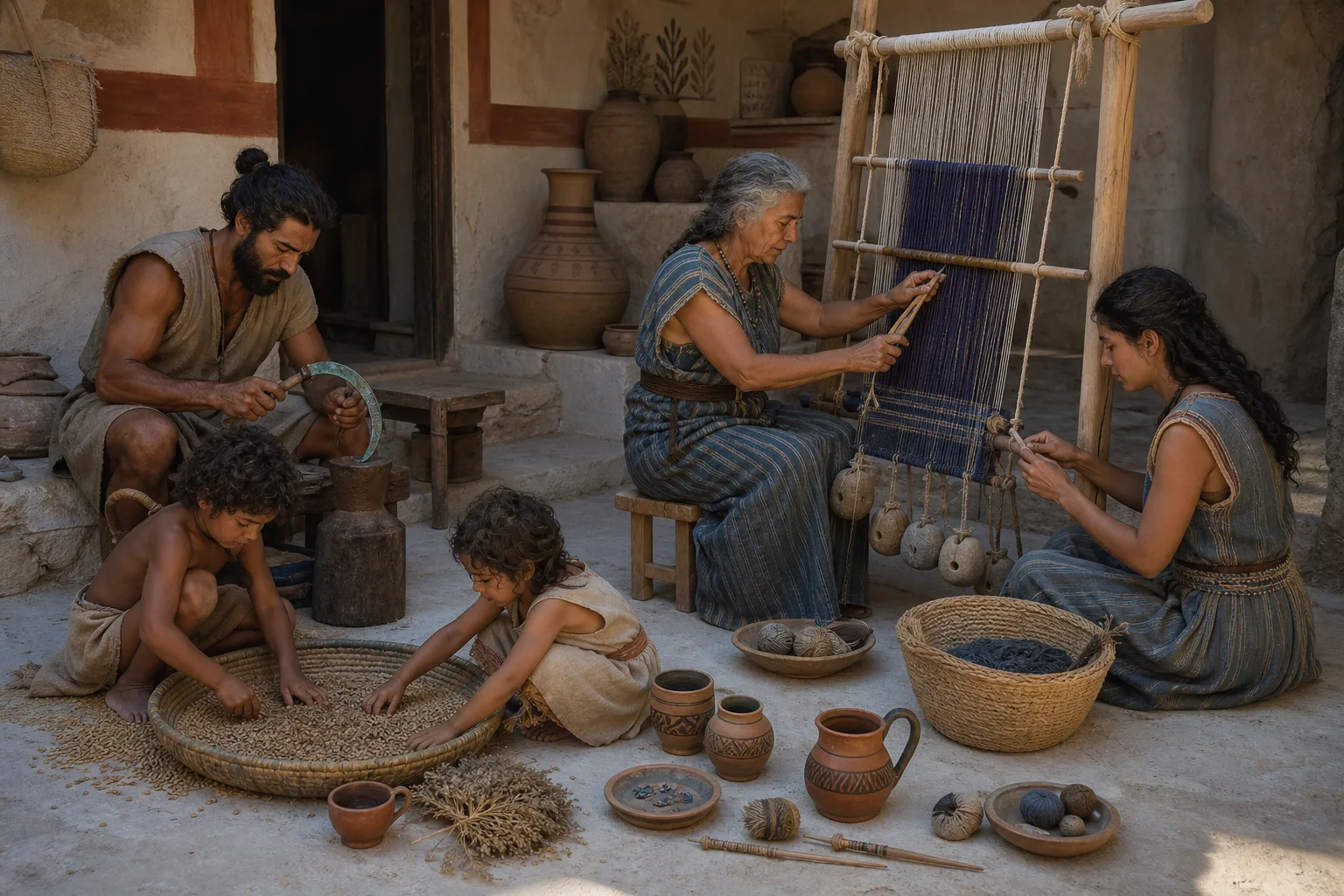
A family tree beneath a Mycenaean house#
At the Late Bronze Age settlement of Mygdalia, archaeologists found a small stone-lined grave beneath a house containing at least eight perinatal infants. Genetic relatedness could be estimated for seven.
Six were reconstructed as children and grandchildren of one couple. The seventh was a third-degree maternal relative of one infant, plausibly a first cousin. The burial therefore represents an extended biological family across generations, making visible the household relationships behind an archaeological collective grave.
Other sites also contained relatives. Researchers identified first- to third-degree pairs in chamber tombs at Aidonia and among remains at Hagios Charalambos on the Lasithi plateau. Yet burial together was not exclusively biological: ancient social families could include foster relationships, servants, dependants, spouses, and community members that genomic kinship cannot detect.
Were cousin marriages common in the Bronze Age Aegean?#
In several sampled contexts, yes. Long runs of homozygosity occur when a person's parents share recent ancestors. At Hagios Charalambos, roughly half of 27 sufficiently analyzed individuals showed patterns compatible with close parental relationships. When the possible first-cousin cases were combined, their distribution fit first-cousin unions better than alternative close-kin scenarios.
When the researchers applied the same test to another 61 Aegean individuals from all periods that met coverage thresholds, they found that, in total, about 30% of the individuals carried long homozygous segments consistent with parents related at a first- or second-cousin level. The signal appeared from the Neolithic through the Late Bronze Age and at mainland and island sites. Several smaller islands showed about 50%, but the pattern was not restricted to small islands and was not evident at some locations, including sampled second-millennium Chania.
The authors suggest cross-cousin marriage could have preserved land, labour, or household alliances, perhaps important for crops such as olives that reward long-term local investment. This remains an anthropological hypothesis. Genomes show parental relatedness, not the marriage rules, motives, terminology, or consent surrounding a union.
“Endogamy” also should not be confused with genetic purity. These communities could receive ancestry from distant regions while choosing spouses within a local network. Migration and cousin marriage are not opposites; a mobile population can become locally endogamous, and an endogamous community can still change through occasional newcomers.
Minoan and Mycenaean were cultural identities#
Minoan and Mycenaean labels organize recognizable patterns in architecture, writing, pottery, burial, and political economy. Genome-wide ancestry does not make those categories biological species. People sharing similar ancestry could speak different languages or participate in rival polities, while people with different ancestry could live in the same city and culture.
This point matters especially for language. Western Eurasian steppe-related ancestry is often discussed alongside Indo-European language dispersal, but DNA cannot show which language an individual spoke. Linguistic models such as the Indo-European hybrid hypothesis must be evaluated with linguistic evidence rather than inferred directly from ancestry percentages.
Likewise, the shared ancestry of Bronze Age Aegeans does not erase regional difference. Crete, the mainland, and individual islands experienced gene flow at different times and intensities. Chania itself contained substantial variation.
What the study cannot establish#
| Limitation | Why it matters |
|---|---|
| 102 people across thousands of years | Many periods, regions, and social groups remain sparsely sampled. |
| 66 individuals come from Crete | The geographical distribution is uneven. |
| Collective burials often contain relatives | Family-rich samples may not represent a whole settlement. |
| Ancient genomes have variable coverage | Individual ancestry and runs-of-homozygosity estimates differ in precision. |
| Several migration-source models fit | Broad direction is clearer than a precise homeland. |
| Archaeological labels are not genetic groups | DNA cannot identify language, status, or self-understood ethnicity. |
The overall burial record is also selected by ancient practice, preservation, excavation, and modern sampling. People denied formal burial or treated in ways hostile to DNA recovery may be absent.
Frequently asked questions about Minoan and Mycenaean DNA#
Were Minoans and Mycenaeans genetically the same?#
They shared substantial ancestry rooted in early Aegean farmers and later eastern-related gene flow, but sampled mainland Mycenaean-era groups generally carried more central/eastern European or steppe-related ancestry. Late Bronze Age Crete became increasingly mixed.
Did Mycenaeans replace the Minoans?#
The study does not show wholesale replacement. It documents gradual and uneven admixture in Crete across several centuries during growing mainland influence.
How many ancient people were sequenced?#
Researchers generated genome-wide data from 102 people: six Neolithic, 95 Bronze Age, and one Iron Age individual. Sixty-six came from Crete.
Did steppe ancestry bring the Greek language?#
The genomes cannot answer that directly. The timing is relevant to language-history debates, but ancestry is not evidence that a specific individual or migrating group spoke Greek.
Did Minoans marry their cousins?#
Some sampled Aegean communities frequently arranged unions between biological relatives at levels consistent with first or second cousins. The practice was not universal, and DNA cannot reveal its social rules or motivations.
Does close-kin marriage mean these populations were isolated?#
Not necessarily. The same dataset records repeated migration and admixture. Close-cousin unions can reflect household strategy or social preference even in connected societies.
Mobility and family shaped the same world#
The Aegean genomes unite two scales of history. At the continental scale, people and ancestry moved through Anatolia, the Caucasus, central/eastern Europe, mainland Greece, and Crete. At the household scale, families buried children beneath homes and sometimes kept marriage within established kin networks.
Neither story reduces to a straight replacement. New arrivals mixed with local communities, while cultural categories changed across centuries. Minoan and Mycenaean archaeology remains essential because genes reveal relationship—not the full meaning people gave to those relationships.
Primary sources and data#
- Skourtanioti, E. et al. (2023). Ancient DNA reveals admixture history and endogamy in the prehistoric Aegean. Nature Ecology & Evolution 7, 290–303. DOI: 10.1038/s41559-022-01952-3.
- Lazaridis, I. et al. (2017). Genetic origins of the Minoans and Mycenaeans. Nature 548, 214–218.
- Raw sequencing reads: European Nucleotide Archive PRJEB56216.
Editorial note: the hero and section artwork in this article was generated with AI as a realistic archaeological interpretation. It does not reconstruct sampled families, reproduce a scientific figure, or establish the appearance of any Minoan or Mycenaean individual.


