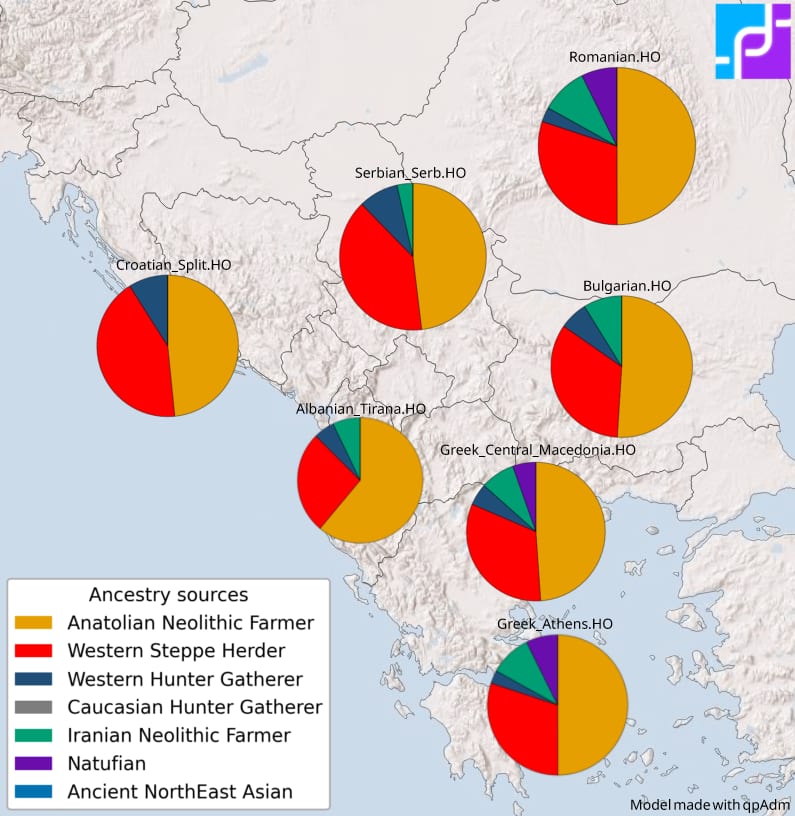
The Balkans hold one of Europe's deepest ancient-DNA stacks: Neolithic farmers, a Bronze Age steppe arrival, the Illyrian and Thracian Iron Age, Roman provincial centuries that brought Anatolian mobility, and an Early Medieval migration associated with Slavic expansion that left a measurable layer in every modern population of the peninsula. Because those layers are dated and sampled, the proportions can be estimated rather than guessed, and they say nothing about who anyone is: ancestry is a record of descent, not identity.
The articles read the region country by country: a 2026 study tracing Albanian ancestry from Bronze and Iron Age West Balkan groups, the Thracian base and thin Bulgar trace in Bulgarian genomes, Dacians and the Roman frontier in Romanian ancestry, why Serbian, Croatian and Bosniak genomes overlap almost completely, the 555-genome Slavic migration study, qpAdm modelling of Neolithic farmer and steppe proportions in present-day Balkan populations, and the Roman-era and late-antique migrations seen in ancient Balkan DNA.
What Ancient Ancestry, our paid qpAdm analysis, includes