

Ancient DNA from the Balkans does not support a simple story of either unchanged continuity or total population replacement. A major 2023 Cell study found that local Iron Age-related ancestry persisted through Roman rule, while imperial cities received substantial migration from Anatolia and occasional travelers from much farther away. After 700 CE, a distinct Eastern European-related ancestry associated by the authors with Slavic-speaking migrations became a lasting part of the region's population history.
The result is a history of continuity through repeated migration. Roman political and cultural influence was not accompanied by a comparably large movement of people from Italy into the sampled Middle Danube frontier. Later Slavic-associated migration, by contrast, made a substantial demographic contribution without eliminating the ancestry already present in the Balkans.
Published as A genetic history of the Balkans from Roman frontier to Slavic migrations, the study follows people across the first millennium CE. Its richest new ancient-DNA evidence comes from present-day Serbia and Croatia, so its regional conclusions—and especially its modern population models—must be read with that geography in mind.
The short answer: the Roman Balkans were genetically diverse and highly connected. Local people remained important, Roman-era migration brought a durable Anatolian-related layer, late-antique communities mixed local, Central or Northern European, and steppe-related ancestries, and Eastern European-related ancestry spread widely after 700 CE. None of these statistical ancestry components is the same thing as an ethnicity, language, or modern nationality.
What the ancient Balkan DNA study analyzed#
The researchers selected 146 ancient Balkan samples from 20 archaeological sites in modern Serbia and Croatia. DNA recovery produced genome-wide data from 136 of them. Six additional Early Medieval individuals from Austria, the Czech Republic, and Slovakia were analyzed as comparative material.
Quality controls then removed newly reported individuals with contamination or too few covered genetic markers. The final Balkan analysis combined 123 newly reported individuals with 15 previously published genomes, producing a dataset of 138 ancient Balkan people, mostly dated from approximately 1 to 1000 CE. The team also generated 38 new radiocarbon dates and genotyped 37 present-day Serb men.
The settings ranged from Roman cities and military sites to Early Medieval cemeteries. The largest concentration came from Viminacium, the capital of Roman Upper Moesia, where 57 individuals represented six necropolises. The study compared the High Imperial (ca. 1–250 CE), Late Imperial (ca. 250–550 CE), and post-Roman (ca. 550–1000 CE) periods.
This is a powerful frontier transect, but it is not a uniform survey of every Balkan country. In the final ancient analysis, 72 people were from Serbia and 56 from Croatia. Only three previously published individuals came from Albania, four from Bulgaria, and one each from North Macedonia, Greece, and Romania. Readers looking for a country-focused transect should distinguish this regional study from newer Albania-specific ancient DNA research.
Roman rule did not bring mass ancestry from Italy#
Among 45 individuals dated to roughly 1–250 CE, around half could be modeled using only Balkan Iron Age-related sources. These people lived in Roman towns and were buried in Roman-period contexts, yet their ancestry was consistent with descent from populations already established in the region.
The researchers also found almost none of the paternal lineage R1b-U152, which had been common in Bronze and Iron Age populations of the Italian Peninsula. More broadly, they could not detect a large contribution from central Italian Iron Age ancestry in this sample.
That does not mean no people from Italy lived in the Balkans. It means Roman institutions and material culture spread more extensively than ancestry from the sampled Italian comparison populations. Cremation was also common during the first and second centuries, leaving less recoverable DNA and potentially excluding communities with different funerary customs.
The wider background was already layered long before Rome. Neolithic farmers, hunter-gatherers, and later steppe-related groups had helped form the earlier regional landscape described in our guide to Neolithic Balkan ancestry.
Roman cities drew migrants from Anatolia and beyond#
Rome's demographic effect appeared most clearly through movement within the empire. Fifteen of the 45 High Imperial individuals—about one-third—fell outside the established Balkan genetic clines. Most could be modeled predominantly with ancestry related to Roman- or Byzantine-period populations from western Anatolia; one was closer to a Northern Levantine source.
Many were buried at Viminacium, but Anatolian-related individuals also appeared at Trogir and Zadar. People with local and non-local ancestry shared cemeteries and sometimes tombs, revealing integration rather than neatly separated communities.
The fully Anatolian- or Levantine-related adult group was male-skewed: only two of 12 were women, a difference reported at p=0.019. The researchers caution that sex-specific burial customs could contribute to this pattern. Anatolian-related ancestry did not disappear when this migration stream declined; later Medieval individuals retained a modeled mean of 23%, with a 95% confidence interval of 17–29%.
Three second- or third-century men illustrate even longer-distance mobility. One person from Zadar was modeled with 33% North African-related ancestry, another from Viminacium with wholly North African-related ancestry, and a young man at Viminacium with East African-related ancestry. The last individual also carried mtDNA L2a1j and Y-DNA E1b-V32, while isotope evidence suggested a non-local childhood diet.
Their genomes demonstrate movement across enormous distances, but not why or under what social conditions they traveled.
Late Antiquity brought mixed frontier communities#
Beginning in the third or fourth century, some individuals carried combinations of local Balkan, Central or Northern European, and Pontic-Kazakh steppe-related ancestry. The Central/Northern and steppe components often occurred together, suggesting that admixture had already happened beyond the Roman frontier before people entered imperial territory.
Many of these individuals still derived 42–55% of their modeled ancestry from Balkan Iron Age-related sources. Only three had more than 80% combined Central/Northern European and steppe-related ancestry. Their paternal lineages included I1, R1b-U106, and R1a-Z93, while dietary isotope differences added another sign that some had distinct life histories.
The cemetery at Kormadin shows why archaeological labels require care. Although its material culture was identified as “Gepid,” two of four tested people had an entirely local Balkan profile and two were admixed. Artifact style cannot define genetic ethnicity; the evidence instead fits diverse confederations and local incorporation.
What changed after 700 CE?#
After 700 CE, the transect shifts toward ancestry related to present-day Eastern European Slavic-speaking populations. The researchers distinguished this signal from the earlier Central/Northern European-plus-steppe stream through PCA, allele-sharing statistics, and qpAdm ancestry modeling.
Most people with this ancestry lived in the seventh to tenth centuries and were already admixed. Seven individuals carried more than 90% Eastern European-related ancestry, making recent migrant origins more plausible; three of the seven were women. A roughly even balance between local and incoming-associated Y-chromosome lineages, together with supplementary X-chromosome tests, is consistent with major contributions from both sexes. The formal sex-bias tests remained imprecise, so the study does not establish an exact male-to-female ratio.
The timing also needs precision. Historical and archaeological evidence places Slavic migrations as early as the sixth century, but the genetic dataset has a major gap between 500 and 700 CE and relatively few sixth-century individuals. The study detects the ancestry clearly after 700; it cannot use that absence of samples to date the first arrivals.
Migration without complete replacement#
The Eastern European-related signal had a more durable impact than the earlier Central/Northern European-plus-steppe arrivals. Present-day Serbs, Croats, Bulgarians, and Romanians could be modeled similarly to some Balkan individuals living after 900 CE. The signal decreased toward the south but remained detectable in mainland Greece and the Aegean.
At the same time, the models retained local Bronze or Iron Age-related and Roman Anatolian-related sources. The authors therefore reject complete replacement. They also reject an unbroken, unmixed line from a single pre-Roman population: one-source continuity models failed for every present-day group they tested.
This combination helps explain why modern Balkan populations can share broad demographic history while speaking languages from four families—Slavic, Latin, Greek, and Albanian. Culture and language do not move in a fixed ratio with genes. Regional histories such as the relative isolation of the Deep Maniots of southern Greece can also differ from a broad peninsula-wide model.
What the modern percentages mean#
The paper summarizes Eastern European-related ancestry as contributing roughly 30–60% to present-day Balkan peoples, while its supplementary qpAdm models describe a north-to-south cline. Selected point estimates were:
| Population sample | Eastern European-related proxy estimate |
|---|---|
| Croatian | 66.5% ± 2.7 |
| Serbian | 58.4% ± 2.1 |
| Romanian | 55.4% ± 2.4 |
| Bulgarian | 51.2% ± 2.2 |
| Greek Macedonia | 40.2% ± 2.0 |
| Albanian | 31.0% ± 5.3 |
| Greek Peloponnese | 29.9% ± 1.9 |
| Greek Cyclades | 19.7% ± 2.2 |
| Cretan | 17.9% ± 2.0 |
| Greek Dodecanese | 3.5% ± 2.2 |
These are population-level statistical estimates produced by a particular source model. They are not personal DNA-test predictions, literal fractions of named ethnic ancestors, or values that apply uniformly inside a modern country. The “Eastern European” source was itself a proxy: eight Early Medieval people from western Hungary, the Czech Republic, eastern Austria, and western Slovakia whose genetic profiles overlapped present-day Balto-Slavic-speaking populations.
The researchers used this proxy because suitable contemporary genomes from proposed Slavic homelands in Ukraine, Belarus, and eastern Poland were unavailable. Changing sources can change an ancestry estimate, and qpAdm tests whether a proposed mixture is compatible with the data rather than identifying one uniquely true genealogy.
How the researchers reached these conclusions#
DNA was extracted from skeletal material, treated to reduce characteristic damage, and enriched at approximately 1.2–1.4 million targeted markers. Authenticity, coverage, and contamination checks filtered the data.
The main analytical tools answered different questions:
- PCA visualized broad similarities and revealed parallel ancient and present-day Balkan clines.
- f-statistics tested whether populations shared more genetic drift with Eastern European or Central/Northern European comparison groups.
- qpAdm evaluated mixture models using local Balkan, Anatolian, Central/Northern European, steppe, and Eastern European-related proxies.
- Y-DNA and mtDNA followed single paternal and maternal lines.
- Kinship and runs of homozygosity identified family relationships and close parental relatedness.
- Radiocarbon and stable-isotope analysis anchored individuals in time and added evidence about childhood diet and mobility.
Agreement among methods strengthens the broad sequence, but cannot reveal a person's language or chosen identity.
The study's most important limitations#
The authors identify three central sampling problems. Cremation restricts the earliest Roman-period dataset. Sixth-century samples are scarce, obscuring the transition into the earliest Slavic migration period. Urban cemeteries are overrepresented relative to rural populations.
Several additional cautions follow from the design:
- Most new ancient evidence comes from Serbia and Croatia, especially Viminacium.
- The 500–700 CE gap prevents precise dating of the earliest Eastern European-related arrivals.
- Statistical sources are imperfect stand-ins for real historical populations.
- Modern population labels conceal regional and individual variation.
- Material culture, ancestry, language, citizenship, and ethnic identity are related historical evidence—not interchangeable categories.
Frequently asked questions about ancient Balkan DNA#
Did Romans genetically replace Balkan populations?#
No. Around half of the sampled High Imperial individuals could be modeled from local Balkan Iron Age-related sources, and the study found little detectable central Italian-related contribution. Roman-era migration from Anatolia and the Eastern Mediterranean was substantial, however.
When does Slavic-associated ancestry appear in the Balkans?#
The study finds a clear Eastern European-related signal across its sampled regions after 700 CE. Because few people were sampled from the sixth century and none cover much of 500–700, the result should not be read as a precise arrival date.
Did Early Medieval migration replace everyone already living there?#
No. Local Balkan and Roman Anatolian-related ancestry persisted through the Medieval period and in the study's present-day models. The evidence supports large-scale admixture, not complete demographic replacement.
How much Slavic-related ancestry do Balkan populations have?#
The paper's broad summary is 30–60%, with lower estimates toward southern Greece and the Aegean. Exact values depend on the sampled population and chosen proxy. They are research-model averages, not percentages that can be assigned to an individual person.
Were the Early Medieval migrants only men?#
No. Women were present among individuals with very high Eastern European-related ancestry, and the combined evidence is consistent with migration by both sexes. The available data are not precise enough to prove an exactly balanced contribution.
Can ancient DNA prove that someone was Roman, Goth, Slav, Illyrian, or another identity?#
No. DNA can estimate biological affinity and admixture. Connecting those patterns to a historically named community requires archaeology, written evidence, and linguistic context, and even then individual identity may remain unknown.
A more connected history of the Balkans#
The evidence replaces two opposing myths—perfect isolation and total replacement—with a connected history. Local ancestry survived Roman transformation; the empire linked frontier cities to Anatolia, Africa, and distant Europe; and migrations associated with Slavic expansion left a durable legacy after Roman control ended.
The shared history did not erase local variation or determine which language a community would speak. Ancient DNA is strongest when it is treated as one line of historical evidence: unusually direct evidence about biological relationships, but not a genetic passport carrying a person's nationality or culture.
Primary sources and data#
- Olalde, I. et al. (2023). A genetic history of the Balkans from Roman frontier to Slavic migrations. Cell 186, 5472–5485.e9. PubMed and open full text.
- Supplementary archaeological information, statistical models, and Data S2 tables.
- Raw ancient sequencing data: ENA project PRJEB66422.
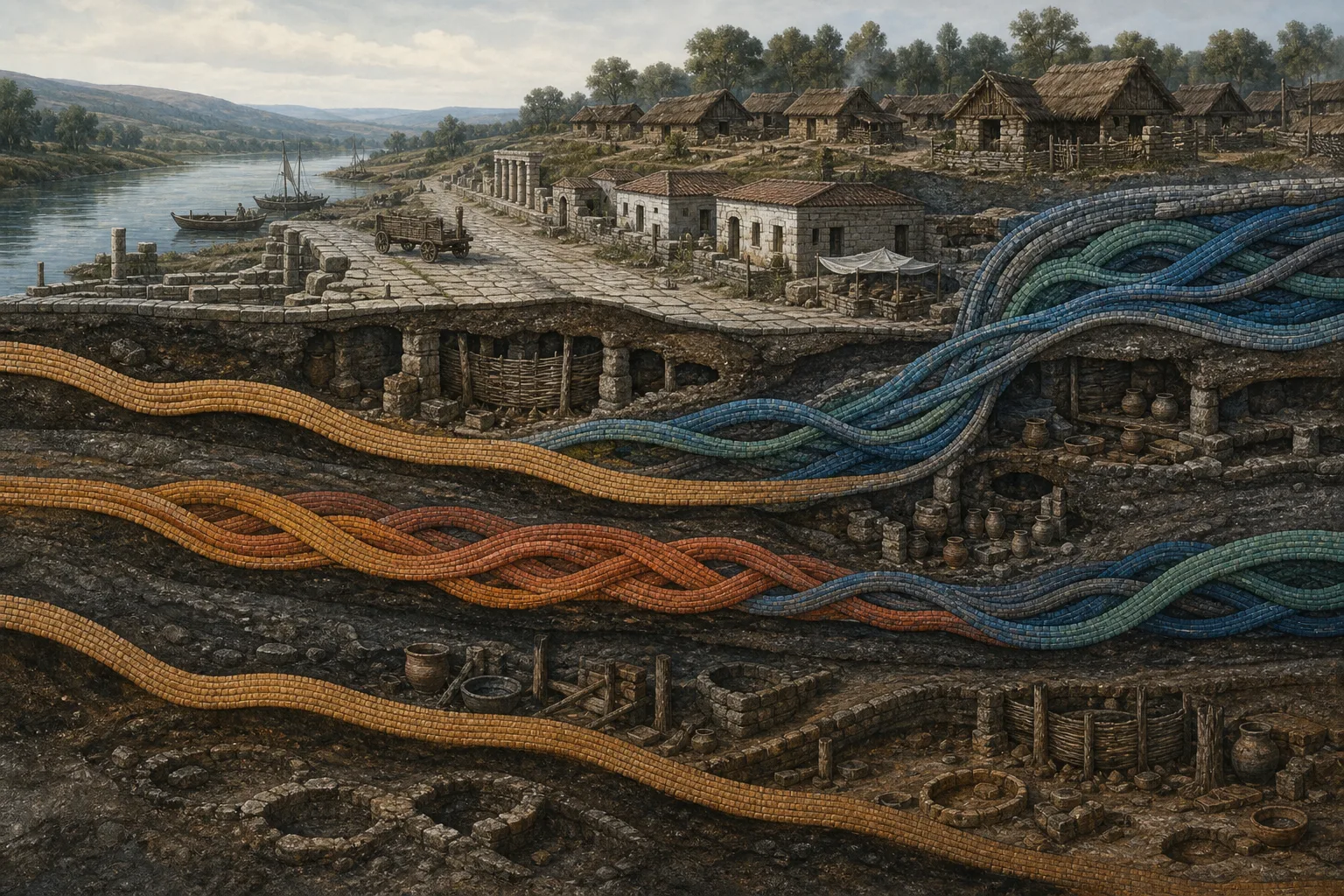
Editorial note: the hero and body artwork for this article was generated with AI as conceptual illustration. It does not reproduce a scientific figure, reconstruct a specific ancient person, or depict measured migration routes or ancestry proportions.


