

Are Albanians descended from Illyrians according to DNA? Largely yes: the 2026 Nature Human Behaviour study models present-day Albanians as roughly 75 to 90% an Early Medieval Albanian population whose own ancestry was Late Bronze and Iron Age western Balkan, plus 10 to 20% later East European-related admixture. Ancestrify models the same eras from your raw DNA.
Key facts
Figures as published, one source per row.
| Early Bronze Age, about 2700 BCE | The sampled man from Çinamak (2663 to 2472 BCE) is modelled as about 70% Pontic-Caspian steppe-related and the rest Early European Farmer-related, and carried Y-DNA R1b-M269.Source: Ancient DNA evidence for the history of the Albanians (2026), Davranoglou et al. |
|---|---|
| Late Bronze and Iron Age West Balkans | Sampled central-west Balkan groups model as roughly 60% Early European Farmer-related, 30 to 40% steppe-related and 0 to 5% Neolithic Iranian-related ancestry.Source: Ancient DNA evidence for the history of the Albanians (2026), Davranoglou et al. |
| Roman-period layer | Early Medieval genomes from Albania carry a 16 to 32% Anatolian or southeast Balkan-related contribution, depending on the model. No Roman-period Albanian genome is in the transect, so the timing is inferred.Source: Ancient DNA evidence for the history of the Albanians (2026), Davranoglou et al. |
| Early Medieval anchor, 773 to 989 CE | The individuals from Kënetë and Shtikë model as 68 to 84% Late Bronze and Iron Age West Balkan-related, with no detectable East European-related ancestry in the preferred models.Source: Ancient DNA evidence for the history of the Albanians (2026), Davranoglou et al. |
| Share of present-day Albanian ancestry | The Medieval Albanian profile accounts for roughly 75 to 90% of present-day Albanian ancestry in the study's models, depending on which East European comparison population is used.Source: Ancient DNA evidence for the history of the Albanians (2026), Davranoglou et al. |
| East European-related admixture | Roughly 10 to 20% overall: 4 to 16% by region (average 10%) against an unadmixed Medieval central-east European proxy, 8 to 32% (average 20%) against a Medieval Montenegrin proxy. The admixture dates span a broad time range.Source: Ancient DNA evidence for the history of the Albanians (2026), Davranoglou et al. |
| Paternal and maternal lines | About 16 to 19% of present-day Albanian paternal lineages belong to Migration Period-associated branches of R1a, I2a and I1, and about 16% of 375 mtDNA samples. The other major paternal lines are E-V13, J2b-L283 and R1b.Source: Ancient DNA evidence for the history of the Albanians (2026), Davranoglou et al. |
| What Ancestrify reports | An era-by-era qpAdm model of your raw DNA against these ancient sources, published with its p-value, every source's standard error and the full right set, from from €29.99.See Ancient Ancestry |
Ancient DNA now supports a deep regional history for Albanians. A major 2026 study finds that present-day Albanians predominantly descend from a population already living in Albania by the Early Middle Ages, whose ancestry was largely rooted in the Late Bronze and Iron Age western Balkans. It also detects later, geographically uneven East European-related admixture averaging roughly 10–20%.
That is evidence of substantial continuity—but not of isolation, genetic “purity,” or a direct genetic proof that every ancient ancestor spoke Albanian. The distinction matters. DNA can reveal biological relationships and population change; it cannot recover a person’s language, culture, or self-identity.
Published in Nature Human Behaviour on 4 May 2026, Ancient DNA evidence for the history of the Albanians is the most focused genome-wide investigation yet of Albanian population history. This article explains what the researchers found, how they reached their conclusions, and where the evidence still runs out.
The short answer: modern Albanian ancestry is modeled as predominantly Early Medieval Albanian, with strong roots in pre-Roman western and central Balkan populations. Roman-era contact and later medieval admixture added further layers. The evidence supports continuity through change, not an unchanged population frozen in time.
What the 2026 Albanian DNA study analyzed#
The researchers assembled several complementary datasets rather than relying on one ancestry calculator or a single statistical model:
- More than 6,000 previously published ancient West Eurasian genomes were considered across the study’s analytical layers, including 22 ancient individuals from the territory of present-day Albania.
- 74 present-day ethnic Albanians were newly sequenced at high coverage. The cohort covered Gheg, Tosk, and transitional dialect areas across Albania, Kosovo, Montenegro, northern Greece, North Macedonia, and Serbia.
- Public Y-chromosome and mitochondrial datasets added information from more than 4,000 ancient and present-day Balkan samples.
Not every method used all 6,000 genomes. The researchers selected smaller, fit-for-purpose subsets for individual analyses: for example, more than 660 ancient genomes for admixture modeling, 330 imputed ancient genomes for one identity-by-descent analysis, and 5,664 reference individuals for spatial modeling. That distinction is important when interpreting the headline sample size.
The main methods included:
- PCA, which places individuals according to broad patterns of genetic similarity.
- qpAdm, which tests whether a target population can be modeled as a mixture of proposed source populations.
- f-statistics, which compare shared genetic drift and relative affinity among populations.
- DATES, which estimates when ancestry sources mixed.
- Identity by descent (IBD), which looks for inherited DNA segments shared through common ancestors.
No single method can identify an ethnicity. Their value comes from asking different questions and checking whether the results converge.
A 4,000-year timeline of ancestry in Albania#
The paper follows population history from the Early Bronze Age to the present. The sequence is more informative than any isolated percentage.
Around 2700 BCE: steppe-related ancestry reaches Albania#
The earliest sampled transition rests on one man from Çinamak in northeastern Albania, dated to 2663–2472 BCE. In the study’s models, about 70% of his ancestry was related to Pontic-Caspian steppe pastoralists and the remainder to local Early European Farmer-related populations. He also carried the paternal lineage R1b-M269.
DATES placed the mixture around 2700 BCE, offering a plausible window for the arrival of Indo-European-related ancestry in Albania. But this is one individual. His language is unknown, and the authors explicitly avoid claiming that he spoke an ancestral form of Albanian.
For the earlier farming background shared across the region, see our overview of Neolithic ancestry in present-day Balkan populations.
Late Bronze and Iron Ages: part of a West Balkan continuum#
Five later individuals from Çinamak, spanning roughly 1700–400 BCE, clustered with populations from Montenegro, Croatia, North Macedonia, and northern Greece. Most sampled central-west Balkan groups in this period were modeled with approximately 60% Early European Farmer-related ancestry, 30–40% steppe-related ancestry, and 0–5% Neolithic Iranian-related ancestry.
IBD segments connected the Albania Bronze–Iron Age group to ancient people in Croatia, Montenegro, and eastern North Macedonia. The authors describe these people as part of a wider West Balkan continuum associated with the cultural world that ancient writers called “Illyrian,” while also finding connections farther east toward groups called “Paeonian.” Those historical labels covered diverse communities and should not be read as genetically uniform nations.
The Roman period: an important missing interval#
The Roman era is the largest chronological gap in the Albanian ancient-DNA transect. This means the study cannot directly watch every ancestry change happen inside Roman-period Albania.
The Early Medieval genomes nevertheless carry a 16–32% Anatolian- or southeast Balkan-related contribution in different models. The authors argue that this layer probably entered during the Roman period, consistent with the movement of people from Anatolia and the eastern Mediterranean across the wider empire. The exact source remains uncertain because genetically similar proxies can be difficult for qpAdm to separate.
773–989 CE: the Early Medieval anchor#
Two individuals form the key bridge between ancient and present-day Albanians:
- Kënetë, in northeastern Albania, dated to 773–885 CE.
- Shtikë, in southeastern Albania, dated to 889–989 CE.
Together, they were modeled with 68–84% Late Bronze–Iron Age West Balkan-related ancestry, plus the Anatolian- or southeast Balkan-related layer noted above. In the preferred models, neither individual showed detectable East European-related ancestry.
Their position on PCA shifted only slightly from the Bronze–Iron Age cluster, and both shared IBD segments with later people from Albania. Most strikingly, they shared large segments with Post-Medieval individuals from Bardhoc and with present-day Gheg and Tosk Albanians.
The authors estimate that, on average, the genetic profile represented by these two Medieval samples accounts for roughly 75 to 90% of present-day Albanian ancestry in the study's models, depending on which East European-related comparison population is used. This is a Medieval-profile estimate, not a claim that modern Albanians are “75 to 90% Illyrian.”
1400–1700 CE: continuity alongside new contact#
Post-Medieval individuals from Bardhoc mostly continued the earlier profile. Outliers from Bardhoc and Pazhok, however, required an additional East European-related source in the study’s models. The Pazhok individual also carried an R1a lineage associated in the paper with Migration Period movements.
These genomes show that East European-related ancestry was already spreading through some Albanian communities by the Late Medieval and Early Modern periods, but unevenly. The history is therefore neither total replacement nor complete isolation.
What “genetic continuity” actually means#
In population genetics, continuity means that a later population derives a substantial share of its ancestry from earlier people in the same region. It does not mean that no migration, marriage, bottleneck, or cultural change occurred.
The Albanian study supports continuity through several independent signals:
- Bronze–Iron Age, Medieval, Post-Medieval, and present-day samples occupy overlapping genetic space.
- qpAdm models present-day Albanians primarily from the Medieval Albanian profile.
- IBD analysis finds inherited segments connecting the Medieval samples to both Gheg and Tosk individuals today.
- Paternal and maternal lineages also preserve substantial pre-Migration-period Balkan ancestry.
At the same time, the paper detects Roman-era Anatolian or southeast Balkan input, later East European-related admixture, and strong geographic variation. Continuity and admixture are not opposites; both are normal parts of population history.
How much East European or Slavic-related ancestry do Albanians have?#
The study deliberately reports a range because different reference populations answer slightly different versions of the question.
Using a comparatively unadmixed Medieval central-east European proxy, present-day Albanian subpopulation averages ranged from 4 to 16%, with an overall average of 10%. Using a Medieval Montenegrin proxy that already carried Balkan ancestry, estimates ranged from 8 to 32%, with an overall average of 20%. The abstract summarizes the broad signal as roughly 10–20%.
Higher estimates appeared near the Albanian–Montenegrin border, northeastern Albania and Kosovo, and the Lake Ohrid region. These areas broadly overlap with zones where linguists and place-name evidence indicate long Albanian–South Slavic contact.
DATES gave admixture dates that span a broad time range rather than one moment. That spread probably reflects several episodes of contact and the difficulty of separating already-admixed source groups. “East European-related” is therefore the precise genetic description. It should not be treated as a one-to-one label for language, identity, or a single historical migration.
Are Ghegs and Tosks genetically different?#
Ghegs and Tosks share the same deep ancestry and both connect directly to the sampled Medieval population of Albania. The study does not support treating them as separate biological peoples.
It does find more recent regional structure. In the IBD network, Gheg and Tosk samples form distinguishable clusters, consistent with geographic distance, local marriage networks, and the long-standing dialect boundary around the Shkumbin River. Some individuals in both broad dialect groups also carry higher East European-related estimates than others.
The best interpretation is shared origin followed by regional history—not two separate ancestries.
What the Y-DNA and mitochondrial DNA add#
Autosomal DNA reflects ancestry across all recent family lines. Y-DNA follows one paternal line, while mitochondrial DNA follows one maternal line. The study used all three, but they should not be confused.
Among present-day Albanian men in the study's two paternal datasets (academic samples and the Rrënjët public database), 16 to 19% of paternal lineages belonged to groups the authors associated with Migration Period movements, including branches of R1a, I2a, and I1. In 375 mitochondrial samples, the estimated comparable share was about 16%. These values sit near the autosomal estimate summarized as 10–20%, suggesting that later ancestry entered through both men and women at broadly similar rates.
The remaining major paternal lineages include branches of E-V13, J2b-L283, and R1b, with deeper Balkan or eastern Mediterranean histories. But no haplogroup is an “Albanian gene” or an “Illyrian gene.” A Y-DNA label describes one branch of one family line, and its modern frequency can be amplified by founder effects and genetic drift.
Does ancient DNA prove Albanians are Illyrian?#
No—not in the absolute cultural or linguistic sense. The study provides strong evidence that present-day Albanians derive much of their ancestry from pre-Roman western and central Balkan populations, including people from regions ancient authors associated with Illyrians. That makes substantial biological descent from those populations well supported.
What genetics cannot establish is whether a particular skeleton identified as genetically related to later Albanians spoke Illyrian, proto-Albanian, another palaeo-Balkan language, Greek, or Latin. “Illyrian” itself was an external label applied to diverse communities. Genes do not encode an ethnonym, and language can spread with little genetic change—or disappear despite population continuity.
The authors propose a broad proto-Albanian formation zone spanning mountainous northern Albania, southwest Kosovo, southern Serbia, and parts of North Macedonia, near the historical contact zone of Illyrian- and Dardanian-associated groups. This is a reasoned interpretation of genetic, linguistic, and geographic evidence, not a pinpointed homeland proven by DNA alone.
The study’s most important limitations#
The paper is a major advance, but its unanswered questions are as important as its headline result.
| Evidence gap | Why it matters |
|---|---|
| One Early Bronze Age individual | A single person cannot represent all of Albania around 2700 BCE. |
| Five Late Bronze–Iron Age individuals from Çinamak | The sample is geographically concentrated and spans more than a millennium. |
| No direct Roman-period Albanian genomes in the transect | Roman-era ancestry change must be inferred from later genomes and regional proxies. |
| Only two Early Medieval individuals | Kënetë and Shtikë are powerful anchors, but they cannot capture every community in Medieval Albania. |
| Proxy-dependent admixture ranges | East European-related estimates change depending on whether the proxy was already Balkan-admixed. |
| An ancestry-selected modern cohort | The 74 participants cover all dialect groups and had documented Albanian grandparents, but they are not a random national census sample. |
| Genetics cannot identify language | Population continuity does not automatically establish linguistic continuity. |
More Roman and Early Medieval genomes—especially from central Albania and neighboring parts of Kosovo, Montenegro, North Macedonia, and southern Serbia—could narrow the origin area and resolve which ancestry changes occurred when.
Frequently asked questions about Albanian DNA#
What does ancient DNA reveal about Albanian origins?#
It indicates that present-day Albanians predominantly descend from an Early Medieval population in Albania with strong Late Bronze and Iron Age western Balkan ancestry. Roman-era and later medieval contacts added further ancestry.
Are modern Albanians direct descendants of Illyrians?#
They have substantial descent from pre-Roman western and central Balkan populations, including groups historically called Illyrian. “Direct descendants” becomes misleading if it implies no later admixture or proves an ancient cultural identity.
How much Slavic ancestry do Albanians have?#
The study describes East European-related ancestry, not a direct measurement of identity. It averages roughly 10–20% in the paper’s summary, varies by region and individual, and changes with the comparison proxy used.
When did proto-Albanian ancestry form?#
The authors propose a broad population-expansion and ethnogenesis window between approximately 200 and 800 CE. By 800–900 CE, the sampled Medieval population already had a profile closely related to many Albanians today.
Which ancient samples are most important?#
The Early Bronze Age man from Çinamak shows early steppe-related ancestry; later Çinamak individuals connect Albania to a wider Bronze–Iron Age West Balkan continuum; and the Medieval individuals from Kënetë and Shtikë form the key bridge to present-day Albanians.
Can a DNA test tell whether someone is Illyrian?#
No consumer or research DNA test can certify an ancient cultural identity. Tests can estimate genetic similarity or model ancestry against reference populations, but those results depend on available samples, chosen proxies, and statistical assumptions.
What this research changes#
The 2026 study moves the debate about Albanian origins away from a choice between total continuity and total replacement. Its evidence instead describes a population with deep roots in the western and central Balkans, a recognizable Early Medieval profile, and later contacts that varied across geography.
The most defensible conclusion is also the most interesting: Albanian population history shows continuity through change. Ancient DNA strengthens the case for deep regional ancestry, but archaeology, history, and linguistics are still necessary to explain when Albanian identity and language took their recognizable form.
For the wider first-millennium context—including Roman-era Anatolian mobility and Eastern European-related ancestry after 700 CE—read our review of ancient Balkan DNA from Rome to the Slavic migrations.
Sources and further reading#
- Davranoglou, L.-R. et al. (2026). Ancient DNA evidence for the history of the Albanians. Nature Human Behaviour 10, 1371–1391. PubMed record.
- Olalde, I. et al. (2023). A genetic history of the Balkans from Roman frontier to Slavic migrations. Cell 186, 5472–5485.
- Mallick, S. et al. (2024). The Allen Ancient DNA Resource (AADR): a curated compendium of ancient human genomes. Scientific Data 11, 182.
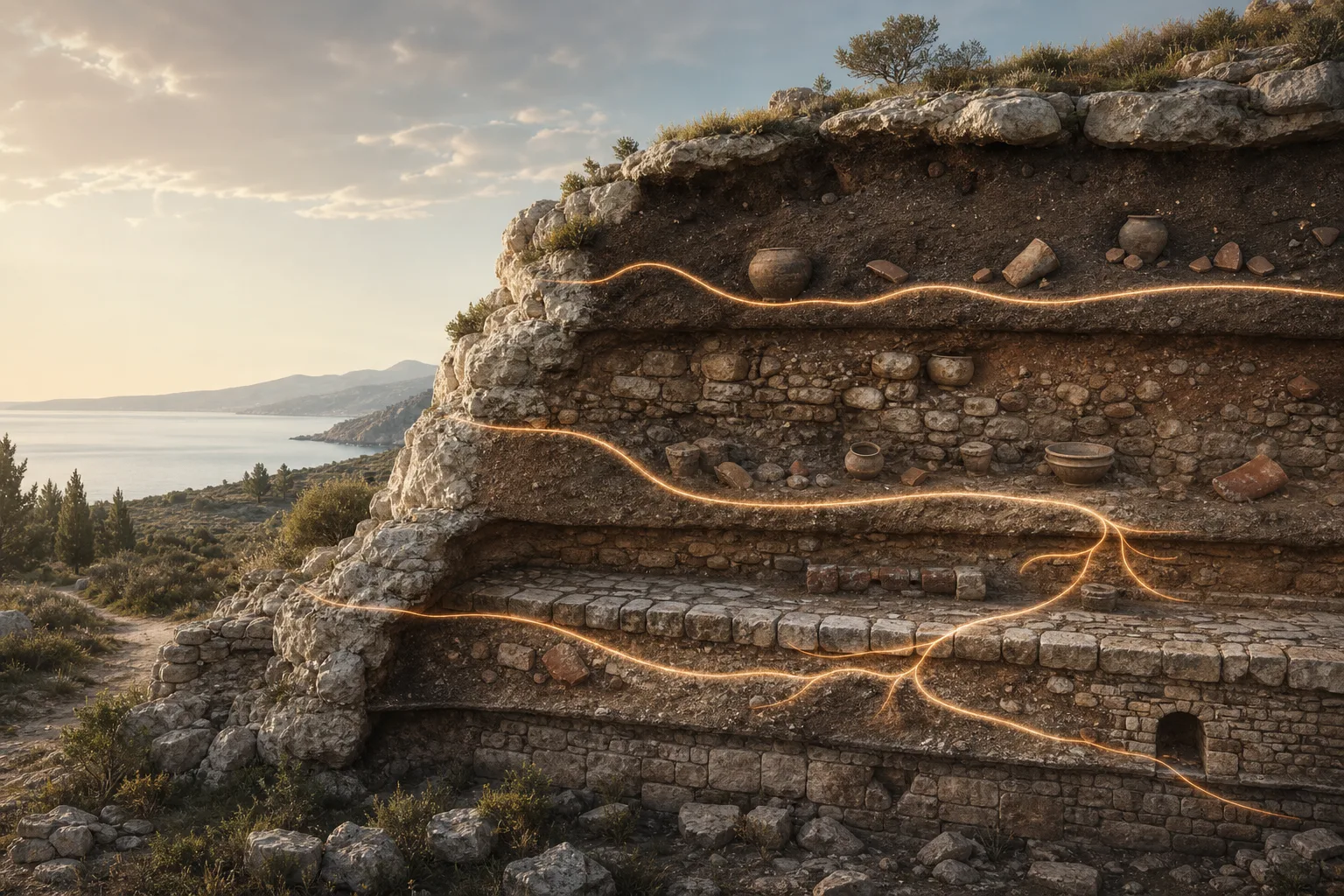
Editorial note: the hero and section artwork in this article was generated with AI as conceptual illustration. None of the artwork reproduces a scientific figure, an ancient individual, or a measured migration route.


