
Notable Matches · Iconic discoveries
The Tylos-Era Bahrainis
The Tylos-Era Bahrainis (c. 300-650 CE · Madinat Hamad burial mounds, Northern Governorate, Bahrain): what the published ancient DNA shows, 3 sequenced genomes, and how close your own Global25 coordinates come. Free with every Ancestry Map.
The dossier
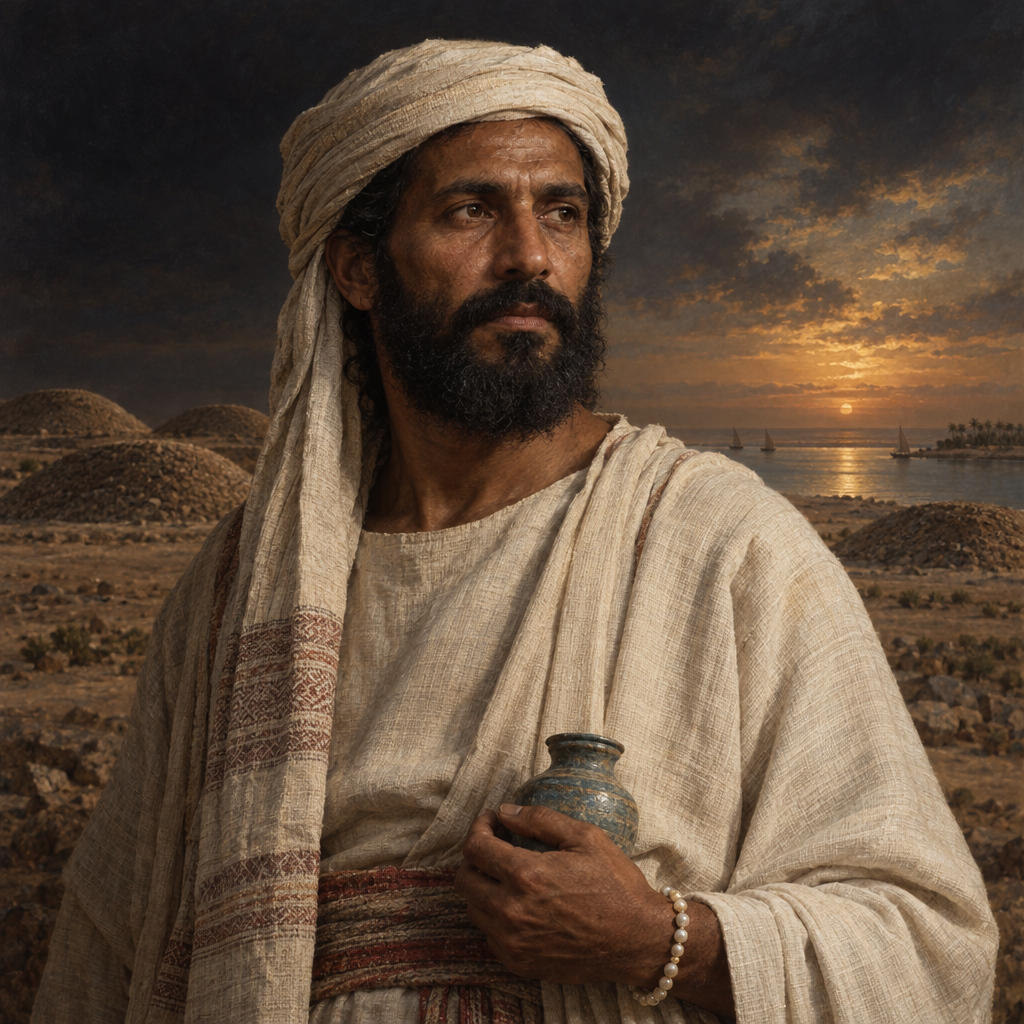
- Catalog tier
- Iconic discoveries
- Period
- c. 300-650 CE
- Found
- Madinat Hamad burial mounds, Northern Governorate, Bahrain
- Sequenced genomes
- 3 (MH3_LT.SG, MH2_LT.SG, MH1_LT.SG)
Who they were
Bahrain's burial-mound fields are among the largest in the world, and from the Madinat Hamad mounds came the island's first ancient genomes, recovered with the Bahrain Authority for Culture and Antiquities. These three lived in the Late Tylos period, in the age of the Sasanian empire. Their ancestry mixes Anatolian, Levantine and Iran and Caucasus-related sources, and sits closer to present-day Iraqis and Assyrians than to today's Arabians. Three of the four Bahrainis studied carry the malaria-protective G6PD Mediterranean variant, corroborating evidence that malaria was endemic in eastern Arabia. One individual's long runs of homozygosity point to parents related at about the level of second cousins. They are islanders of the Gulf in the last centuries before Islam.
The genome-wide data behind this entry was published in Ancient genomes illuminate eastern Arabian population history and adaptation against malaria.
How your distance is measured
Every Ancestry Map includes the free Notable Matches lens: your coordinates are compared to every sequenced member of every catalog entry, and the distance to the closest member is reported, a Euclidean distance in the same 25-dimensional space the Distance lens uses. Because these are a small group of real individuals, not a population average, distances naturally run larger than population distances. That is expected, not a poor result. And one thing is never claimed: a small distance means similar ancestry composition, not that the Tylos-Era Bahrainis are your ancestor. See how it looks in the live demo or read about Ancestry Map, the full Global25 report.
Questions
Who were the Tylos-Era Bahrainis?
The Tylos-Era Bahrainis (c. 300-650 CE, Madinat Hamad burial mounds, Northern Governorate, Bahrain) are one of the Iconic discoveries entries in our Notable Matches catalog, represented by 3 sequenced ancient genomes published in the study "Ancient genomes illuminate eastern Arabian population history and adaptation against malaria".
What does "matching" the Tylos-Era Bahrainis mean?
Your Global25 coordinates are compared to the entry's sequenced members and the distance to the closest one is reported, a Euclidean distance in the same 25-dimensional reference space the Distance lens uses. A notable entry is one person or one small burial group, not a population average, so distances naturally run larger than population distances.
Are they my ancestor?
No, and no DNA test can show that. A small distance means your genome sits near theirs in a shared reference space: similar ancestry composition, not descent. Ancestrify never claims a notable individual is your ancestor or relative.
How do I see my own distance to the Tylos-Era Bahrainis?
Notable Matches is a free lens on every Ancestry Map, never sold separately. Order Ancestry Map, our Global25 analysis (29.99 EUR), and your report ranks your coordinates against the full catalog, with a portrait, dossier and map for every entry. The public demo shows the lens with example data.
More from the catalog
The catalog holds every published entry across three tiers. Browse the full Notable Matches directory. Nearby entries:
The Moche of Huaca Cao Viejoc. 200-600 CE
The Gepid Kingdomc. 450-560 CE
The European Hun Elites5th century CE
The Pictsc. 420-630 CE
The Silla Nobles of Gyeongsanc. 300-500 CE
The Early Bavariansc. 500-600 CE
The Huns of the Tian Shanc. 150-600 CE
The Anglo-Saxonsc. 450-750 CE
The Romans of Naissusc. 250-500 CE
The Ancient Highlanders of the Bogotá Altiplanoc. 100 BCE-800 CE
The Lovelock Cave Peoplec. 150-1400 CE
The Kofun-Period Japanese of Iwadec. 570-630 CE