

The people buried at sampled Punic sites across the central and western Mediterranean carried surprisingly little ancestry directly traceable to the Phoenician Levant. Although their communities used Phoenician-derived language, religion, artifacts, and institutions, most sampled ancestry resembled people from Sicily and the Aegean. North African-related ancestry supplied much of the remainder and increased under Carthage's influence.
This does not mean Phoenicians never sailed west or that Punic culture was somehow unreal. It shows that a cultural world founded through Levantine maritime networks grew mainly by incorporating and connecting people already living around the central and western Mediterranean. Culture can spread, persist, and transform without population-wide biological replacement.
That is the central result of the 2025 Nature study Punic people were genetically diverse with almost no Levantine ancestors. The researchers generated genome-wide data from 210 ancient people, including 196 individuals from 14 sites traditionally classified as Phoenician or Punic across the Levant, North Africa, Iberia, Sicily, Sardinia, and Ibiza.
The short answer: sampled Punic communities from the sixth to second centuries BCE were genetically cosmopolitan and predominantly Sicilian/Aegean-like rather than transplanted Levantine populations. North African ancestry was widespread but remained a minority in every sampled site, even Carthage. These are ancestry patterns among excavated individuals—not a DNA test for who was culturally Phoenician or Punic.
Who were the Phoenicians and Punic peoples?#
Phoenician culture emerged among coastal city-states of the Levant, including Tyre, Sidon, and Byblos. During the early first millennium BCE, merchants and settlers built maritime networks extending through Cyprus, North Africa, Sicily, Sardinia, the Balearic Islands, and Iberia. Their writing system influenced Greek and ultimately many later alphabets.
Carthage, established on the North African coast in present-day Tunisia, became the dominant western Mediterranean power by the sixth century BCE. Greek and Roman writers called communities associated with Carthage “Punic,” a term historians now use for a diverse cultural and political world connected by Phoenician-derived language and practices.
Older narratives often imagined this expansion as a chain of colonies populated mainly by migrants from the Levant. Archaeologists have long argued for more complicated processes: local communities adopted, negotiated, and remade Phoenician objects, rituals, foods, and institutions. Ancient DNA now adds biological evidence for that local participation.
What the 2025 Punic DNA study sampled#
The project reported genome-wide data from 210 individuals. Of these, 196 came from 14 sites traditionally identified as Phoenician or Punic; the broader dataset also included an early Iron Age person from Algeria and comparative individuals from related Mediterranean settings. The geographical span included:
- The Phoenician homeland in the Levant.
- Carthage and other North African contexts.
- Sicilian sites including Motya and Lilybaeum.
- Sardinia, Ibiza, and several Iberian communities.
Coverage varied. The paper's qpAdm overview presents models for 140 Phoenician-Punic individuals, while a higher-coverage ADMIXTURE analysis used 122 people sequenced at more than 100,000 targeted SNPs. These different totals reflect analytical thresholds, not contradictory sample claims.
Most western individuals date from the sixth to second centuries BCE, after Phoenician contact and settlement had already been established for generations. The sample is therefore much better at describing the mature Punic world than the earliest foundation events. It cannot measure how many first-generation Levantine founders arrived centuries earlier.
The main ancestry pattern was Sicilian and Aegean-like#
Across Punic sites, the most common profile resembled Bronze and Iron Age populations from Sicily and the Aegean. Formal models used ancient groups as proxies rather than modern national populations. “Sicilian/Aegean-like” therefore describes shared allele patterns, not a claim that every individual came directly from Sicily or Greece.
The pattern was remarkably consistent across distant regions. People at Punic sites in North Africa, Sardinia, Sicily, Ibiza, and Iberia showed high ancestry diversity within each community, yet the same broad sources recurred. This suggests that the western Punic network itself moved people around, creating communities with connected demographic histories.
Levantine Phoenician ancestry was rare in the available western sample. That conclusion is strongest for the later Punic period and weaker for early settlement phases, which are sparsely represented. Even a small founding population can transmit language, religious practices, and political institutions while leaving a limited genome-wide contribution centuries later.
The result complements research on Minoan and Mycenaean mobility, which shows how connected Aegean populations had already been long before Punic expansion. It also helps contextualize the mixed military world seen in ancient DNA from the Battle of Himera, fought between Greek and Carthaginian forces in Sicily.
North African ancestry and the rise of Carthage#
North African-related ancestry formed much of the balance in western Punic individuals. Its distribution fits the growing power and connectivity of Carthage, but it was a minority ancestry contribution in every sampled site—including Carthage itself.
That last point is easily misread. It does not make ancient Carthaginians “non-African,” because geography, civic membership, culture, and statistical genetic affinity answer different questions. Carthage was a North African city whose residents could have multiple ancestry histories. Nor does the finding imply an unmixed local population outside Punic settlements; North Africa had its own deep structure and long history of Mediterranean and Saharan exchange.
Research on the first Old Kingdom Egyptian genome and Green Sahara pastoralists shows why “North African ancestry” is not one timeless component. The available proxies represent distinct places and periods, and many ancient populations remain unsampled.
Genetic relatives reveal real movement across the sea#
Population-level affinities show broad patterns, but shared identity-by-descent segments can identify biological relatives. The Punic study detected a fifth- to seventh-degree relationship between two people buried in Sicily and North Africa, separated by hundreds of kilometres of sea. That relationship is distant enough to require careful statistical treatment, yet it offers unusually personal evidence that families participated in Mediterranean mobility.
At Villaricos in Iberia, people in one Punic tomb formed an endogamous community with elevated parental relatedness. Shared genetic segments also connected individuals across burial areas and sites. These discoveries complicate any vision of ports filled only with unrelated transient merchants. Punic networks could include durable kinship, household, and community ties.
The details should not be generalized to every settlement. One tomb may reflect a family, status group, or local marriage practice rather than a civilization-wide rule. Ancient cemeteries capture selected people, and funerary customs decide whose DNA survives.
Culture traveled differently from genes#
The study is a clear demonstration that language and material culture are not genetic packages. A person could speak a Phoenician-derived language, worship Punic deities, use characteristic ceramics, and participate in Carthaginian institutions without having recent Levantine ancestors. Conversely, a person with Levantine-related ancestry did not automatically hold a Phoenician identity.
Several processes could create this mismatch:
- A relatively small number of Levantine founders established commercial or religious institutions.
- Local people joined settlements, intermarried, and adopted Punic practices.
- People moved between western Punic communities, spreading a mixed Sicilian/Aegean and North African profile.
- Later demographic growth diluted an initially larger founder contribution.
- Cremation and uneven preservation removed parts of the early population from the recoverable sample.
The genetic study cannot choose one universal mechanism. Different ports likely followed different histories. It demonstrates the resulting pattern, while archaeology must reconstruct how it emerged.
What “almost no Levantine ancestry” does—and does not—mean#
The paper's title describes the sampled central and western Punic populations, not every individual ever called Phoenician. Levantine Phoenicians in the homeland did carry local Levantine ancestry, and western archaeological links to the Levant are abundant. The unexpected finding is the weak demographic contribution visible in later western genomes.
It also does not imply that Punic people were “really Greeks,” “really Sicilians,” or members of any modern ethnic category. Genetic models use sampled prehistoric populations because they approximate ancestry branches. They do not recover language, citizenship, religion, or self-identification.
This is why ancestry percentages should be interpreted as model outputs. The team's qpAdm analyses compared alternative combinations of ancient sources; ADMIXTURE displayed mathematical components; PCA summarized variation; and identity-by-descent analysis tested recent shared relatives. Agreement across methods supports the broad result, but none assigns an ancient passport.
The most important limitations#
| Limitation | Why it matters |
|---|---|
| Most western samples date to the sixth–second centuries BCE | Early Phoenician founders are underrepresented. |
| Preservation and burial customs are uneven | Inhumed people may differ from those cremated or not excavated. |
| Sites contribute different sample sizes | A few cemeteries can disproportionately shape regional patterns. |
| Ancient source populations are proxies | “Sicilian,” “Aegean,” “North African,” and “Levantine” are model labels, not identities. |
| Punic culture covered centuries and vast distances | No single genetic profile can define all communities. |
| Genetic kinship is not social kinship | DNA cannot reveal how relatives understood or organized their relationships. |
The study also focuses on recoverable human remains. Enslaved people, sailors who died elsewhere, mobile traders, children, and groups with different funerary practices may be missing or poorly represented.
Frequently asked questions about Phoenician and Punic DNA#
Did Phoenicians have no genetic impact outside the Levant?#
The study found little Levantine Phoenician contribution in sampled western Punic communities, not none everywhere. Early settlers are sparsely sampled, and some individuals and places may preserve Levantine-related ancestry.
What ancestry did Punic people have?#
Most sampled individuals were best represented by ancestry similar to ancient Sicily and the Aegean, with a substantial but minority North African-related contribution. Communities were highly diverse, so there was no single Punic genetic profile.
Were Carthaginians genetically North African?#
They carried North African-related ancestry, but it was a minority component in the sampled Carthage group. Calling people “Carthaginian” describes a city and political-cultural identity, not an ancestry percentage.
How many people were analyzed?#
Researchers generated genome-wide data from 210 ancient individuals, including 196 from 14 Phoenician- and Punic-associated sites. Particular analyses used smaller subsets after coverage and context filtering.
Did DNA prove Punic culture spread without migration?#
No. The genomes show extensive movement, including cross-Mediterranean biological relatives. What they challenge is mass migration directly from the Levant as the main source of later western Punic ancestry.
Can a consumer DNA test identify Phoenician ancestry?#
Not with historical certainty. Consumer labels depend on present-day references and proprietary models. No segment of DNA independently records Phoenician language, religion, or civic identity.
A Mediterranean network made by many peoples#
The Punic genetic record replaces a simple colony story with a network. Levantine seafarers helped establish institutions and connections, but the communities that carried Punic culture forward drew most of their sampled ancestry from the central and western Mediterranean. North Africans, Sicilian- and Aegean-related people, and others became participants in a shared world.
That is not evidence against cultural continuity. It is evidence that continuity can be social. The Punic world endured precisely because ideas, practices, families, and political relationships could cross ancestry boundaries.
Primary sources and data#
- Ringbauer, H. et al. (2025). Punic people were genetically diverse with almost no Levantine ancestors. Nature 643, 139–147. DOI: 10.1038/s41586-025-08913-3.
- Raw sequence data: European Nucleotide Archive PRJEB86313.
- Processed genotype data and documentation, Harvard Dataverse.
- Moots, H. M. et al. (2023). A genetic history of continuity and mobility in the Iron Age central Mediterranean. Nature Ecology & Evolution.
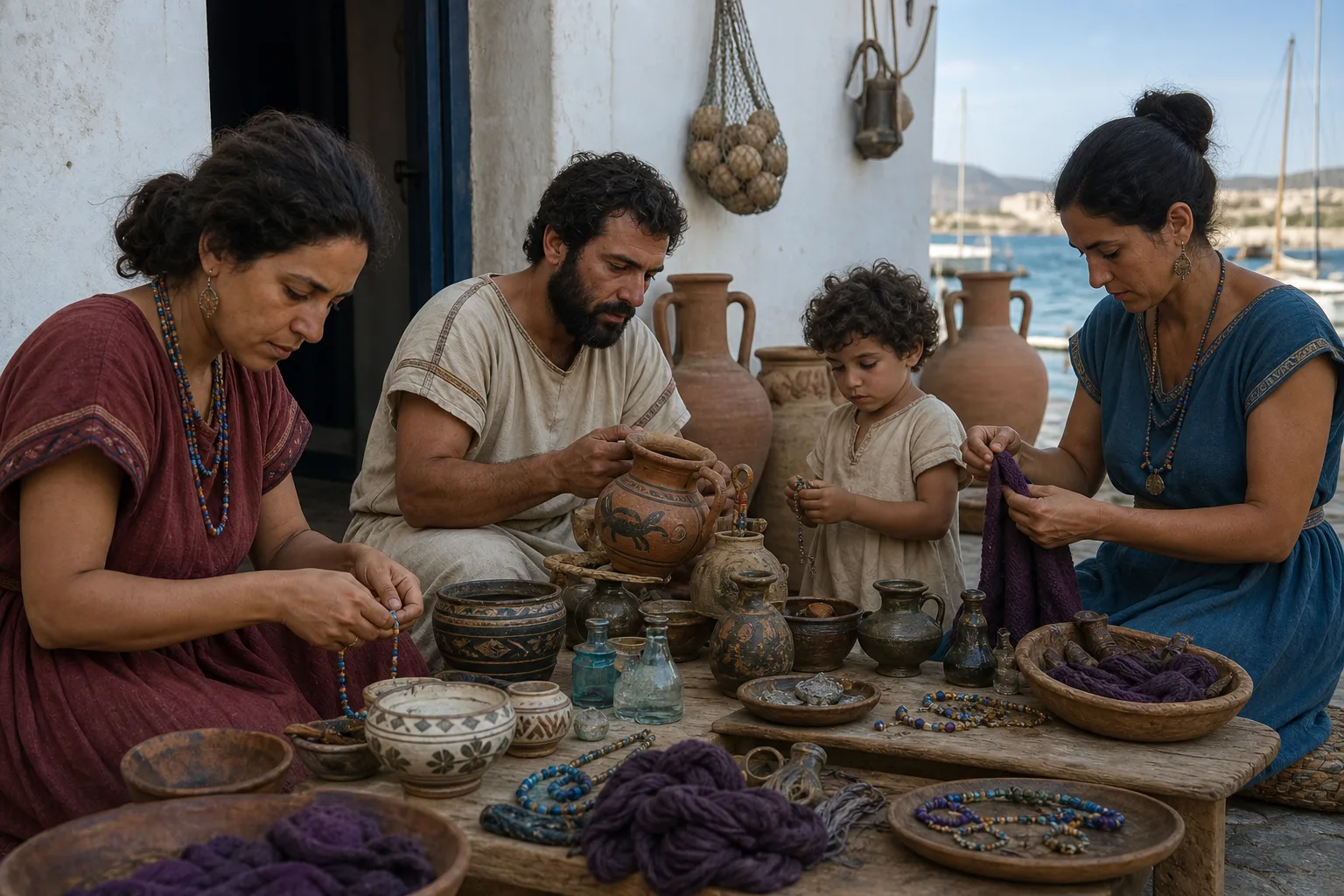
Editorial note: the hero and section artwork in this article was generated with AI as a realistic archaeological interpretation. It does not depict a specific excavated harbor, reconstruct sampled individuals, or encode measured ancestry proportions.


