

Ancient DNA from Rome's former frontier in southern Germany shows that the empire's fall was followed by regional movement and intermarriage, not a clean replacement of Romans by northern “barbarians.” People with northern European-related ancestry were already present near the frontier before Roman administration collapsed. After about 470 CE, they mixed extensively with genetically diverse people moving out of Roman towns and military communities.
Within roughly 150 years, these groups formed populations genetically closer to later Central Europeans. Their artifacts rarely separated them by ancestry, and reconstructed families reveal flexible inheritance, mostly monogamous unions, avoidance of close-kin marriage, and continuity with Late Roman social practices.
The evidence comes from the 2026 Nature paper Demography and life histories across the Roman frontier in Germany 400–700 CE. The researchers generated 258 ancient genomes, analyzed them with 2,500 other ancient and 379 present-day genomes, measured strontium isotopes, and reconstructed pedigrees in exceptionally well-sampled cemeteries.
The short answer: northern migration mattered, but much of the decisive mixing happened locally after Roman institutions weakened. Descendants of northern newcomers and mobile Roman provincial communities lived, married, and were buried together. The resulting society retained important Roman family customs even as its language, politics, and material world changed.
What did the Roman frontier study analyze?#
The project focused on two former frontier regions in present-day southern Germany:
- The Danube–Isar region of Bavaria, especially the cemeteries at Altheim and Weilheim.
- The Rhine–Main region, especially Büttelborn and Mömlingen.
Both had belonged to the Roman Empire. The Rhine frontier shifted west during the late third century, while the Danube–Isar area remained in the province of Raetia Secunda until western imperial control dissolved in the fifth century. Ostrogothic and then Frankish power followed, but written sources reveal little about ordinary rural families.
The project reports 258 newly generated genomes at a median depth of 2.25×, including 221 Early Medieval people from its main study regions. The wider comparison also drew on people from nearby Late Antique sites and sites as far away as Serbia, the Danube Delta, Anatolia, and Italy. Another 2,500 ancient genomes placed the new data in broader context.
At Altheim, 114 strontium-isotope measurements helped identify people who likely grew up outside the local geological zone. This combination matters: genomes describe ancestry and biological relationships, while tooth isotopes provide evidence about individual childhood mobility.
Row graves record a changing society#
From about 450 CE, furnished row-grave cemeteries appeared across former Roman frontier lands from northern France to Hungary and northern Italy. Graves might contain brooches, belts, jewelry, weapons, pottery, or glassware. Older scholarship often interpreted these objects as straightforward ethnic markers for peoples such as Alemanni, Franks, or Bavarians.
The genomic results make that reading difficult. At Altheim, ancestry and grave furnishings were largely decoupled. People at opposite ends of the genetic distribution received overlapping treatments, and families of mixed ancestry shared the same cemetery. Objects could express age, gender, status, fashion, or local affiliation without revealing biological origin.
The cemeteries instead record small agricultural communities—people raising livestock and crops while connected to regional networks. Their dead preserve the transition because few contemporary settlements or ordinary lives are described in writing.
Northern ancestry arrived before Rome fully disappeared#
The earliest Altheim burials began around 414 CE. Several individuals there and at Pförring and Kemathen had ancestry related to northern Europe and predated the classic row-grave horizon. One Altheim burial dates to 412–414 CE; another falls around 400–425 CE.
Long identical-by-descent segments also connect individuals across the Danube–Isar region, showing recent family relationships among communities. The evidence suggests that many people with northern ancestry were established along or within the Roman frontier by the late fourth century, perhaps with continued movement afterward.
Their historical circumstances remain uncertain. Some could have descended from soldiers or federate groups; others from peasants settled by Roman authorities. “Northern European ancestry” does not identify a tribe, legal status, or language. The source itself had already entered Roman-connected networks.
Roman southeastern European and central Italian-related ancestry was also present locally by the fourth century. At the military base of Azlburg, many people carried both, while others had northern components—consistent with the empire's geographically diverse recruitment.
The major shift began around 470 CE#
For its first decades, Altheim's sampled community was dominated by northern European-related ancestry and relatively limited mixing. Around 470 CE, people with profiles typical of neighboring Roman towns, forts, and provincial communities began entering the cemetery in greater numbers.
The timing coincides with the breakdown of western Roman state structures. The authors propose that weakening military, economic, and legal systems loosened bonds tying dependent peasants and workers to estates. Merchants, laborers, former soldiers, displaced farmers, and small kin groups could move into rural communities. Large new invasions are not necessary to explain most of the post-470 pattern.
For people buried at Altheim between 470 and 620 CE, ancestry-painting models attributed more than three-quarters of the signal to four broad sources:
| Modeled source | Approximate contribution |
|---|---|
| Northern Europe | 34% |
| Northern Britain | 9% |
| Roman southeastern Europe | 20% |
| Iron Age central Italy | 16% |
The remaining model included smaller Central European, Baltic, and Pontic-steppe-related sources. These percentages describe a population and depend on available proxy samples. “Northern Britain” or “Iron Age central Italy” marks genetic affinity to a reference group, not a claim that a specific fraction of Altheim residents arrived directly from those places.
The ancestry linked to Roman southeastern Europe may partly reflect the Balkans' role as a recruitment center for the Roman military. It connects this German frontier story to the genetic history of Roman and Early Medieval Balkans.
Most movement was regional, not transcontinental#
Strontium isotopes indicate that most people at Altheim grew up locally. The earliest six detected non-locals were women, and the estimated proportion of non-local individuals declined from about 35% around 470 CE to 7% by 540 and none by 620. The credible intervals are wide, particularly for the earliest phase.
This pattern fits incoming marriage partners and shorter-distance movement from north of the Danube. It does not exclude exceptional long journeys. One Altheim man dating to approximately 528–553 CE carried mostly East Asian and western-steppe-related ancestry and shared long DNA segments with people at Berel in present-day Kazakhstan.
Such individuals are historically important but demographically rare. The core transformation occurred through local and regional intermarriage among ancestries already represented near the frontier.
Long IBD segments connected 37 people in the Rhine–Main and Danube–Isar regions with contemporaries more than 200 kilometers away—from northern Germany, the Netherlands, and England to Austria, Hungary, Croatia, and Viminacium in Serbia. Likely second cousins were buried over 270 kilometers apart. The pattern suggests mobile individuals and small family networks, not whole populations traveling as sealed ethnic units.
Intermarriage created a new local population#
Pedigrees at Altheim show northern-ancestry individuals forming families with people carrying Roman provincial ancestry. The researchers developed filia, a method that uses sampled relatives to estimate genetic affinity for unsampled parents and ancestors. This made integration visible even when part of a family tree was missing from the cemetery.
The results show immediate intermarriage after the demographic shift. Over the sixth century, ancestry differences remained visible between individuals but steadily declined. By the early seventh century, the sampled population approached the genetic profile characteristic of later Central Europe, while retaining a modest southern and southeastern Roman-related contribution.
That convergence should not be mistaken for the birth of a modern nation. Modern populations have another 1,400 years of migration and drift behind them. It means only that the distinctive mixture already resembled a major component of later regional ancestry.
The process also varied locally. Rhine–Main communities had somewhat more British-, eastern-central-European-, and Baltic-related ancestry, while Danube–Isar communities carried more central-Italian-related ancestry. People with unusual profiles persisted into the eighth century at some sites.
Family life after the empire#
Two new computational tools let the paper move beyond population history. Chronograph combined radiocarbon dates, grave chronology, age at death, and genetic relationships to estimate individual birth and death dates. Pedigrees then reconstructed household and inheritance behavior.
The study estimated:
- An average generation interval of about 28 years.
- Life expectancy of 39.8 years for women and 43.3 years for men, conditional on the sampled demographic model.
- Nearly one-quarter of children losing at least one parent by age ten.
- Most children nevertheless having a living grandparent during childhood.
These are modeled averages from cemetery samples, not exact biographies or modern life-expectancy statistics. Infant and child mortality was high, and cemetery preservation affects who is visible.
Pedigrees suggest nuclear-family households and mostly lifelong monogamy. Among Altheim and Büttelborn families, researchers identified 68 probable single-partner unions and five people who had children with multiple partners; even those five could fit serial monogamy after a partner's death.
No close-incest or levirate unions—marriage to a deceased brother's widow—were detected. Those practices align with Late Roman and Christian norms that increasingly promoted monogamy and prohibited close-kin marriage.
Descent was flexible rather than strictly patrilineal#
Family lines more often continued through sons: 20 cases at Altheim and nine at Büttelborn, compared with nine and two through daughters. Women shared more long-distance IBD with people at other sites, while men were more related within each cemetery. This supports generally patrilocal residence, with women often joining a partner's community.
Yet the pattern was not rigid. Daughters continued family lines when sons did not, some men joined women's communities, and both mitochondrial and Y-chromosome diversity were too high for strict patriliny. The authors describe a flexible patrilineal or bilateral system.
That flexibility resembles Late Roman inheritance practice, which increasingly recognized daughters and maternal kin while often favoring sons, especially for land. Political rule changed, but family organization preserved important Roman-era patterns. Compare this with the strongly matrilocal Iron Age British communities, which structured movement in the opposite direction.
Did northern migration bring Germanic languages?#
Networks among people with northern ancestry could have helped early Germanic dialects spread through regions where Latin and Gaulish had been important. Their numerical prominence may have favored the development of pre-literary Old High German.
The study treats this as a historical possibility, not a genetic finding. DNA cannot identify the language spoken at Altheim or tell when one household changed languages. Roman social norms, Christian practice, and northern vernaculars could all persist in the same mixed families.
Important limitations#
| Limitation | Why it matters |
|---|---|
| Cemeteries are not population censuses | Burial access, preservation, and changing ritual affect the sample. |
| Altheim supplies exceptional detail | Other frontier regions may have followed different timelines. |
| Ancestry sources are broad proxies | Model labels do not prove a person's birthplace or identity. |
| Isotope origins are not unique | Similar geology can occur in several regions. |
| Pedigrees contain unsampled people | Family rules are inferred from incomplete biological networks. |
| Language is not encoded in DNA | Links to Germanic speech require linguistic and historical evidence. |
Frequently asked questions#
Did northern invaders replace Roman people in southern Germany?#
No. Northern-related ancestry was important, but it was present before the final collapse of Roman rule and mixed with diverse Roman provincial groups. Much post-470 movement appears regional and family-based.
How many ancient genomes were generated?#
The study produced 258 genomes, including 221 Early Medieval individuals. They were analyzed with around 2,500 published ancient and 379 present-day genomes.
What happened around 470 CE?#
People with ancestry typical of Roman towns and military sites increasingly entered rural row-grave communities. This coincided with weakening state structures and was followed by extensive intermarriage.
Were artifacts linked to ancestry?#
Usually not at Altheim. People with different ancestry profiles received similar grave treatment, showing that brooches, weapons, and burial styles cannot be treated as genetic ethnic labels.
Were post-Roman families strictly patrilocal?#
They were mostly but flexibly patrilocal. Family lines more often continued through sons and women more often moved, but daughters sometimes continued lineages and some men joined a wife's community.
Did these genomes identify the first Germans?#
No. They reveal population formation in southern Germany, not the origin of a timeless German people. Modern nationality and early medieval ancestry are different categories.
Rome ended, but Roman society did not vanish#
The frontier genomes replace a dramatic collision between two biological peoples with a finer-grained history. Northern mobility had already reshaped the borderlands while Rome still functioned. When imperial structures failed, people from towns, forts, estates, and rural settlements moved and married across ancestry lines.
Their descendants combined northern and Roman provincial ancestry, new row-grave traditions, flexible descent, Christianizing family rules, and long-distance kin networks. Political institutions fell faster than the relationships and customs built beneath them.
Primary sources and further reading#
- Blöcher, J. et al. (2026). Demography and life histories across the Roman frontier in Germany 400–700 CE. Nature 654, 984–993. DOI: 10.1038/s41586-026-10437-3.
- Veeramah, K. R. et al. (2018). Population genomic analysis of elongated skulls reveals extensive female-biased immigration in Early Medieval Bavaria. PNAS 115, 3494–3499.
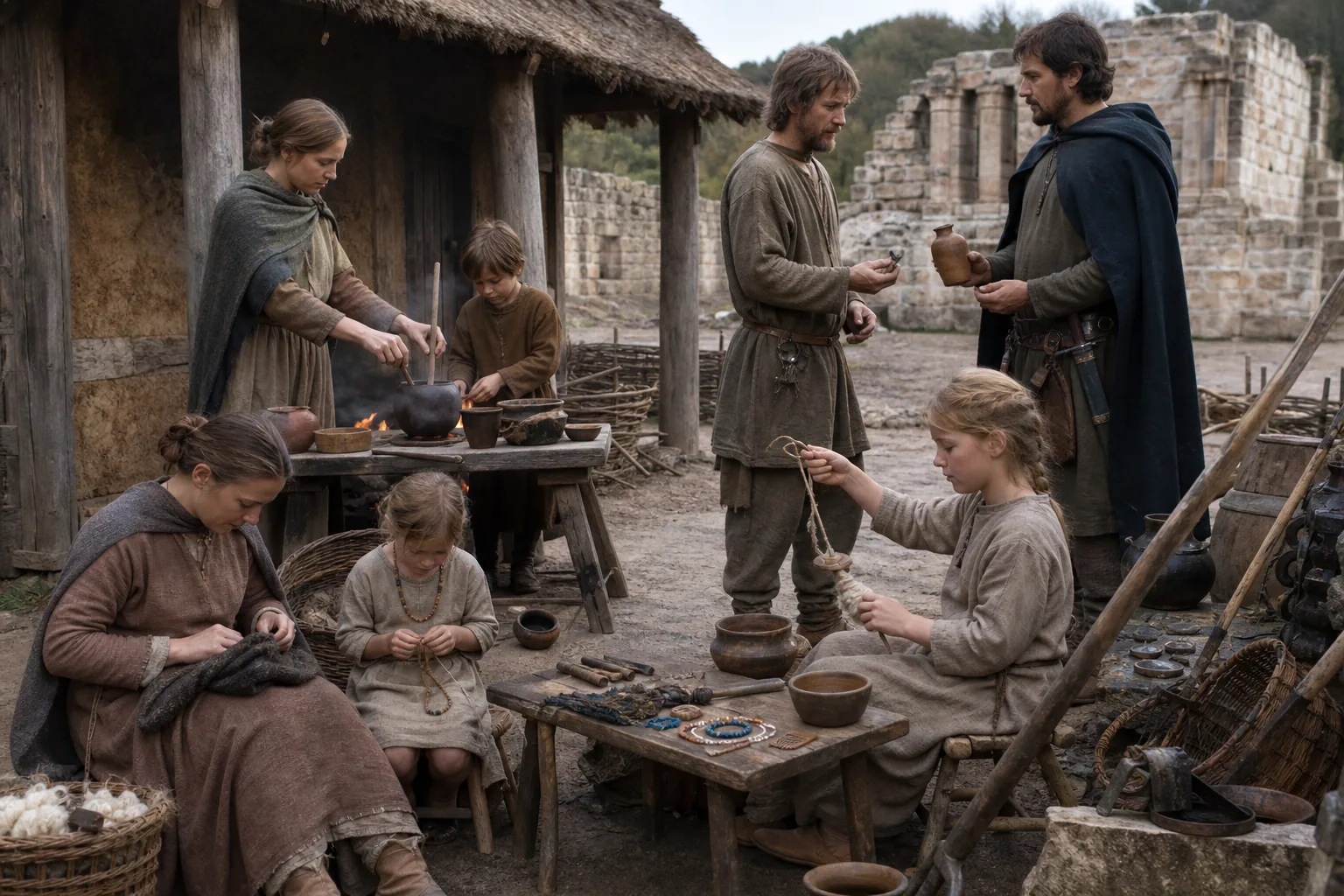
Editorial note: this article was written as an evidence-led synthesis of the cited research. Its hero and section artwork was generated with AI as a realistic but conceptual archaeological scene; it does not reproduce a scientific figure, portray an excavated person or provide documentary evidence.


