

Ancient DNA from Iron Age Britain reveals communities in which women often remained close to their maternal families while men moved in from elsewhere. At Winterborne Kingston in Dorset, more than two-thirds of the sampled people descended through one rare maternal lineage, while paternal lineages were strikingly diverse. Similar patterns across Britain suggest that matrilocal residence was widespread rather than an isolated local custom.
The result does not prove that Iron Age Britain was a matriarchy. Matrilocality describes where couples lived after forming a union; it does not by itself identify who owned property, made political decisions, or held the highest status. Nor does a dominant maternal lineage mean the community lacked newcomers. The paternal and genome-wide evidence indicates sustained movement, including connections across the English Channel.
Published in Nature as Continental influx and pervasive matrilocality in Iron Age Britain, the study generated 57 new ancient genomes and combined them with hundreds of previously published genomes. It reconstructs household organization and regional mobility at a scale that artifacts and classical writers cannot provide alone.
The short answer: sampled Iron Age communities were often anchored by female kin. Men more frequently moved between communities, and people along the south coast also maintained substantial biological connections with continental Europe. These findings support matrilocal residence, not a genetically uniform “Celtic people” or automatic proof of female political rule.
What did the Iron Age Britain study analyze?#
Researchers sequenced 55 people from cemeteries at Winterborne Kingston, Dorset, plus two richly furnished women from Maiden Newton and Langton Herring. Winterborne Kingston's core burial phase spans approximately 100 BCE to 100 CE, around the period associated archaeologically with the Durotriges of southern Britain.
The study then compared these people with genome-wide and uniparental data from other British and continental sites. For population-level analyses, the team assembled 534 Iron Age genomes, while identity-by-descent methods placed communities in networks extending across Britain and coastal Europe.
Several types of evidence answered different questions:
- Autosomal DNA identified relatives and broader ancestry.
- Mitochondrial DNA followed maternal lines.
- Y chromosomes followed paternal lines among genetic males.
- Long identical-by-descent segments connected distant relatives and sites.
- Radiocarbon dates and burial archaeology placed those relationships in time and social context.
The 57 new genomes are not a national census. Formal Iron Age cemeteries are relatively uncommon in Britain because cremation, excarnation, wetland deposition, and other treatments often left few recoverable skeletons. Dorset is unusually visible because Durotrigian communities used flexed inhumation cemeteries.
One maternal lineage dominated Winterborne Kingston#
About three-quarters of the Winterborne Kingston individuals were biologically related to someone else in the cemetery. More than two-thirds carried variants of a rare mitochondrial lineage called U5b1, inherited from one maternal ancestor. Small new mutations within that lineage helped the researchers order descendants across generations.
The Y chromosomes told the opposite story. Related men belonged to several paternal lineages, implying that they or their recent male ancestors arrived from other families. Women at the site also accumulated more genome-wide kinship connections than men and were more likely to carry the dominant maternal lineage.
Together, these observations fit matrilocality: partners joined or lived near the woman's community, while daughters tended to remain within the maternal group. They also fit an emphasis on female-line descent in burial. A cemetery centered on one matriline is not necessarily a society in which surnames, offices, or all property passed through women, because those institutions are not directly observable in DNA.
Why mitochondrial and Y-DNA must be combined#
Mitochondrial DNA is passed from mothers to children, but only daughters continue transmitting it. Most of the Y chromosome passes from father to son. Comparing their diversity can therefore reveal different patterns of female and male movement.
At Winterborne Kingston, low maternal diversity plus high paternal diversity fits incoming men. Either fact alone would be weaker. A common mitochondrial lineage could arise through a small founder population, while varied Y chromosomes could accumulate for other reasons. The dense autosomal pedigree and burial chronology make residence behavior the more convincing interpretation.
Uniparental markers still describe only two narrow lines within every family tree. Most ancestry recombines through all parents and grandparents. This is why a mitochondrial haplogroup cannot tell a modern customer how much “Durotrigian ancestry” they have—or whether an ancient carrier spoke a Celtic language.
Matrilocality appeared beyond Dorset#
The researchers tested whether Dorset was exceptional by looking across other British Iron Age sites. At Pocklington in East Yorkshire, 28 of 33 sampled individuals belonged to one of three dominant mitochondrial lineages. Across 156 archaeological sites considered for mitochondrial diversity, 12 of the 13 sites with lower diversity than Winterborne Kingston were in Britain.
The contrast between relatives within and between settlements was especially revealing. The team detected 30 pairs of relatives from different sites, generally separated by 2 to 40 kilometers. None of those pairs shared the same mitochondrial haplotype. Within a site, by contrast, 51% of relative pairs shared one.
At Dibbles Farm and Worlebury Hillfort near the Bristol Channel, eight relative pairs linked the two sites, but each settlement was dominated by a different maternal lineage. The pattern is consistent with men moving between communities whose women maintained separate local matrilines.
East Yorkshire sites east of the River Derwent shared unusually high levels of autosomal relatedness while preserving distinct maternal lines between sites. The result suggests a cohesive regional population structured into local female-centered groups.
Matrilocal does not automatically mean matriarchal#
The study has drawn attention because classical sources describe powerful British women. Cartimandua ruled the Brigantes for decades, while Boudica led the Iceni revolt against Rome. Women in some Durotrigian cemeteries also received more numerous and varied prestige objects than men.
Those facts are compatible with women holding substantial status, but they do not prove that all political authority was female. Roman writers often emphasized customs they considered exotic, and their descriptions are shaped by imperial stereotypes. Grave goods can express age, kinship, ritual identity, community investment, or status without revealing formal inheritance law.
Matrilocality and matriliny are also different. Matrilocality concerns residence near the woman's kin. Matrilineality organizes descent or group membership through women. Winterborne Kingston's burial structure suggests both female-local residence and an emphasis on maternal descent, but the genetic evidence cannot reconstruct every rule of the living society.
The responsible conclusion is that women were unusually central to community continuity—not that DNA has discovered a universal Celtic matriarchy.
Iron Age Britain had fine regional structure#
Long shared DNA segments clustered Iron Age sites into geographically meaningful networks in Scotland, Yorkshire, the Midlands, Dorset, and the southwest. Natural features such as rivers often matched genetic boundaries. The Dorset cluster overlapped the later distribution of Durotrigian-style coins.
This is evidence against treating “the Celts” as one homogeneous biological population. Celtic languages and related artistic traditions extended across broad regions, while local communities retained distinct genealogical networks. Classical tribal names may refer to political or territorial groups, but genomes cannot confirm membership for an individual burial.
The south and east of England showed lower levels of close-kin genomic sharing and runs of homozygosity than peripheral regions. That pattern suggests larger, more connected populations in highly productive agricultural zones where the first British proto-towns developed before Rome's conquest in 43 CE.
Cross-Channel migration continued during the Iron Age#
Britain was not genetically isolated. Some IBD-based communities included sites on both sides of the English Channel, and coastal southern Britain carried ancestry signals connected to continental populations.
The study detected an increase in Early European Farmer-related ancestry between the Early and Late Iron Age—from 39.7 ± 0.2% to 41.8 ± 0.5%—driven by the central and eastern Channel coast. The change is statistically significant but modest at a national scale. It becomes more informative alongside outlying individuals and long shared haplotypes.
Using SOURCEFIND, the researchers estimated that English and Welsh Iron Age populations retained an average of about 73% British Early Bronze Age-related ancestry; an alternative model gave 75%. Continuity was lower along the Channel, reaching an estimate of about 60% in Hampshire. These are population models, not literal fractions attached to every person.
The migration was likely continuous and two-way. One person from coastal Normandy carried an estimated 72% British Bronze Age-related ancestry, showing movement from Britain toward the continent as well as into the island. Hengistbury Head's major port and intensifying Roman activity in Gaul provide plausible historical settings for this mobility.
Did migrants introduce Celtic languages?#
The paper cannot determine what language any sampled person spoke. Earlier research identified larger-scale continental migration during the Middle to Late Bronze Age as one plausible route for Celtic languages, while this study adds evidence of later Iron Age movement along the Channel.
Genes and languages can spread together, separately, or at different speeds. A small mobile network can influence speech without replacing most ancestry; a large migration can adopt a local language. “Celtic” is therefore useful for linguistic and archaeological questions but should not be turned into a genomic percentage.
This distinction matters when the story moves into later centuries. The Anglo-Saxon migration study finds major post-Roman ancestry change in eastern England, while the Viking genome study shows that cultural identity could cross ancestry boundaries.
Important limitations#
| Limitation | Why it matters |
|---|---|
| Most new genomes came from one Dorset site | Winterborne Kingston provides exceptional depth, not a complete map of Britain. |
| Iron Age burial practices were uneven | Cremated or unburied people are underrepresented. |
| Mitochondrial and Y-DNA follow single lines | They cannot summarize a person's total ancestry. |
| Matrilocality is inferred from cemetery patterns | Residence rules could vary over time, class, and region. |
| Ancestry models require proxy sources | Percentages depend on reference samples and methods. |
| “Celtic” is not a genetic category | DNA cannot recover language, tribe, law, or political authority. |
Frequently asked questions#
Were Iron Age British communities matrilocal?#
Many sampled communities appear to have been. Women tended to remain in their maternal community while men moved between groups. The pattern is strongest at Winterborne Kingston and is supported by comparisons across Britain.
How many new genomes were sequenced?#
The study generated 57: 55 from Winterborne Kingston and one each from Maiden Newton and Langton Herring. Hundreds of published Iron Age genomes were used for wider comparisons.
What was the U5b1 maternal lineage?#
U5b1 is a mitochondrial haplogroup. More than two-thirds of the sampled Winterborne Kingston community descended from one rare branch of it, indicating long-lived maternal continuity at the cemetery.
Does matrilocality prove women ruled Iron Age Britain?#
No. It describes post-marital residence, not political power. Female-rich burials and historical women rulers add context, but neither DNA nor grave goods establish a universal matriarchy.
Were Iron Age Britons genetically isolated?#
No. Regional structure was strong, especially away from the south coast, but IBD and ancestry analyses reveal repeated movement across the Channel and between British communities.
Can DNA identify a person as Celtic or Durotrigian?#
No. Archaeology can associate a burial with a regional cultural context, and DNA can reveal ancestry and relatives. Neither alone determines an individual's language or chosen identity.
Women as anchors in a mobile world#
The Dorset genomes reveal an Iron Age society organized differently from many earlier European cemeteries. Maternal lines anchored local communities, while men connected them through movement and partnership. This family structure coexisted with trade, migration, and cross-Channel ancestry—not isolation.
Its deeper lesson is that residence and descent can be visible in ancient genomes without becoming biological destinies. The U5b1 lineage was important to one community, but it did not define every person in Iron Age Britain. Women, men, migrants, relatives, artifacts, and regional identities formed a social landscape much more varied than a single “Celtic DNA” label allows.
Primary sources and further reading#
- Cassidy, L. M. et al. (2025). Continental influx and pervasive matrilocality in Iron Age Britain. Nature 637, 1136–1142. Open full text.
- Patterson, N. et al. (2022). Large-scale migration into Britain during the Middle to Late Bronze Age. Nature 601, 588–594.
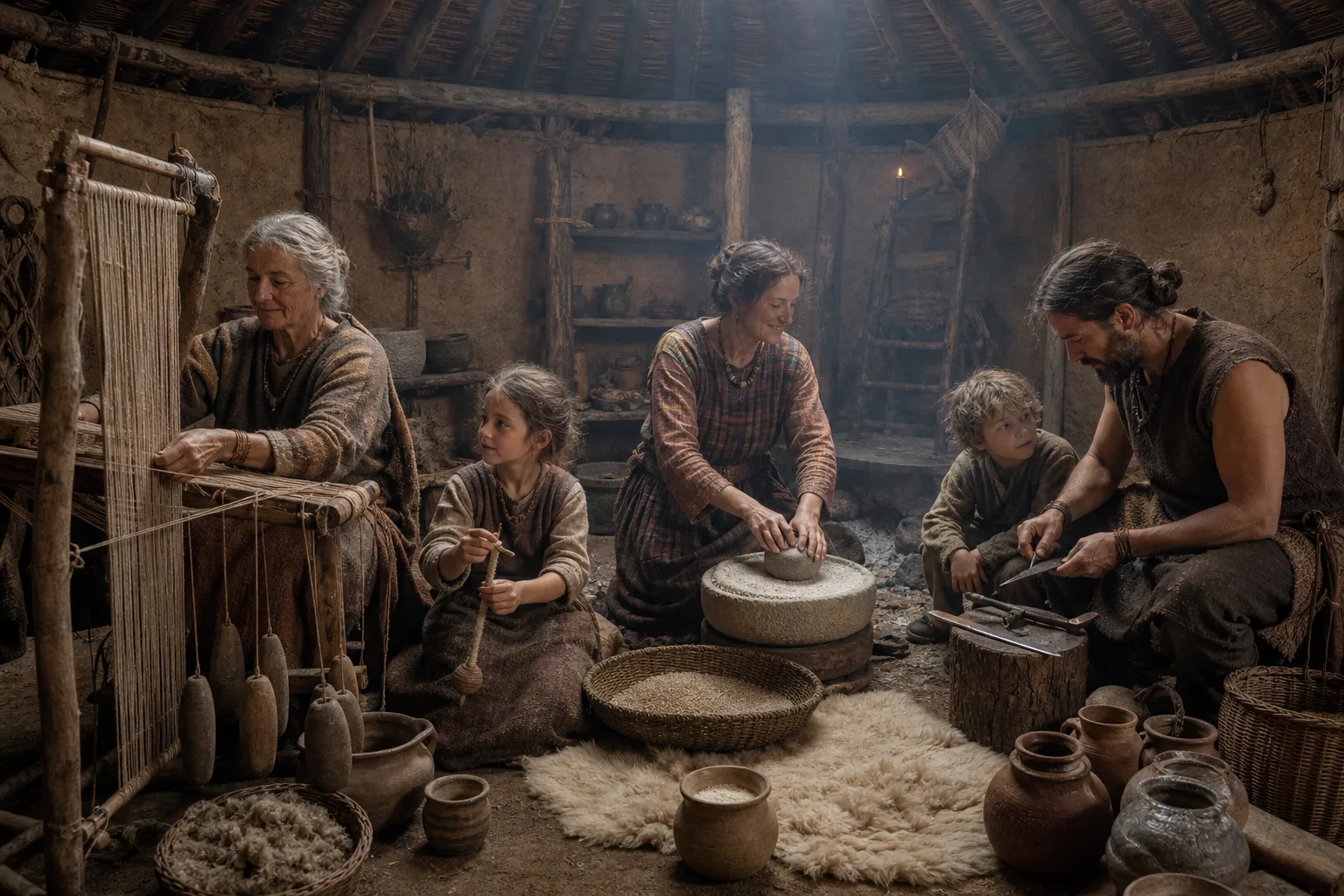
Editorial note: this article was written as an evidence-led synthesis of the cited research. Its hero and section artwork was generated with AI as a realistic but conceptual archaeological scene; it does not reproduce a scientific figure, portray an excavated person or provide documentary evidence.


