

The earliest sampled Tarim Basin mummies were not descendants of newly arrived western steppe herders, despite long-standing claims based on their clothing, material culture and physical appearance. Genome-wide DNA instead identifies a deeply rooted, genetically isolated population with ancestry connected to ancient northern Eurasian and Northeast Asian groups.
Their culture was anything but isolated. People of the Xiaohe horizon used wheat and millet, consumed dairy from cattle, sheep and goats, wore woven and felted clothing, and buried their dead with distinctive wooden artifacts. The contrast is the study's most important result: ideas, foods and technologies crossed population boundaries even when large-scale migration did not.
The evidence comes from the 2021 Nature study The genomic origins of the Bronze Age Tarim Basin mummies. Researchers examined remains from 33 people and obtained usable ancient genomes from 13 Early–Middle Bronze Age Tarim individuals dated to approximately 2100–1700 BCE, plus five Early Bronze Age individuals from neighboring Dzungaria dated to about 3000–2800 BCE.
The short answer: the 13 earliest sampled Tarim people formed a genetically homogeneous, bottlenecked population that could not be modeled with recent Afanasievo or other western Eurasian pastoralist ancestry. Statistical models instead fit them as roughly 72% ancestry related to an Upper Paleolithic northern Eurasian proxy and 28% related to an Early Bronze Age Baikal proxy. Those percentages describe deep ancestry models—not modern ethnic categories, race or literal two-population parent groups.
Why the Tarim mummies became controversial#
The Tarim Basin is an enormous desert depression in present-day Xinjiang, surrounded by mountain systems and crossed by oasis corridors. Its dry, salty conditions naturally preserved human bodies, hair, textiles, food and wooden grave structures. The earliest major cemeteries include Xiaohe, Gumugou and Beifang.
Since their discovery, some mummies have been described through racialized terms such as “European-looking” or “Caucasian.” Wool textiles, wheat, cattle-related artifacts and later Indo-European Tocharian manuscripts from the broader region encouraged a migration story: perhaps western steppe pastoralists entered the basin and founded its earliest Bronze Age communities.
That proposal combined evidence from very different periods. The sampled mummies date around 2100–1700 BCE, while surviving Tocharian texts are from the first millennium CE, more than two thousand years later. Facial features and hair color are also unreliable measures of population origin. Natural preservation can make ancient individuals appear unusually familiar, but appearance does not supply a genome or language.
The 2021 study tested migration hypotheses directly using genome-wide data from the earliest known inhabitants.
What the researchers sampled#
The team examined skeletal material from 33 Bronze Age individuals at sites in two neighboring regions:
| Region and period | Genome-wide data recovered | Archaeological context |
|---|---|---|
| Dzungarian Basin, about 3000–2800 BCE | 5 individuals | Early Bronze Age contexts associated with Afanasievo culture |
| Tarim Basin, about 2100–1700 BCE | 13 individuals | Xiaohe-horizon burials at Xiaohe, Gumugou and Beifang |
The five Dzungarian genomes did show ancestry relationships to Afanasievo steppe pastoralists, alongside evidence of local mixture. This demonstrates that steppe-associated migrants reached northern Xinjiang before the Tarim cemeteries were founded.
The Tarim genomes told a different story. Individuals separated by more than 600 kilometers of desert formed a tight genetic cluster. They were not close relatives, so the similarity was not merely one extended family. Limited mitochondrial and Y-chromosome diversity, together with genome-wide patterns, pointed to a substantial population bottleneck.
An isolated ancestry profile with deep Asian roots#
Using qpAdm, the authors modeled the main Tarim group from two ancient proxies:
- approximately 72% ancestry related to Afontova Gora 3, an Upper Paleolithic individual from southern Siberia used to represent Ancient North Eurasian-related ancestry;
- approximately 28% ancestry related to Early Bronze Age people around Lake Baikal, used as an ancient Northeast Asian-related proxy.
These are not claims that two named tribes mixed in those exact proportions shortly before Xiaohe. Afontova Gora 3 lived thousands of years earlier, and the Baikal proxy is also a stand-in for a broader ancestry stream. The mixture profile appears to have formed deep in the past, long before the sampled Tarim people.
Models using Afanasievo, Inner Asian Mountain Corridor or Bactria–Margiana groups as a recent western Eurasian source failed for the earliest Tarim cluster. Within the available reference set, there was no detectable Bronze Age western pastoralist ancestry comparable to that in nearby Dzungaria.
For readers interested in why a working mixture is not the same as a literal genealogy, see how qpAdm ancestry models are tested.
Dairy without lactase persistence#
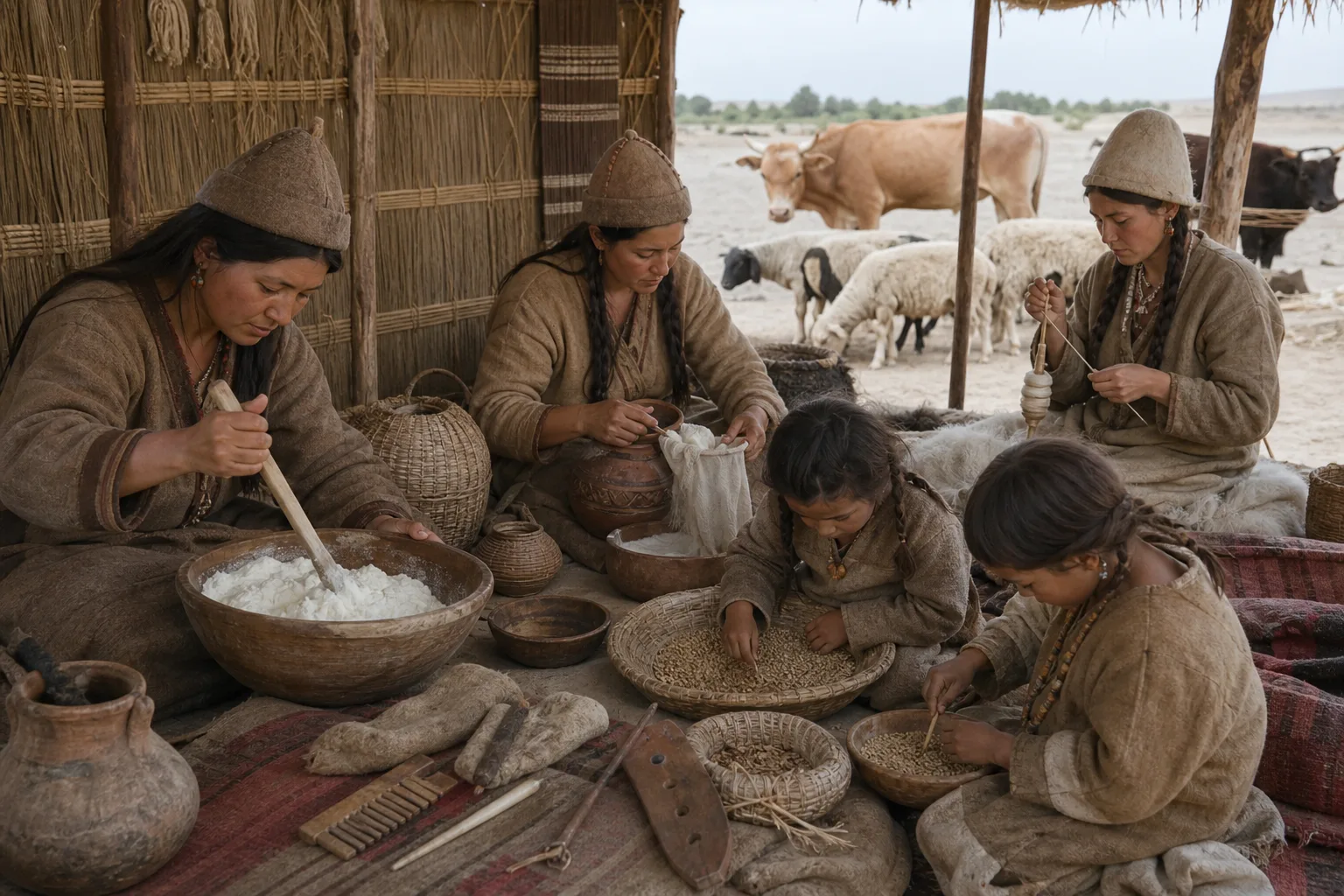
Genetics alone did not explain how these communities lived. Researchers also examined proteins trapped in dental calculus from seven Xiaohe individuals. All seven tested strongly positive for ruminant-milk proteins, with diagnostic peptides from cattle, sheep and goats.
None of the sampled Tarim individuals carried the genetic variant associated with adult lactase persistence that later became common in parts of Europe. This is not a contradiction. Fermentation into yogurt, cheese or other products can reduce lactose, and people can consume varying amounts of fresh dairy without the variant.
The finding shows that dairy pastoralism and milk-processing knowledge can spread culturally without either population replacement or the immediate spread of lactase-persistence alleles. Technologies are learned; they do not require the same people who developed or transmitted them to migrate in large numbers.
A culturally cosmopolitan community#
The Xiaohe world combined practices and products with connections in several directions. Wheat and dairy traditions ultimately had western Asian histories; millet originated farther east; medicinal Ephedra connected to wider Inner Asian networks. Woven woolen clothing, felt, wooden coffins and posts, baskets, cattle remains and other organic objects survived unusually well in the desert.
This does not mean that every artifact can be assigned a single foreign source. Nor does it turn the inhabitants into passive recipients. Communities selected, adapted and recombined useful practices into a distinctive local way of life.
The genome results make migration less necessary as an explanation for this early cultural package. Exchange could move through neighboring pastoralists, marriage contacts too limited to leave a detectable population-wide signal, seasonal interaction, trade or chains of transmission across several communities.
The same principle appears on a different scale in Avar-period genetic and cultural networks, where shared objects crossed a strong ancestry boundary between nearby settlements.
Were the earliest Tarim people Tocharians?#
The study cannot answer that question. Tocharian A and B are Indo-European languages known from manuscripts written in Tarim Basin oasis communities mainly during the first millennium CE. The sampled Xiaohe people lived more than two millennia earlier.
Afanasievo ancestry in Dzungaria remains relevant to hypotheses about the earlier movement of Indo-European languages toward Inner Asia. But the absence of that ancestry in the 13 early Tarim genomes makes a simple equation—Xiaohe people equal Afanasievo migrants equal Proto-Tocharian speakers—untenable.
Language can cross genetic boundaries, and a population can adopt a new language without wholesale replacement. Conversely, deep ancestry cannot reveal vocabulary. Our article on Yamnaya origins and steppe ancestry follows the genetic formation of one population implicated in wider Indo-European debates, while the Indo-European language-tree article explains the independent linguistic evidence.
“Local” does not mean unchanged or pure#
The authors describe the Tarim group as autochthonous in contrast with the proposed recent Afanasievo migration. That does not mean its ancestors had always lived inside the desert basin or remained biologically pure.
The ancestry model itself reflects much older mixture. The population had passed through a strong bottleneck, and its cultural contacts spanned Eurasia. “Local” here is a relative historical conclusion: the sampled early Bronze Age community did not derive primarily from the nearby migrant groups proposed as its immediate founders.
Later Tarim Basin populations were also more diverse. “Tarim mummies” is a preservation label applied to people from many cemeteries and periods, not one biological population. Results from 13 early individuals should never be generalized to every naturally mummified person found across Xinjiang.
What the study cannot establish#
| Limitation | Why it matters |
|---|---|
| Only 13 Tarim genomes passed analysis | The sample may miss rare immigrants and other early communities. |
| The study focuses on 2100–1700 BCE | It does not represent later Bronze and Iron Age populations called Tarim mummies. |
| Ancestry models rely on proxies | The 72/28 result is not a literal recent mixture of the named reference individuals. |
| Failed western-source models are dataset-specific | Future samples could reveal ancestry not represented in current references. |
| Seven dental-calculus samples establish dairy use | They cannot reconstruct every food, processing method or person's diet. |
| DNA cannot recover language or identity | The relationship to much later Tocharian speakers remains unresolved. |
Frequently asked questions about Tarim mummy DNA#
Where did the earliest Tarim mummies come from?#
The 13 sampled people belonged to a deeply rooted, genetically isolated population modeled mainly from Ancient North Eurasian-related and ancient Northeast Asian-related ancestry.
Were the Tarim mummies Europeans?#
The earliest sampled group was not derived from recent European or Afanasievo migration. Modern racial labels are inaccurate tools for describing Bronze Age Inner Asian populations.
How many Tarim genomes were analyzed?#
Researchers obtained genome-wide data from 13 Tarim Basin individuals and five earlier individuals from the neighboring Dzungarian Basin.
Did the Tarim people drink milk?#
Yes. Dental calculus from seven Xiaohe individuals contained proteins from cattle, sheep and goat milk, even though none carried the sampled adult lactase-persistence variant.
Were they related to the Yamnaya or Afanasievo?#
The earliest Tarim group lacked the recent western steppe ancestry expected under an Afanasievo-founder model. Five Dzungarian individuals did show Afanasievo-related ancestry.
Did they speak Tocharian?#
There is no direct evidence. The surviving Tocharian manuscripts are more than two thousand years later, and language cannot be read from DNA.
The real surprise is cultural exchange#
The Tarim genomes do more than replace one proposed biological origin with another. They demonstrate why artifacts and ancestry must be analyzed independently. A small, genetically distinctive population could participate fully in long-distance networks, combining crops, livestock practices, textiles and ritual forms from several directions.
The people of Xiaohe were not genetically western migrants wearing a local disguise, nor an untouched remnant outside history. They were a local Bronze Age community whose daily life was built through contact—a reminder that cultural cosmopolitanism does not require mass migration.
Sources and further reading#
- Zhang, F., Ning, C., Scott, A. et al. (2021). The genomic origins of the Bronze Age Tarim Basin mummies. Nature 599, 256–261. DOI: 10.1038/s41586-021-04052-7.
- Max Planck Society (2021). The surprising origins of the Tarim Basin mummies, an institutional summary with archaeological and proteomic context.
- Open full text and supplementary materials: PubMed Central PMC8580821.
Editorial note: this article avoids projecting modern racial and ethnic categories onto Bronze Age people. Its AI-generated artwork is an interpretive archaeological reconstruction and does not reproduce an excavated body, scientific figure or documented individual.


