

Ancient DNA has reconstructed Avar-period family networks across as many as nine generations, revealing communities organized around paternal descent and linked by women who usually moved to marry. Yet a second, larger dataset found that two settlements only about 20 kilometers apart maintained sharply different ancestry profiles for generations despite sharing the same late-Avar material culture.
Together, the studies replace a single biological image of “the Avars” with a more interesting reality. The Avar realm joined migrants with eastern Eurasian ancestry, people rooted in European populations and many intermediate communities. Cultural belonging, political rule, marriage networks and biological descent overlapped in some places but did not define the same boundaries.
The primary 2025 Nature study, Ancient DNA reveals reproductive barrier despite shared Avar-period culture, analyzed genome-wide data from 722 individuals in the Vienna Basin. A 2024 companion study, Network of large pedigrees reveals social practices of Avar communities, generated usable genome-wide data from 424 people in four cemeteries on the Great Hungarian Plain.
The short answer: whole-cemetery sampling revealed extensive patrilineal pedigrees, female exogamy, rare close-relative unions and occasional levirate partnerships. At Leobersdorf, median eastern Asian-related ancestry remained about 71.5% late in Avar rule, while nearby Mödling averaged less than 5%. Partner choice linked each community to different settlements, preserving that contrast without preventing both from participating in a shared Avar culture.
Who were the Avars?#
The Avars established a powerful realm in the Carpathian Basin after arriving in 567–568 CE. Historical accounts connect their core to steppe groups moving west after the destruction of the Rouran polity in Mongolia, although other peoples joined them during the migration. Avar rulers dominated a heterogeneous population that written sources variously called Avars, Bulgars, Gepids, Slavs and Romans.
After raids and wars—including the failed siege of Constantinople in 626—the realm became more settled. Large cemeteries and increasingly standardized objects and burial customs characterize much of the seventh and eighth centuries. Frankish campaigns ended Avar political power around 800 CE.
The written record was usually produced by outsiders and enemies. Archaeology supplies far more graves—almost 100,000 are known—but objects do not automatically identify ethnicity. Ancient DNA adds biological relationships and population connections while creating its own risk: ancestry can be mistaken for a cultural label if the disciplines are not kept distinct.
Two nearby communities, radically different ancestry#
The 2025 study focused on late-Avar communities south of Vienna. Researchers analyzed entire or large portions of cemeteries at Leobersdorf and Mödling-An der Goldenen Stiege, smaller pre-Avar groups at Mödling, and selected people from Wien-Csokorgasse. The full dataset contained 722 individuals; 677 passed the contamination threshold used for ancestry analysis.
Leobersdorf, Mödling and Csokorgasse lie within a radius of roughly 20 kilometers and share archaeological features of mid-to-late Avar culture. Genetically, however, Leobersdorf and Mödling were far apart:
- Leobersdorf individuals carried a median of about 71.5% eastern Asian-related ancestry, with additional steppe and pre-Avar Carpathian Basin-related components.
- Mödling individuals averaged less than 5% eastern Asian-related ancestry and were modeled mainly from varied European-related sources.
- The contrast persisted for about 150 years, with little evidence of biological kinship between the two communities.
These percentages are results from ancestry models using ancient proxies. “Eastern Asian-related” does not establish an individual's birthplace, language or self-identity, and “European-related” does not describe one homogeneous population.
How did the ancestry difference persist?#
Pedigrees and identity-by-descent networks show that people did move between communities—but partner choice followed different social networks. Women were usually the mobile partners. Leobersdorf had stronger biological connections with Avar heartland sites farther east, while Mödling was connected to another European-ancestry community in the Vienna Basin.
This pattern created what the authors call a reproductive barrier. It was not an absolute prohibition on all mixture: ancestry at both sites reflected earlier contacts, and exceptions existed. Rather, repeated partner choices within distinct networks maintained a large average difference over many generations.
The same culture therefore encompassed communities with very different ancestry. Belts, earrings, horse equipment, burial rows and other late-Avar practices crossed the genetic boundary more readily than marriage ties did. At Csokorgasse, objects once interpreted as evidence for an eighth-century eastern immigration appeared without a matching eastern genetic influx—an unusually clear example of artifacts traveling without a mass movement of people.
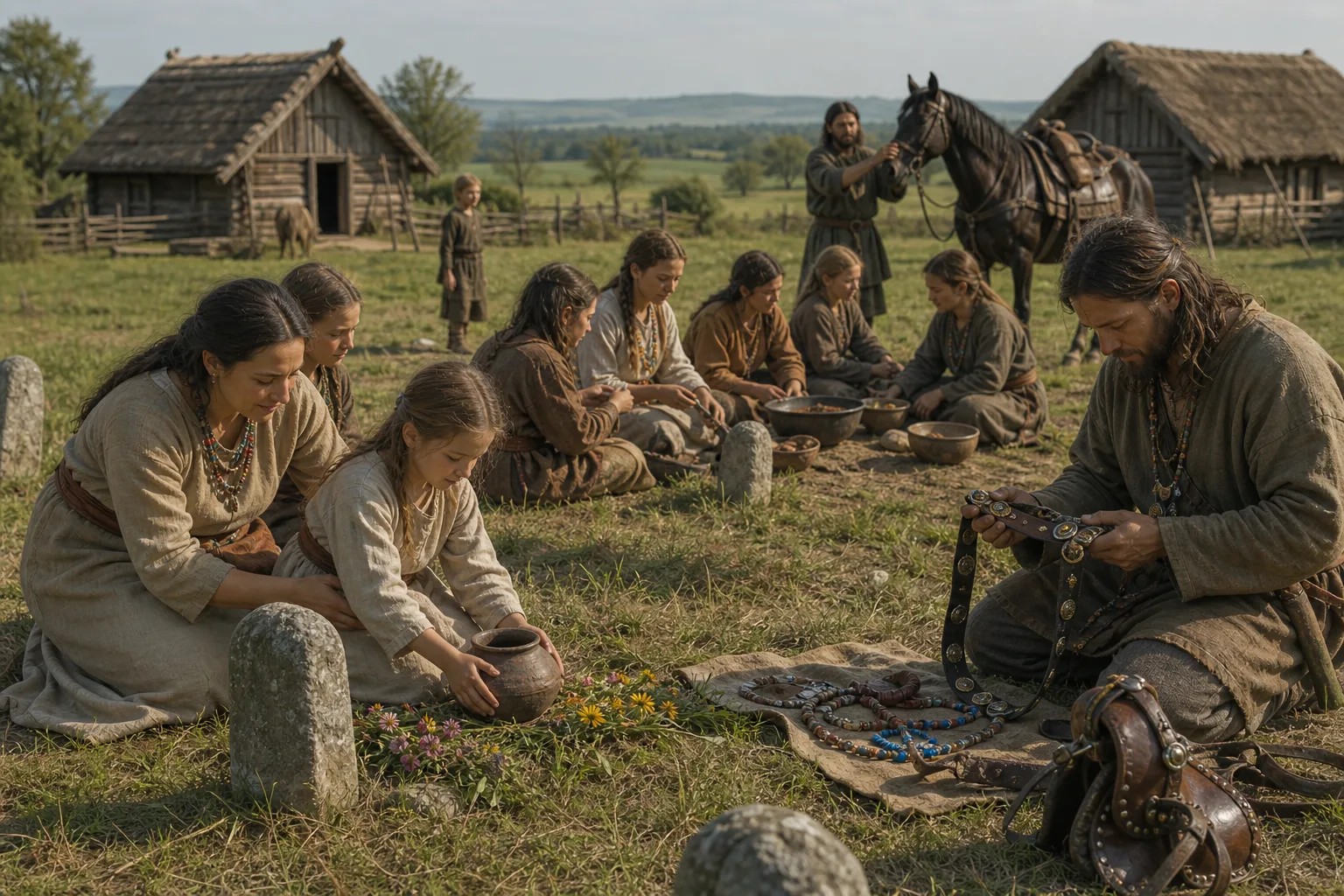
The nine-generation pedigrees in Hungary#
The 2024 study sampled four cemeteries across the Great Hungarian Plain: Rákóczifalva, Kunszállás, Kunpeszér and Hajdúnánás. Genome-wide data passed quality control for 424 individuals, with average coverage of about 2.6× at the targeted ancestry sites. Researchers also produced isotope data for 154 people and 57 new radiocarbon dates.
Close-kin analysis identified 298 people with biological relatives and enabled construction of 31 pedigrees ranging from two to 146 individuals. The dataset contained 373 first-degree pairs—235 parent–child and 138 sibling pairs—and more than 500 second-degree relationships. Connected family trees comprised roughly 300 people and stretched across as many as nine generations.
At Rákóczifalva, 146 individuals formed one interconnected macro-pedigree descended from 11 founding males. Related people were usually buried near one another, and prestigious grave goods sometimes accompanied founding men. The cemetery did not merely hold isolated nuclear families; its layout recorded large descent groups over centuries.
Biological genealogy is not identical to socially recognized kinship. Adoption, fostering, friendship and political bonds leave no simple genetic signature. Nevertheless, repeating patterns across hundreds of graves make some residence and partnership practices visible.
Patriliny, female mobility and marriage rules#
The Hungarian pedigrees show striking continuity through paternal lines. Fathers belonged to a site's founding male lineages, while nearly all mothers lacked parents buried in the same cemetery. Adult daughters were also rare within their birth pedigrees. Together, these observations support patrilocal residence and female exogamy: men generally remained with their paternal community, and women moved between communities to form partnerships.
Y-chromosome diversity was consequently narrow within pedigrees, while mitochondrial lineages were much more varied. At Rákóczifalva, the main related groups carried only two paternal lineages but around 50 maternal haplogroups. These are lineage counts within sampled cemeteries, not a statement that Avar men everywhere belonged to only two haplogroups.
The family trees also contain multiple reproductive partnerships and probable levirate unions, in which a widow partnered with a male relative of her deceased partner. Close biological relatives did not reproduce together in the reconstructed pedigrees, implying that communities tracked ancestry well enough to avoid consanguineous unions across several generations.
Women were not passive entries in a male genealogy. Their movement connected distinct paternal groups within and between settlements. One woman at Rákóczifalva had four reproductive partners across two pedigrees and participated in two apparent levirate unions, making her a central connector in the network.
A community replacement without an ancestry change#
The nine-generation reconstruction revealed something broad ancestry averages would have missed. In the second half of the seventh century, one paternal community at Rákóczifalva was largely replaced by another. Burial construction, grave placement and dietary isotope patterns changed at the same time.
Yet the incoming and outgoing groups had broadly similar ancestry profiles and followed the same patrilineal social system. Only dense biological relationships exposed the discontinuity. This is a warning against equating genetic continuity with an unchanged community: a local population can be replaced by genetically similar people.
The reverse is also true at Leobersdorf and Mödling. Shared cultural practices did not require genetic homogenization. Ancient societies can show cultural continuity with biological change, or biological continuity with social and political change.
Was everyone in the Avar realm genetically East Asian?#
No. Early elite burials and some communities preserve strong ancestry connections to eastern Eurasia, consistent with long-distance migration from the steppe. Other communities carried primarily varied European-related ancestry while living under Avar rule and using Avar-period material culture.
Even Leobersdorf's modeled ancestry was not uniform. Many individuals carried a Pontic-steppe-related component as well as eastern Asian-related and pre-Avar Carpathian Basin-related ancestry. The Avar realm formed through migration, alliance, incorporation and local reproduction—not genetic isolation at an imperial scale.
This is comparable to the broader lesson from Viking genomes and cultural identity: a historical label can describe participation in a political and cultural world without mapping onto one ancestry profile.
What the studies cannot establish#
| Limitation | Why it matters |
|---|---|
| Cemeteries capture selected communities | Burial access and preservation exclude many people who lived in the realm. |
| Biological kinship is not all social kinship | DNA cannot detect adoption, alliance, household service or chosen family. |
| Ancestry sources are proxies | Model percentages do not translate into ethnic membership or exact origins. |
| Female exogamy is inferred from burial patterns | A missing parent may be buried elsewhere, unexcavated or under another rite. |
| Levirate is a pedigree interpretation | DNA reveals partnerships and kin connections, not the rules or names participants used. |
| Two neighboring cemeteries are not the whole empire | Other Avar communities may have maintained different marriage systems. |
Frequently asked questions about Avar DNA#
How many Avar-period genomes were analyzed?#
The Vienna Basin study generated genome-wide data from 722 individuals. The Great Hungarian Plain study obtained usable data from 424 people across four cemeteries.
What did the reconstructed Avar family trees show?#
They showed patrilineal descent, men usually remaining in their paternal communities, women usually arriving from elsewhere, avoidance of close-relative unions and some multiple or levirate partnerships.
Were the Avars genetically homogeneous?#
No. Leobersdorf retained mostly eastern Asian-related ancestry, while nearby Mödling was overwhelmingly European-related, despite both sharing late-Avar culture.
What is a reproductive barrier?#
Here it means repeated partner choice within separate marriage networks that maintained different ancestry profiles. It does not mean complete isolation or a biological inability to have children together.
Did grave goods reveal ancestry?#
Not reliably. Shared objects appeared across different ancestry groups, and at Csokorgasse artifact change occurred without evidence for the proposed large eastern migration.
Can an ancestry test prove Avar descent?#
No. Modern similarity to selected ancient samples cannot prove cultural membership or a direct named ancestor. The Avar realm contained multiple ancestries, and more than a millennium of later history separates its people from customers today.
Family history at the scale of an empire#
The Avar studies show what becomes possible when archaeogenetics samples entire cemeteries rather than a few visually impressive graves. Hundreds of genomes turn burial grounds into multigenerational networks, revealing who stayed, who moved, which lineages continued and when one community replaced another.
Their clearest lesson is not that genes defined Avar society. It is almost the opposite: people with sharply different ancestry participated in the same cultural world, while partnership networks—not artifacts alone—maintained local boundaries. Political identity, family organization and ancestry were connected, but none can substitute for the others.
Sources and further reading#
- Wang, K., Tobias, B., Pany-Kucera, D. et al. (2025). Ancient DNA reveals reproductive barrier despite shared Avar-period culture. Nature 638, 1007–1015. DOI: 10.1038/s41586-024-08418-5.
- Gnecchi-Ruscone, G. A., Rácz, Z., Samu, L. et al. (2024). Network of large pedigrees reveals social practices of Avar communities. Nature 629, 376–383. DOI: 10.1038/s41586-024-07312-4.
- For regional context, see ancient Balkan DNA across the Roman and early medieval transition.
Editorial note: this article synthesizes two peer-reviewed datasets and separates biological relationships from social identity. Its AI-generated images are interpretive archaeological reconstructions rather than study figures or evidence.


