

Ancient DNA does not support a severe population collapse on Rapa Nui in the 1600s of the kind proposed by the popular “ecocide” narrative. It instead fits a small population whose genetic effective size increased after the island was settled and did not crash before the devastating effects of European contact, slave raids and introduced disease.
The same genomes carry about 10% Indigenous American-related ancestry, similar to present-day Rapanui people. By combining radiocarbon and genetic information, researchers dated that admixture to approximately 1250–1430 CE—centuries before the first recorded European arrival at Rapa Nui in 1722.
These conclusions come from the 2024 Nature study Ancient Rapanui genomes reveal resilience and pre-European contact with the Americas. The team whole-genome sequenced 15 ancestral Rapanui individuals held in French museum collections and worked with Rapanui representatives while developing the research questions and interpreting the results.
The short answer: the 15 genomes reject the particular model of a drastic, self-inflicted demographic bottleneck before European contact. They also provide direct ancient-genome evidence of pre-European contact between Polynesian and Indigenous American ancestors. DNA does not reveal which people made the voyage, its direction, the exact coast reached or whether contact occurred once or repeatedly.
Why the collapse story became so influential#
Rapa Nui lies at the eastern edge of Polynesia, about 3,700 kilometers west of South America and more than 1,900 kilometers from the closest inhabited island. Polynesian navigators settled it by around 1250 CE and created a distinctive landscape of monumental platforms, or ahu, and hundreds of carved moai.
A once-popular scenario claimed that an island population of perhaps 15,000 people overused forests and wildlife, triggering famine, warfare and demographic collapse in the 1600s. Rapa Nui was presented as a parable of “ecological suicide.” Deforestation and major environmental change are real parts of the island's history, but archaeologists and anthropologists have long disputed the proposed scale, chronology and social consequences.
The difference matters because collapse narratives can turn Indigenous people into a cautionary abstraction while minimizing well-documented colonial violence. European visitors killed islanders and introduced unfamiliar pathogens. In the 1860s, Peruvian slave raiders abducted roughly a third of the population. Smallpox and other disruptions followed, and the population eventually fell to an estimated 110 people.
The genome study asks a narrow demographic question: is there evidence for a severe bottleneck before those nineteenth-century disasters?
Whose genomes were analyzed?#
The researchers sampled petrous bone or loose teeth from 15 individuals in the collections of the Muséum national d'Histoire naturelle and Musée de l'Homme in France. Museum records associate 11 with an 1877 collection and four with a 1934–1935 collection.
Direct radiocarbon dates were obtained for 11 people. After accounting for marine foods that can make remains appear artificially old, the broad calibrated ranges spanned 1670–1950 CE. Collection dates provide additional upper limits, and the authors judged it unlikely that the individuals were born after the 1860s slave raids and epidemics.
Whole-genome coverage ranged from 0.4× to 25.6×, an unusually wide range. Researchers imputed missing diploid genotypes and repeated key analyses using direct pseudohaploid calls where possible. Estimated contamination was below 5% for every library.
Genetic comparisons placed all 15 within Polynesian diversity and closest to present-day Rapanui people. Long shared DNA segments supported that connection. This confirmation is also relevant to community-led repatriation efforts seeking the return of ancestral remains.
What the genomes say about population size#
Researchers reconstructed changes in effective population size, a genetic measure influenced by how many people contributed offspring and how lineages were related. It is not the same as a head count. A society of several thousand people can have a much smaller effective size, and different demographic histories can sometimes produce similar genetic patterns.
The inferred trajectory declined around the island's initial settlement bottleneck and then increased steadily. It did not show the sharp seventeenth-century reduction expected under the severe ecocide model.
The team therefore simulated many histories with two possible bottlenecks: one during initial settlement and another in the 1600s. Models leaving only 10–50% of the population after the later event did not match the observed data. Runs of homozygosity—long genomic stretches inherited from related ancestors—also failed to support an extremely strong later bottleneck.
This does not prove that no hardship, conflict, environmental pressure or local population fluctuation occurred. Fifteen genomes cannot measure every historical change. The result specifically rejects a major island-wide demographic crash before European contact as modeled in the paper.
Evidence for contact with the Americas#
All 15 ancestral Rapanui genomes carried a predominantly Polynesian profile plus Indigenous American-related ancestry. Estimates were around 10%, close to the proportion in present-day Rapanui individuals after accounting for later European mixture.
The researchers used several methods to test the signal. Allele-sharing and admixture models favored an Indigenous American source over African, European, East Asian or Papuan alternatives. Local-ancestry methods then identified chromosome segments likely inherited from Polynesian and Indigenous American ancestors.
Recombination shortens ancestry blocks through time. The distribution of those segment lengths, combined with genetic dates for the ancient people and their radiocarbon ranges, produced an admixture estimate of 1250–1430 CE. That interval overlaps the early centuries of settlement on Rapa Nui and substantially predates recorded European contact.
Earlier research using present-day Polynesian genomes had also inferred pre-European contact, but small ancient-DNA studies did not detect the signal. The new whole genomes are deeper and more numerous than those earlier ancient datasets, giving them enough power to identify the approximately 10% contribution.
Who crossed the Pacific?#
DNA demonstrates that the ancestral populations met and had descendants. It does not preserve a travel log. The genomic result cannot determine:
- whether Polynesian navigators reached South America or Indigenous American voyagers reached Polynesia;
- whether contact happened on Rapa Nui, another island or the American coast;
- how many people traveled or how many voyages occurred;
- which vessels, winds or routes they used; or
- what language, goods or knowledge moved with them.
Polynesian eastward voyaging is often considered historically and technologically plausible, but that is an interpretation using navigation history rather than a direction encoded in the admixture segments. The study also could not identify one exact Indigenous American source because available ancient and present-day reference sampling along the Pacific coast is incomplete.
The finding does not support claims that South Americans founded or replaced Polynesian society on Rapa Nui. The analyzed genomes are overwhelmingly Polynesian and closest to Rapanui people today. Contact added ancestry to an established Polynesian population.
Kinship and life in a small island population#
The 15 ancestral individuals included no first- or second-degree relatives and only one possible third- to fourth-degree pair. Estimated inbreeding coefficients were low, suggesting their immediate parents were not close relatives.
They did carry many runs of homozygosity, as expected for a population founded by a small number of people and living in long-term geographic isolation. Most runs were relatively short. None showed the large share of very long segments typical of recent close-relative parentage.
This distinction matters. A small effective population does not mean that every person married a close cousin. Social rules can maintain wide partner networks even where the total population is limited—just as the Avar cemetery pedigrees reveal structured exogamy in a very different historical setting.
Community engagement and ancestral remains#
The human remains were removed from Rapa Nui during colonial-era collecting and are held thousands of kilometers from their community. The research team met with representatives of the Comisión de Desarrollo Rapa Nui and Comisión Asesora de Monumentos Nacionales, presented goals and preliminary findings, and incorporated questions raised by the community. Both commissions voted in favor of the work continuing.
Genetic confirmation that the individuals are closely related to present-day Rapanui supports the Ka Haka Hoki Mai Te Mana Tupuna repatriation effort. Scientific information does not itself settle legal or ethical ownership, but the study treats return and community authority as part of the research context rather than an afterthought.
What the study cannot establish#
| Limitation | Why it matters |
|---|---|
| Fifteen individuals form a small sample | Rare family histories or local demographic events may be missed. |
| Most remains postdate European arrival | The pre-contact conclusions rely on inherited genetic signals and modeling, not pre-1722 skeletons alone. |
| Radiocarbon ranges are broad | Marine-food corrections and collection dates constrain but do not precisely date every person. |
| Effective size is not census size | The study cannot give a definitive island population count. |
| Admixture sources are imperfect proxies | Sparse Indigenous American reference data limits geographic precision. |
| DNA does not record voyage direction | Archaeology, navigation and oral history remain essential to interpreting contact. |
Frequently asked questions about Rapa Nui DNA#
Did Rapa Nui suffer an ecological population collapse before Europeans arrived?#
The genomes do not support a severe seventeenth-century bottleneck leaving only 10–50% of the population. They do not rule out environmental change, conflict or smaller fluctuations.
How many ancestral Rapanui genomes were sequenced?#
Fifteen whole genomes were sequenced at depths from 0.4× to 25.6×. Eleven individuals also received direct radiocarbon dates.
Is there Indigenous American ancestry in Rapanui people?#
Yes. The ancient and present-day genomes analyzed carry about 10% Indigenous American-related ancestry in the study's models.
When did Polynesian and Indigenous American ancestors meet?#
The admixture was dated to approximately 1250–1430 CE, before recorded European arrival on Rapa Nui in 1722.
Does DNA show who sailed across the Pacific?#
No. It establishes biological contact but cannot identify the direction, route, vessel, number of voyages or identities of the travelers.
Are the museum remains related to present-day Rapanui?#
Yes. Genetic tests place them closest to present-day Rapanui people, supporting their identification as ancestral Rapanui and informing repatriation efforts.
Resilience is more accurate than ecocide#
The ancient genomes do not erase the environmental history of Rapa Nui. They do overturn an oversimplified sequence in which reckless islanders supposedly destroyed their society before outsiders arrived. The tested demographic pattern is one of isolation, adaptation and growth until historically documented colonial catastrophes.
At the same time, Indigenous American-related segments preserve evidence of extraordinary trans-Pacific contact. The responsible conclusion is both remarkable and limited: people met before Europeans entered this history, but DNA alone cannot tell the voyage as a complete human story.
Sources and further reading#
- Moreno-Mayar, J. V., Sousa da Mota, B., Higham, T. et al. (2024). Ancient Rapanui genomes reveal resilience and pre-European contact with the Americas. Nature 633, 389–397. DOI: 10.1038/s41586-024-07881-4.
- Ioannidis, A. G. et al. (2020). Native American gene flow into Polynesia predating Easter Island settlement. Nature 583, 572–577.
- The paper's data-availability statement explains that ancestral Rapanui sequence data are governed jointly with community representatives and available for approved population-history research rather than public or commercial reuse.
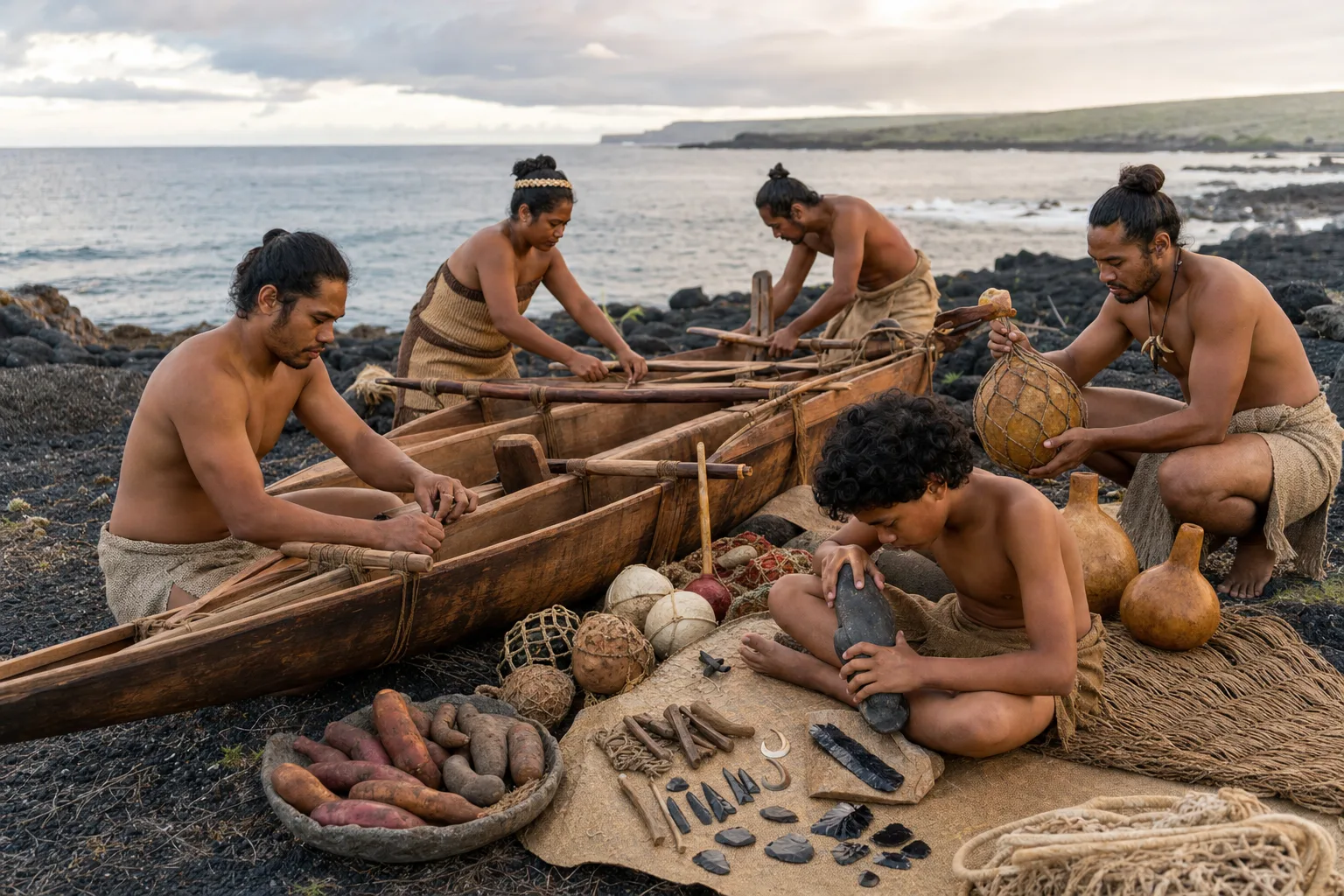
Editorial note: this article uses the community name Rapa Nui and treats repatriation and colonial history as part of the evidence. Its AI-generated artwork is an interpretive reconstruction, not a claim about a documented voyage or ancestral person's appearance.


