

The central Southern Cone of South America was one of the last large regions on Earth that people reached, and it is one of the least represented in ancient DNA. A 2026 study changes that in a single step, reporting genome-wide data from 238 ancient individuals spanning ten millennia across present-day Argentina and its neighbours.
The headline result is a population that nobody had sampled: a deep lineage in central Argentina, whose earliest representative lived around 8,500 years ago, and whose descendants dominated the region for thousands of years with strikingly little evidence of migration from elsewhere.
The evidence comes from the Nature paper Eight millennia of continuity of a previously unknown lineage in Argentina.
The short answer: 238 ancient genomes covering ten millennia show that differentiation between the Southern Cone, the central Andes and eastern Brazil had already begun 10,000 years ago. Individuals from 4,600 to 150 years before present descend mainly from a previously unsampled deep lineage first seen around 8,500 BP. That central Argentina ancestry persisted locally for millennia and later took part in three distinct gene flows — into the Pampas, the northwest and the Gran Chaco. These are modelled ancestry components, not ethnic or tribal identities.
Differentiation was already underway 10,000 years ago#
The oldest individual in the dataset comes from the Pampas and dates to about 10,000 years before present. Genetically, that person shows a distinct affinity to later Middle Holocene Southern Cone individuals — and is already differentiated from the ancestries characteristic of the central Andes and central-eastern Brazil.
That is a substantive finding about the peopling of the continent. People reached southern South America late, and the reasonable expectation would be that regional genetic structure took a long time to form afterwards. Instead, by ten thousand years ago, the major regional divisions of the continent were already visible.
The implication is that the initial dispersal into South America was followed quickly by regional isolation — populations settling into landscapes and staying, rather than continuing to circulate broadly across the continent.
The lineage nobody had sampled#
The study's central result concerns individuals dating from about 4,600 to 150 years before present. They descend primarily from a previously unsampled deep lineage, whose earliest known representative is an individual from around 8,500 BP.
"Previously unsampled" is the operative phrase. This is not a newly discovered mixture of known components; it is an ancestry that no earlier study had encountered, because nobody had sequenced ancient individuals from this part of central Argentina.
During the Mid-Holocene it co-existed with two other lineages in the wider region — so the picture is one of several distinct populations sharing a landscape, not one group in isolation. And within central Argentina, that ancestry then persisted for thousands of years with little evidence of inter-regional migration.
| Period | What the genomes show |
|---|---|
| ~10,000 BP | Oldest Pampas individual, already differentiated from Andes and eastern Brazil |
| ~8,500 BP | Earliest representative of the central Argentina lineage |
| Mid-Holocene | Central Argentina lineage co-exists with two others in the region |
| ~4,600–150 BP | Most individuals descend primarily from the central Argentina lineage |
| ~3,300 BP onward | That ancestry mixes into the Pampas; becomes dominant there after ~800 BP |
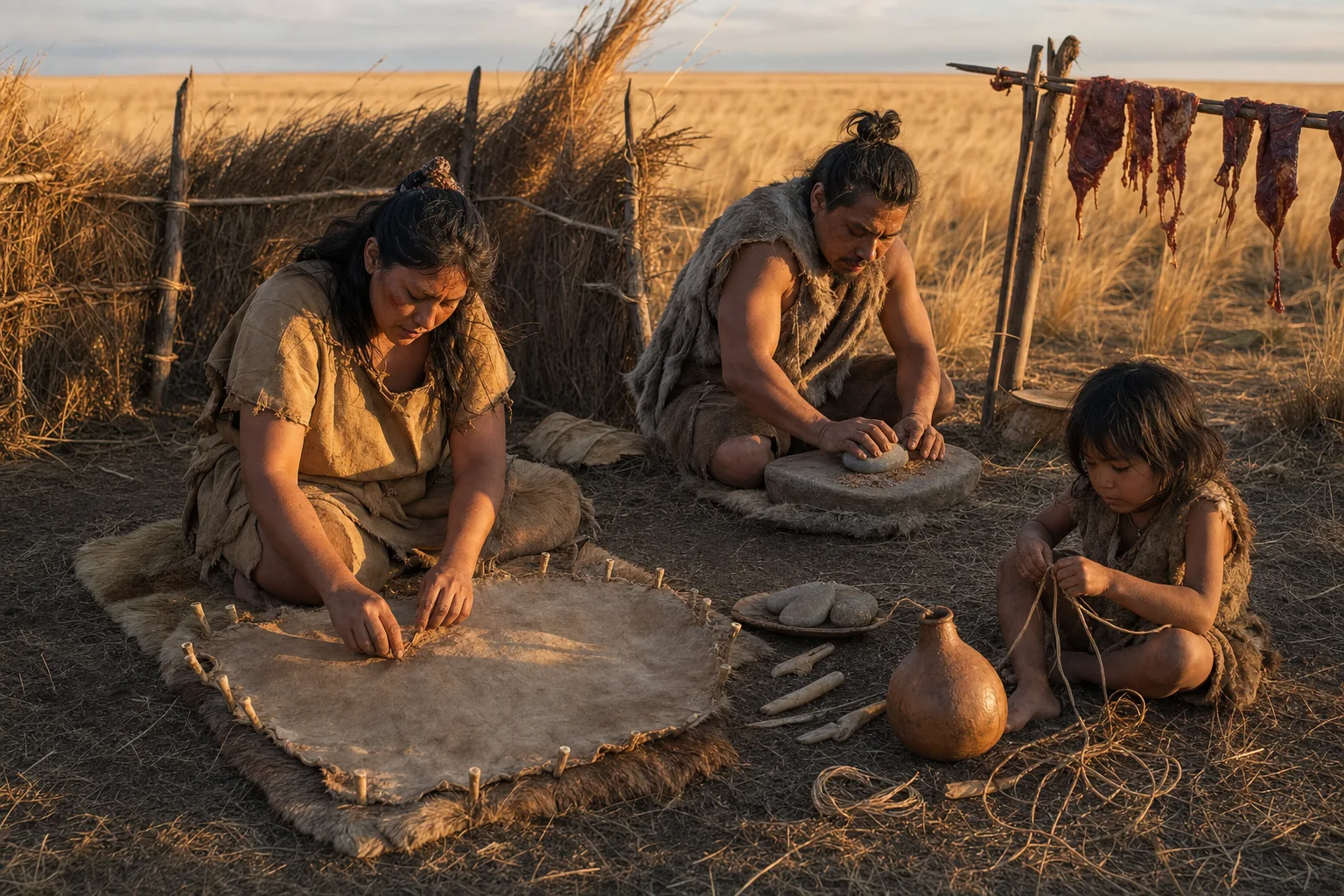
Continuity is a finding, not an absence of one#
Ancient DNA reporting gravitates toward movement. Migrations, replacements, expansions: those make legible stories, and much of the field's public profile rests on them — the Yamnaya expansion and the Anglo-Saxon migration among them.
Continuity is harder to narrate and just as informative. Thousands of years of a single ancestry persisting in one region, with little inward gene flow, tells you about the structure of a society: that communities were reproducing largely among themselves, that whatever exchange existed with neighbours did not move many people permanently, and that the archaeological changes in that landscape over those millennia happened without a corresponding turnover of population.
It also supplies the baseline against which the movements that did occur can be measured. Which is what the study proceeds to do.
Three gene flows out of central Argentina#
Central Argentina ancestry did not stay put forever. The study identifies three distinct gene flows involving it, each with a different partner and a different direction:
- Into the Pampas. By about 3,300 BP this ancestry had mixed into Pampas populations, and it appears to have become the main component there after roughly 800 BP — a substantial demographic shift in the region that holds the dataset's oldest individual.
- With central Andes ancestry in the northwest. In northwest Argentina, central Argentina ancestry mixes with ancestry related to the central Andes, on the margins of the Andean world.
- With tropical and subtropical forest ancestry in the Gran Chaco. In that lowland region it mixes with a very different ancestry associated with forested environments to the north and east.
Three mixtures, three neighbours, three ecological settings. This is a population history with internal structure, not a single migration event, and it is the kind of resolution that only becomes visible once a region has been sampled densely enough.
Close-kin unions and a Guaraní signature#
Two further results extend beyond ancestry proportions.
Close-kin unions increased in the northwest. By about 1,000 BP, northwest Argentina shows a raised rate of unions between close relatives — a pattern that parallels the central Andes. Consanguinity rates are detectable in genomes as long stretches where an individual's two inherited copies are identical, and shifts in those rates reflect social organisation: who was considered a permissible partner, and how large the effective pool of partners was. The parallel with the Andes suggests the northwest was participating in a broader social world, not merely receiving Andean ancestry.
A Guaraní-associated individual clusters with Brazilian groups. In the Paraná River region, a 400 BP individual with a Guaraní archaeological association groups genetically with Brazilian populations — consistent with a Guaraní presence in the region by that time. It is a rare case where an archaeological attribution and a genetic affiliation can be checked against one another in the same individual, and here they agree.
Reading ancestry labels responsibly#
Terms such as "central Argentina lineage", "central Andes ancestry" and "tropical forest ancestry" are modelling constructs. Each names a statistical component defined by the reference populations available, fitted with methods like the ones described in our qpAdm explainer.
Several things follow, and they matter more here than in many regions:
- These labels do not correspond to peoples, nations or self-identifications, past or present.
- A "previously unsampled lineage" is unsampled, not unknown to anyone — the communities of the region have their own histories of themselves, and genetics does not adjudicate them.
- Ancestry components are not evidence about who has a claim to a place. Descendant communities exist, and their relationship to this evidence belongs to them.
The Picuris Pueblo study is a useful contrast on that last point: ancient DNA conducted at a tribe's own initiative, on their terms, to answer their own questions.
Limitations#
| Limitation | Why it matters |
|---|---|
| Coverage is uneven across space and time | Some regions and periods are represented by very few individuals. |
| Ancestry components are model-dependent | They shift as new reference populations are sampled. |
| "Little migration" means little detected | Gene flow between genetically similar neighbours is hard to see. |
| Dates carry radiocarbon uncertainty | Transitions unfold across ranges, not at single years. |
| Archaeological labels and genomes differ | A Guaraní association is a cultural attribution, not a genetic category. |
| Descendant communities are not the subject | The study describes ancient individuals, not living peoples' identities. |
Frequently asked questions about the Southern Cone genomes#
How many ancient individuals were sequenced?#
Genome-wide data were reported for 238 ancient individuals spanning approximately ten millennia in the central Southern Cone of South America.
What is the "previously unknown lineage"?#
A deep ancestry component in central Argentina, first represented by an individual dating to around 8,500 years before present, that no earlier ancient-DNA study had sampled. Most individuals from 4,600 to 150 BP descend primarily from it.
How old is the oldest individual?#
About 10,000 years before present, from the Pampas — and already genetically differentiated from central Andean and central-east Brazilian ancestries.
Does this mean nobody migrated into central Argentina?#
It means little inward migration is detectable over that period. Movement between populations that are already genetically similar leaves a weak signal, so "little detected" is not the same as "none occurred".
What does the increase in close-kin unions indicate?#
Longer stretches of identical inherited DNA in individuals from about 1,000 BP in northwest Argentina point to more frequent unions between relatives — a social pattern that also appears in the central Andes at similar times.
Does this study say anything about Indigenous identity today?#
No. It reports statistical ancestry for ancient individuals. Identity, community membership and descent claims are matters for the communities concerned, and ancestry models are not evidence about them.
Filling in the last-settled continent#
South America's ancient DNA record has been built from its extremes: the Andes, where preservation is good and archaeology is dense, and the far south, where a handful of studies have addressed Patagonia. The vast middle — the Pampas, the Gran Chaco, the Paraná basin, central Argentina — was largely blank.
Two hundred and thirty-eight genomes across ten millennia do more than add points to a map. They reveal that regional structure formed early, that a major lineage persisted locally for thousands of years, and that when it finally moved it did so in three different directions, meeting three different neighbours in three different environments.
That is a level of detail that the continent's population history has rarely been afforded, and it comes with an obvious corollary: the lineage was "previously unknown" only because nobody had looked in the right place. On the evidence of this study, there are almost certainly others.
Sources and further reading#
- Maravall-López, J., Motti, J. M. B., Pastor, N. et al. (2026). Eight millennia of continuity of a previously unknown lineage in Argentina. Nature 649, 647–656. DOI: 10.1038/s41586-025-09731-3.
- Nakatsuka, N., Luisi, P., Motti, J. M. B. et al. (2020). Ancient genomes in South Patagonia reveal population movements associated with technological shifts and geography. Nature Communications 11, 3868.
- The shared genomic history of Middle- to Late-Holocene populations from the Southern Cone of South America, Current Biology (2026) — a companion regional study of 52 individuals.
Editorial note: this article was written as a source-based synthesis and distinguishes modelled ancestry components from the identities of descendant communities throughout. Its hero and section artwork was generated with AI as an interpretive archaeological scene, not as scientific evidence.


