

Ancient DNA now shows that some people associated with the European Huns were genealogically connected to elite individuals of the Xiongnu Empire, which had ruled parts of the Mongolian steppe centuries earlier. Long shared stretches of DNA bridge the Xiongnu period, Central Asian steppe burials, and fifth- to sixth-century people in the Carpathian Basin.
The discovery does not make every European Hun a Xiongnu descendant. Most sampled people from Hun- and post-Hun-period Carpathian Basin contexts showed no East or Central Asian-related ancestry, and the rare “eastern-type” burials themselves were genetically diverse. The Hunnic realm in Europe was a coalition shaped by mobility and admixture, not a uniform biological population arriving intact from Mongolia.
That evidence comes from the 2025 PNAS paper Ancient genomes reveal trans-Eurasian connections between the European Huns and the Xiongnu Empire. By analyzing 370 ancient individuals across roughly eight centuries and thousands of kilometers, the researchers found direct genealogical continuity where earlier studies could identify only broad eastern ancestry.
The short answer: yes, a small number of European Hun-period individuals descended from, or shared very recent ancestors with, elite Xiongnu-period lineages. But no, the wider European Hun population was not simply the Xiongnu transplanted west. The genetic and archaeological evidence points to a long, complex process involving many steppe and European groups.
Why has the Hun–Xiongnu connection been debated?#
The Xiongnu created the first historically documented nomadic empire of the eastern Eurasian steppe, reaching its height around 200 BCE to 100 CE. Their confederation included people with widely different ancestries and local backgrounds. After political fragmentation, the Xiongnu disappear from the historical record as a unified imperial power.
European authors first describe the Huns north of the Black Sea in the 370s CE, roughly three centuries after the Xiongnu empire's collapse. Hunnic attacks and alliances displaced or incorporated Alans, Goths, and other groups before a powerful federation formed in the Carpathian Basin. Under Attila in the fifth century, it became a dominant force along Rome's frontier.
The names have long encouraged comparison, but a similar name is not proof of population continuity. Archaeological evidence across the intervening Central Asian centuries is fragmentary, and only a small fraction of Carpathian Basin graves display distinctive steppe-associated features. The chronological and geographical gap left several possibilities open: direct descent, political memory, unrelated naming, or a mixture of connections.
What the new DNA study sampled#
The researchers produced new genome-wide data from 35 people and assembled a comparative dataset of 370 ancient individuals. Its main chronological groups included:
| Genomic context | Number in the assembled dataset |
|---|---|
| Xiongnu-period eastern Eurasian steppe | 80 |
| Second- to sixth-century Central Asia | 63 |
| Late fourth- to sixth-century Carpathian Basin | 143 |
| Other early medieval East Asian and comparison contexts | Remaining individuals |
Among the European material were 10 people from archaeologically defined Hun-period eastern-type burials. Such graves were generally solitary or in small groups and could contain steppe-associated horse equipment, weapons, jewelry, food offerings, or altered burial orientations. Artifacts were not assumed to prove biological origin; the study tested whether cultural and genomic signals converged.
Of the 370 genomes, 275 met the stricter requirements for identity-by-descent analysis. DNA quality matters because low-coverage ancient genomes can support broad allele-frequency comparisons while remaining unsuitable for reliable detection of long inherited chromosome segments.
Most Hun-period people were not predominantly eastern#
On a Eurasian principal-component plot, most late fourth- to sixth-century Carpathian Basin individuals fell among European populations and showed no detectable East or Central Asian-related admixture. Only a minority occupied positions along the broad west-to-east Eurasian cline.
In a wider survey of 371 people from fifth- and sixth-century Carpathian Basin contexts, including 143 used in this study, just 26—about 6%—had signals of northeast Asian- or steppe-related admixture. Eight of the 10 eastern-type Hun-period burials carried such signals, showing that the archaeology enriched for people with eastern connections. Even those eight did not form one homogeneous group.
Some had substantial eastern Eurasian ancestry; others were mixtures whose affinities stretched across the steppe. Nineteen Carpathian Basin individuals in the study's main dataset carried varying East Asian admixture, including people in modest graves without conspicuously eastern artifacts.
The contrast is central to the interpretation. The incoming Hunnic political and military networks included people from distant eastern lineages, but their genetic footprint does not resemble a large, endogamous migrant population dominating the region numerically.
Long shared DNA provides the missing connection#
Broad East Asian-related ancestry alone cannot identify Xiongnu descent. Similar combinations of eastern and western Eurasian ancestry existed across many steppe populations over millennia. The study's decisive advance was measuring long segments of DNA shared identical by descent, or IBD.
When two ancient people share multiple long IBD segments, they inherited those segments from relatively recent common ancestors. The researchers found a trans-Eurasian network of 97 interconnected people, running from late Xiongnu-period Mongolia through third- to fifth-century Central Asian burials to Hun- and post-Hun-period individuals in the Carpathian Basin.
The network's core contained around 20 people. It included two individuals from Xiongnu imperial-elite graves, several European eastern-type burials, and steppe burials in what is now Kazakhstan. Some segments exceeded 20 centimorgans, far too long to dismiss as a vague shared eastern ancestry component.
A demographic model estimated that the late Xiongnu and Hun-period groups separated about 18 generations before the latter sample, essentially matching their approximately 500-year median date difference. The result implies that some late Xiongnu individuals were direct ancestors of Hun-period lineages or were separated from those ancestors by only a few generations.
Elite lineages crossed extraordinary distances#
The Xiongnu-period dataset itself revealed biological relatives buried 350 to 1,000 kilometers apart. Two imperial-elite individuals and one local-elite individual formed a third- to fifth-degree kin group. That pattern fits high mobility and marriage networks among steppe elites.
In the Carpathian Basin, two people from eastern-type solitary burials were estimated as fifth- to seventh-degree relatives. Both were also related to a woman buried in a poor and disturbed settlement grave at Tiszagyenda. Biological connection therefore crossed the material categories archaeologists use: relatives could receive very different burial treatment.
This is why the paper does not equate rich artifacts with a genetically sealed Hunnic elite. Status, cultural affiliation, family, and ancestry intersected, but none maps perfectly onto another.
The authors cautiously suggest that a handful of elite Xiongnu families may have contributed disproportionately to lineages moving west over generations. Higher-status people could also leave more descendants or form long-distance marriage ties. DNA cannot show whether descendants remembered a Xiongnu identity centuries later.
The route west was not a single migration#
Several Central Asian individuals connected the eastern and western ends of the IBD network. Solitary graves at Aktobe/Kurayly and Halvay included horse remains, riding equipment, bows, arrows, and gold objects with archaeological parallels to later European Hun-period finds.
People from Berel west of the Altai also supplied important genomic links, despite burial customs that differed from the European examples. By contrast, the study found no long IBD links and only limited shorter connections through sampled groups from the Tian Shan region. That result argues against treating every Central Asian group called “Hun” in modern scholarship as one biological population.
Sampling gaps remain large. Missing genomes from the Pontic–Caspian steppe and southern Central Asia could change the apparent routes. The present evidence supports multi-stage mobility and admixture, not one caravan traveling directly from Mongolia to Hungary.
How were the European Huns different from the Avars?#
The study contrasts the Hunnic process with the arrival of the Avars about two centuries later. Ancient DNA suggests that an Avar core group reached the Carpathian Basin soon after the defeat of the Rouran Khaganate and retained predominantly eastern and central Asian ancestry.
The Huns were separated from the latest Xiongnu by a longer gap. Their European-period population was more genetically varied, and their eastern-associated burials were rare and scattered. Both empires incorporated diverse communities, but the demographic paths were not identical. Our overview of Avar family trees and steppe communities examines the later evidence in detail.
Does DNA tell us who was a Hun?#
No genetic test can assign a Hunnic identity. The name appears in written sources as a political and social category within a changing imperial network. A person with only European-related ancestry could serve a Hunnic ruler, while someone with eastern ancestry might belong to another community.
Even archaeologically distinctive burials require caution. A composite bow, cauldron, weapon, or modified skull could express status, fashion, mobility, family practice, or affiliation. Some traits spread locally. Conversely, the Tiszagyenda kinship shows that a person connected to eastern-type burials could be interred without rich or obviously eastern objects.
The same discipline applies to studies of Viking cultural identity and 442 ancient genomes: cultural participation can cross genetic boundaries.
Important limitations#
| Limitation | Why it matters |
|---|---|
| Only 10 eastern-type European burials were included | The rare archaeological category cannot represent the whole Hunnic realm. |
| Just 275 genomes passed IBD thresholds | Direct genealogical links can be missed in lower-coverage samples. |
| Large regions remain unsampled | The precise route and intermediate populations are unresolved. |
| IBD shows genealogy, not cultural memory | Descendants need not have known or claimed a Xiongnu connection. |
| Burial artifacts are socially complex | Objects cannot independently identify ancestry or ethnicity. |
| The Hunnic polity included many peoples | A political label should not be converted into one biological population. |
Frequently asked questions#
Were the Huns the same people as the Xiongnu?#
No. The study demonstrates direct genealogical connections for some lineages, not identity between two empires separated by centuries. European Hun-period populations were highly diverse.
How many ancient people were compared?#
The assembled genomic dataset contained 370 individuals: 80 from Xiongnu contexts, 63 from Central Asia, 143 from the late fourth- to sixth-century Carpathian Basin, and additional comparison groups. Of these, 275 supported IBD analysis.
What proves a direct Xiongnu connection?#
Multiple long IBD segments connect some Xiongnu imperial-elite individuals with Central Asian and Carpathian Basin people. These inherited chromosome blocks indicate genealogical relationships much more recent than a general shared ancestry component.
Did most European Huns have East Asian ancestry?#
No. In the broader Carpathian Basin comparison, only about 6% of fifth- to sixth-century individuals had northeast Asian- or steppe-admixture signals. The frequency was much higher in the small set of eastern-type burials.
Was Attila genetically Xiongnu?#
There is no verified DNA from Attila. The study cannot determine his ancestry or connect him personally to any sampled lineage.
Can a modern DNA test prove Hun descent?#
No. Millions of genealogical paths separate modern people from the fifth century, and there is no exclusive “Hun marker.” Consumer haplogroups follow only one paternal or maternal line and cannot certify historical identity.
A connection without a simple origin story#
The study resolves an old argument in an unexpectedly precise way. Some European Hun-period lineages really did descend from the world of the Xiongnu elite. Their shared chromosome segments preserve connections spanning continents and about five centuries.
Yet the same dataset makes a one-origin narrative impossible. The European Huns incorporated people with ancestries across Eurasia; most sampled inhabitants of their Carpathian Basin world lacked detectable eastern admixture; and even close relatives received different burial treatment.
The answer is therefore both “yes” and “not as a single people.” Xiongnu genealogies survived into Hunnic Europe, but they arrived through a long chain of movement, marriage, coalition, and cultural change.
Primary sources and data#
- Gnecchi-Ruscone, G. A. et al. (2025). Ancient genomes reveal trans-Eurasian connections between the European Huns and the Xiongnu Empire. PNAS 122, e2418485122. Open full text.
- Lee, J. et al. (2023). Genetic population structure of the Xiongnu Empire at imperial and local scales. Science Advances 9, eadf3904.
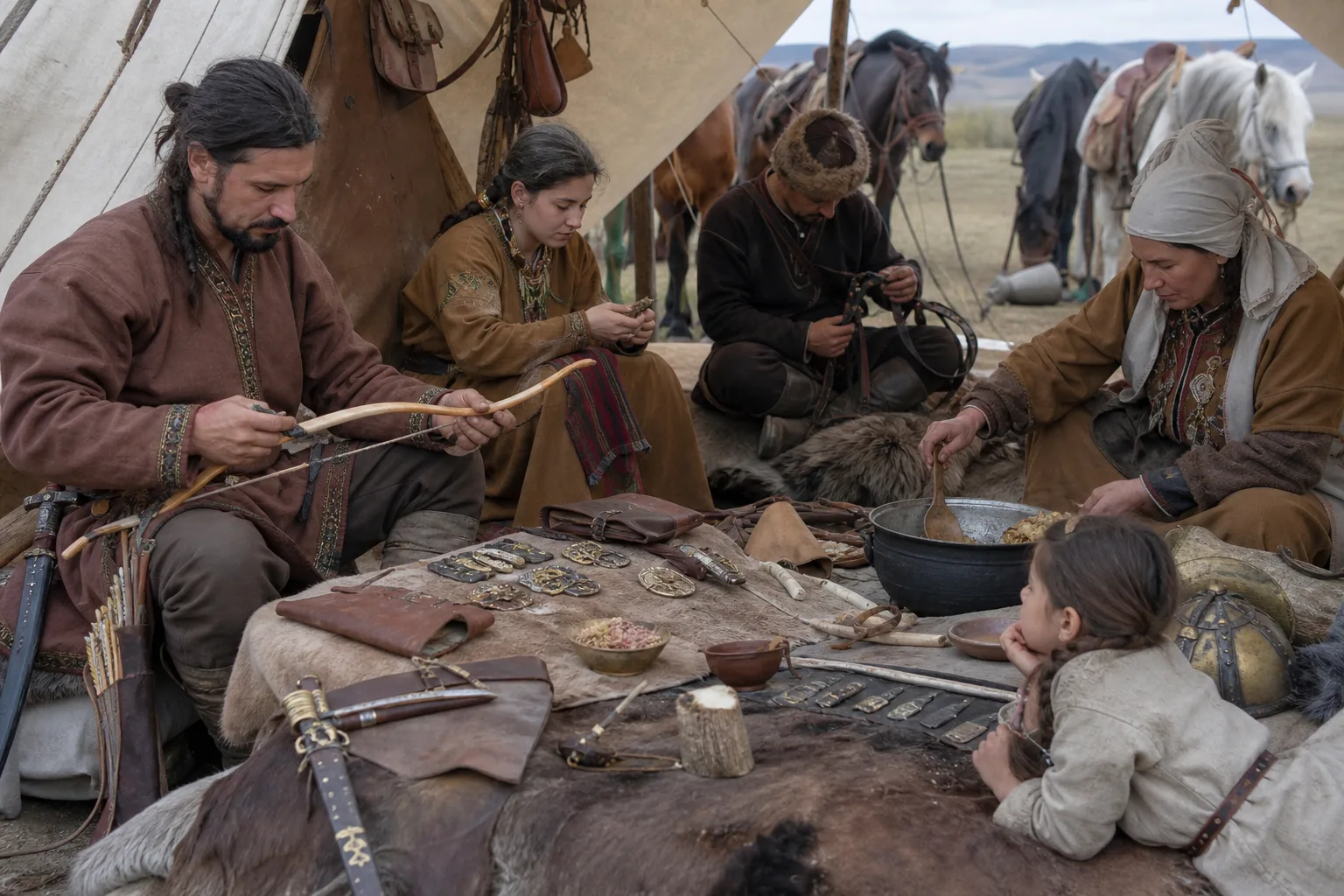
Editorial note: this article was written as an evidence-led synthesis of the cited research. Its hero and section artwork was generated with AI as a realistic but conceptual archaeological scene; it does not reproduce scientific figures, portray known historical people or provide documentary evidence.


