

Ancestors shared by present-day populations outside Africa mixed with Neanderthals approximately 45,000–49,000 years ago, according to genomes from some of the earliest known modern humans in Europe. The estimate comes from the lengths of Neanderthal DNA segments carried by people who lived close to the event, combined with a precise radiocarbon date from Ranis, Germany.
This was not necessarily a single encounter on one day. The statistical model permits gene flow continuing across multiple generations, with a best-fitting extended scenario centered roughly 80 generations before the sampled people lived. Other early modern humans also had more recent Neanderthal ancestors, showing that contact occurred more than once. The 45,000–49,000-year estimate concerns the main admixture shared by the ancestors of the non-African genomes analyzed—not every meeting between the two human groups.
The evidence comes from the 2025 Nature study Earliest modern human genomes constrain timing of Neanderthal admixture. Researchers analyzed one high-coverage and five low-coverage genomes representing six people from the cave site of Ilsenhöhle at Ranis, plus a newly improved high-coverage genome from the Zlatý kůň individual in Czechia.
The short answer: the shared Neanderthal contribution found in the Ranis and Zlatý kůň genomes—and in later populations outside Africa—dates to about 45,000–49,000 years ago. Ranis and Zlatý kůň belonged to the same small, extended population and carried roughly 2.7–3.3% Neanderthal ancestry. Their lineage appears not to have contributed detectably to later people, but its Neanderthal segments came from the same main admixture event preserved in non-African ancestry today.
Why these ancient genomes improve the estimate#
Recombination breaks inherited chromosome segments into smaller pieces in every generation. Soon after an admixture event, DNA inherited from the other population remains in relatively long blocks. Thousands of years later, those blocks have been chopped into much shorter fragments.
Present-day genomes therefore contain a blurred, recombined record of Neanderthal ancestry. A person who lived only dozens of generations after admixture offers a clearer genetic clock. The Ranis remains were directly radiocarbon dated, and one genome was sequenced at about 24-fold coverage. The Zlatý kůň genome reached about 20-fold coverage, allowing researchers to compare the two with unusual resolution for such old remains.
The authors estimated that the individuals lived 56–98 generations after the shared admixture under a single-pulse model. A model allowing continued contact over multiple generations fit even better and placed the event around 80 generations before them. Combining the generation estimate, an assumed 29-year generation time, and the Ranis date of 43,400–46,580 calibrated years before present produced the 45,000–49,000-year range.
The date depends on those assumptions. It is narrower than many earlier estimates because the Ranis13 genome is both precisely dated and exceptionally close in time to the event.
Who were the people from Ranis?#
Small bone fragments from Ilsenhöhle were found during excavations conducted in 1932–1938 and again in 2016–2022. Mitochondrial DNA had already shown that modern humans made the Lincombian–Ranisian–Jerzmanowician, or LRJ, stone-tool assemblage at the site. Direct dates from the human remains fall broadly between 42,200 and 49,540 calibrated years ago.
Multiple fragments turned out to belong to the same people. After genetic matching, the study identified six individuals: three female and three male. Among them were a mother and a daughter younger than about five years old. Another woman was a second- or third-degree relative of the mother. The three males showed no close biological relationship to one another.
This was not a random sample of Ice Age Europe. It is a small set of people from one cave, and family membership makes the effective number of independent genomes even lower. Its value comes from age, DNA preservation, kinship reconstruction and comparison with Zlatý kůň—not from representing every modern human alive at the time.
A family link across 230 kilometers#
The Zlatý kůň skull was found roughly 230 kilometers from Ranis. Direct radiocarbon dating has been unreliable because old conservation adhesives contaminated the specimen, but molecular methods place the individual at around 45,000 years old.
Long identical-by-descent segments revealed that Zlatý kůň was probably a fifth- or sixth-degree relative of two Ranis women. Population-genetic tests also placed the individuals on the same deep branch, which separated early from the lineage leading to other sampled populations outside Africa.
The connection suggests that a small population occupied or moved through central Europe across a surprisingly large area. From DNA shared by the two high-coverage genomes, researchers estimated a recent effective population size of about 160 people, with a 95% interval of 100–240. Effective population size is a genetic parameter shaped by reproduction; it is not a direct census of everyone living across the region.
How much Neanderthal ancestry did they carry?#
The high-coverage Ranis13 and Zlatý kůň genomes each carried an estimated 2.9% Neanderthal ancestry, with a combined 95% range of 2.8–3.0%. Three lower-coverage Ranis genomes produced estimates between approximately 2.7% and 3.3%.
Present-day populations outside Africa generally retain around 2%—the paper describes a range of roughly 2–3%—but no living individual contains an intact miniature Neanderthal genome. Different people carry different fragments, and the collective set across a population is much larger than the share in one person. Natural selection and genetic drift removed some inherited variants while others persisted.
The Ranis genomes already lacked Neanderthal segments in regions commonly called ancestry deserts, where selection appears to have removed archaic DNA rapidly. Zlatý kůň retained one segment in a desert on chromosome 1. This shows that much of the early selection against particular Neanderthal material occurred within roughly the first 80 generations, while the process was not identical in every individual.
Percentages should not be interpreted as a hierarchy of being “more” or “less” human. Neanderthals and modern humans were closely related populations capable of having fertile descendants. Every sampled individual in this study was anatomically and genetically a modern human carrying inherited Neanderthal segments.
Was there only one episode of interbreeding?#
No. The main shared event is only one part of the story. Modern human individuals from Bacho Kiro in Bulgaria and Oase in Romania carried evidence of Neanderthal ancestors within roughly 10–20 generations of their lives. The Ust'-Ishim individual from Siberia also showed an additional, more recent contribution.
By contrast, Ranis and Zlatý kůň showed no convincing evidence for a second local admixture after the shared event. Their small population may have spent little time near Neanderthals, encountered them infrequently, or simply left too few sampled genomes for another episode to be detected.
The study's key test compared the positions and edges of Neanderthal segments in Ranis and Zlatý kůň with those in 274 present-day and 57 ancient modern humans, with an additional breakpoint analysis using 2,000 present-day genomes. Excess sharing supported one common origin for the main ancestry signal.
A population that seems to have disappeared#
Despite their importance for dating admixture, the Zlatý kůň/Ranis people appear to have left no detectable direct ancestry in later sampled hunter-gatherers. They occupied the deepest known branch splitting from the Out-of-Africa lineage, and that branch apparently ended.
There is no contradiction between the lineage disappearing and its Neanderthal DNA reflecting the shared event found in later people. The population had already inherited that ancestry from a common ancestral group before it separated. Other descendant branches survived and carried related Neanderthal fragments forward.
This distinction resists a simple family-tree picture in which every ancient person is a direct ancestor of someone alive. Ancient populations often expanded, divided and disappeared. A genome can illuminate a shared event even if that individual's own population left no known descendants.
What the date says about movement out of Africa#
If the Neanderthal admixture shared by sampled non-African populations happened 45,000–49,000 years ago, their ancestors still formed a connected population around that interval. Groups had begun moving across Eurasia, but their deepest surviving branches had not yet accumulated wholly separate Neanderthal histories.
The authors infer that modern human remains outside Africa older than roughly 50,000 years would probably represent earlier dispersals or branches not descended from this shared population. They also reason that Denisovan ancestry entered modern human populations after the main Neanderthal event because every population carrying Denisovan ancestry also carries the shared Neanderthal contribution.
These are population-level constraints, not a single mapped route. Africa contained substantial human population structure, Eurasia saw repeated movements, and the current record includes only a handful of genomes older than 40,000 years.
What the study cannot tell us#
| Limitation | Why it matters |
|---|---|
| Only six Ranis people and one Zlatý kůň genome were analyzed | The results cannot describe all modern humans in Europe at the time. |
| Several Ranis genomes are low coverage | Some individual-level inferences are less precise than those from Ranis13 and Zlatý kůň. |
| Generation time is assumed | A different average would shift the calendar date of admixture. |
| Segment decay is model-dependent | Continuous gene flow and a single pulse yield somewhat different histories. |
| Ancient geographic sampling is extremely sparse | Other populations may reveal additional encounters and extinct branches. |
| DNA cannot reconstruct a meeting | It cannot identify where people met, their social relationships or how many contacts occurred. |
Frequently asked questions about Neanderthal admixture#
When did modern humans and Neanderthals interbreed?#
The main admixture shared by the ancestors of sampled non-African populations occurred about 45,000–49,000 years ago. Other, more local episodes happened later.
How much Neanderthal DNA did the Ranis people have?#
The study estimated approximately 2.7–3.3%, with the two high-coverage genomes each near 2.9%.
How many ancient people were studied?#
The Ranis fragments represented six people. Researchers produced one high-coverage and five low-coverage Ranis genomes and compared them with a high-coverage Zlatý kůň genome.
Were the Ranis people ancestors of Europeans today?#
No direct contribution to later sampled hunter-gatherers was detected. Their population appears to have been an early branch that later disappeared.
Did all contact happen in Europe?#
The study dates the shared admixture but does not locate it precisely. It could have happened before the sampled group entered central Europe, somewhere along ancestral routes through Eurasia.
Does Neanderthal ancestry define ethnicity or race?#
No. It records ancient gene flow between human populations. Modern ethnic and racial categories are recent social histories and cannot be projected onto people who lived 45,000 years ago.
A sharper date, not a final scene#
The Ranis and Zlatý kůň genomes bring the main Neanderthal admixture into an unusually narrow interval. They also reveal a mother and daughter, distant relatives across central Europe, and a small pioneering population whose lineage seems not to have survived.
What they do not provide is a photograph of first contact. Interbreeding probably unfolded within a wider landscape of encounters, separations and repeated movements. New genomes from western Asia, southeastern Europe and other regions will be needed to locate that history more precisely.
For two much later examples of how ancient genomes refine migration histories without assigning fixed identities, see our guides to Yamnaya DNA and steppe origins and the Bronze Age Tarim Basin.
Sources and further reading#
- Sümer, A. P., Rougier, H., Villalba-Mouco, V. et al. (2025). Earliest modern human genomes constrain timing of Neanderthal admixture. Nature 638, 711–717. DOI: 10.1038/s41586-024-08420-x.
- Mylopotamitaki, D. et al. (2024). Homo sapiens reached the higher latitudes of Europe by 45,000 years ago. Nature 626, 341–346.
- Ancient nuclear sequence data: European Nucleotide Archive PRJEB78725.
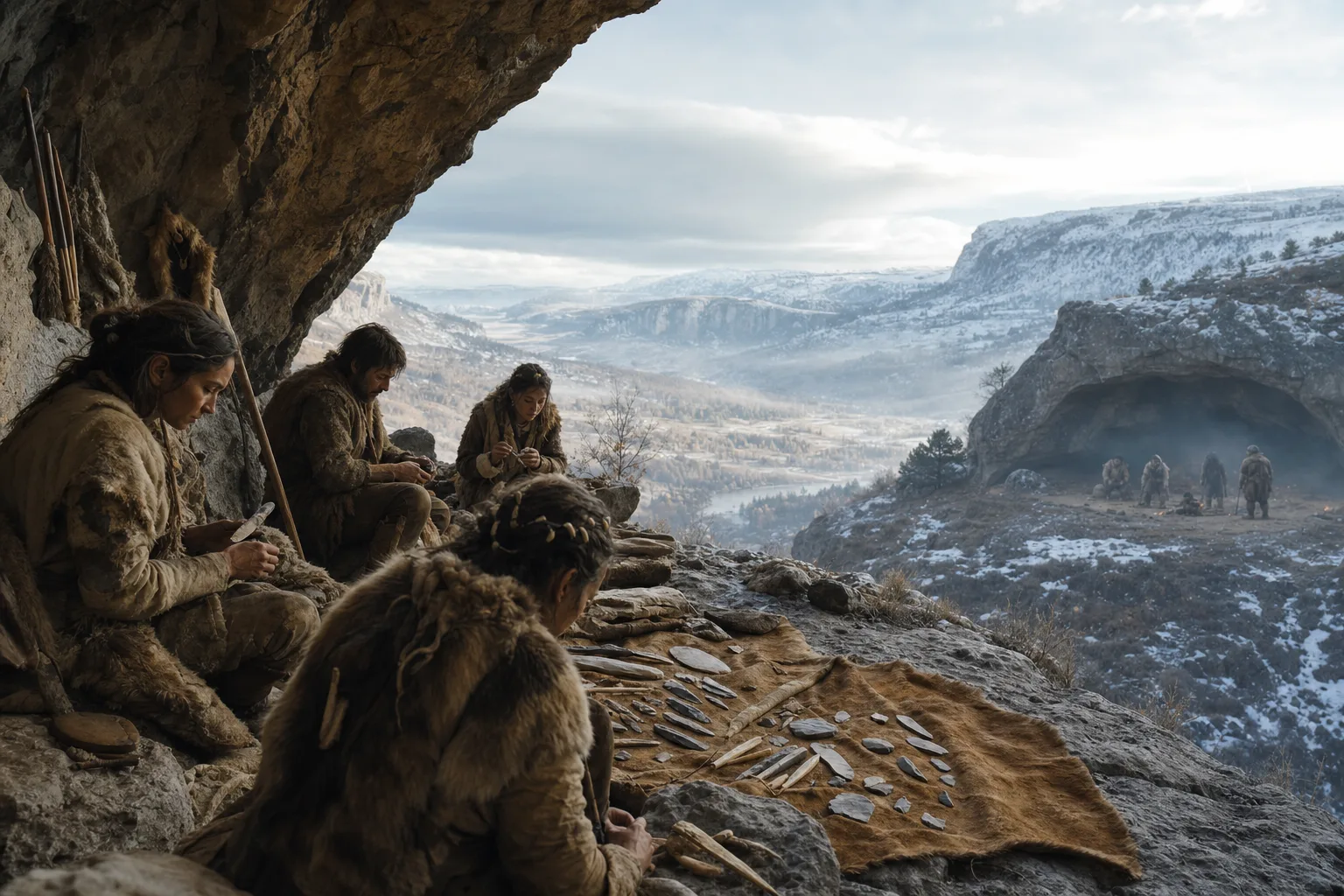
Editorial note: this article is a source-based synthesis. Its AI-generated visuals are interpretive scenes and do not claim to reconstruct the appearance, behavior or meeting place of the analyzed people.


