The Netherlands is a small country with an outsized place in the ancient-DNA story of northwest Europe: the Single Grave and Bell Beaker worlds that reset the region's ancestry ran straight through it, and a millennium later its coast was the launch shore of the migration that made England English. Dutch genomes are, in a real sense, the reference the North Sea world is measured against.
The short answer: Dutch ancestry is the northwest European trio at full strength — heavy steppe-derived ancestry from the Corded Ware and Beaker horizons over a farmer base, essentially stable since the Bronze Age. The famous fact is the internal cline: for a flat, small country, the Netherlands carries measurable north–south genetic structure, with the north (Frisia) the most "North Sea" profile on the continent.
From the wetlands to the Beaker heartland#
The Low Countries' foragers worked a drowned-land world of rivers and coasts; farmers arrived up the rivers (the LBK reached Limburg early) but the wet north stayed forager-leaning for centuries — a frontier the ancient genomes record as slow mixing rather than replacement.
Then the third millennium made the region central: the Corded Ware / Single Grave horizon and the Bell Beaker phenomenon — whose classic early forms are at home on the Rhine — reset the gene pool with steppe-derived ancestry, the same current that then swept Britain from this very coast. By the Bronze Age, the Dutch profile was set: among Europe's most steppe-rich, R1b-dominated (R-U106 the signature branch, R-L21's sibling wing), and it has moved little since.
The launch coast, and the cline#
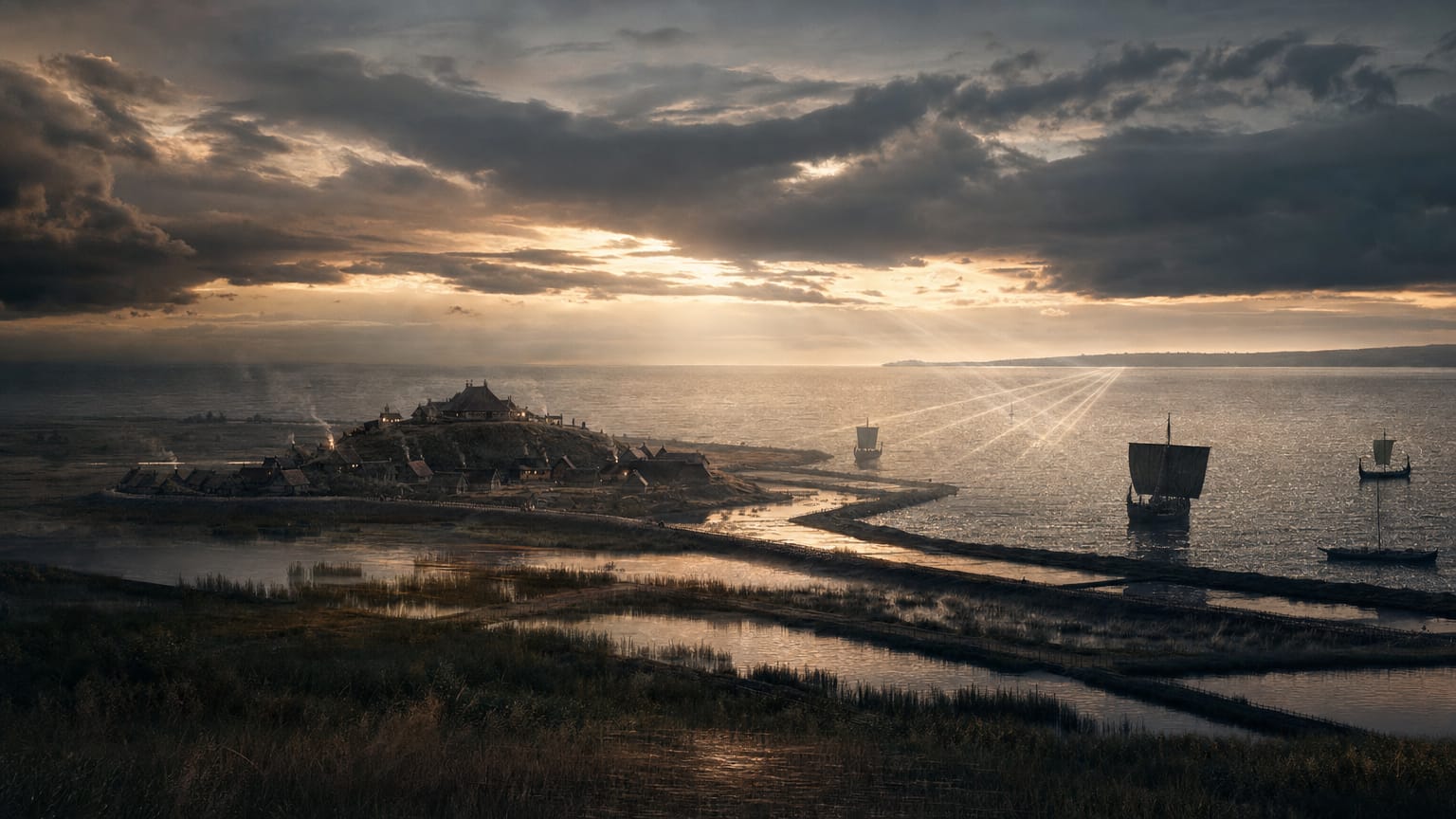
In the Migration Period the traffic reversed the Beaker direction: Frisians, Angles and Saxons sailed west, and the early English genomes measure the result — the continental source of the Anglo-Saxon settlement is genetically this coast, which is why English and Dutch genomes remain so close that formal contrasts strain to separate them.
The modern country's famous finding is its internal structure: Dutch biobank studies resolve a clear north–south cline (plus subtler east–west texture) in a country two hundred kilometres across — the genetic residue of the rivers as old boundaries, Frisian distinctiveness in the north, Frankish-leaning south below the great rivers, and centuries of religiously sorted marriage. The north sits closest to Danish and northern German profiles; Limburg reaches toward Belgium and the German Rhineland.
Reading your own results#
- G25 distances: modern era led by Dutch, northwest German, Danish and English averages — the North Sea neighbourhood is genuinely tight, and rank-order among close kin is noise-prone; read the cluster, not the winner.
- Admixture fits: the deep-era trio with steppe-related ancestry at northern-European maximum and farmer share modest. Within-era, Dutch-vs-English-vs-Danish source splits trade weight freely — treat them as one North Sea signal wearing three labels.
- qpAdm: Dutch kits are well-behaved formal targets (excellent regional reference sampling); the productive questions are usually about edges — a southern kit weighing a Frankish/Rhineland source, a northern one testing pure North Sea continuity — each a clean model with real error bars.
Frequently asked questions#
Are the Dutch and the English genetically similar?#
Very — eastern England's gene pool was substantially resettled from this coast, and the measured Anglo-Saxon source populations are Dutch-adjacent. On most PCA views the two overlap heavily; separating them is contrast work, not eyeballing.
Are Frisians a distinct people genetically?#
A distinct cluster within the North Sea profile — the north of the cline, tightened by geography and endogamy — rather than a separate origin. Frisian genomes are the closest living match to the early Anglo-Saxon settlers' continental sources.
How homogeneous is the Netherlands?#
Less than its size suggests: the north–south cline is measurable and reproducible. It is texture — the deep layers are shared — but texture with history written in it.
Terms used here are defined in the glossary.
Sources and further reading#
- Olalde, I. et al. (2018). The Beaker phenomenon and the genomic transformation of northwest Europe. Nature, 555, 190–196.
- Gretzinger, J. et al. (2022). The Anglo-Saxon migration and the formation of the early English gene pool. Nature, 610, 358–365.
- The Genome of the Netherlands Consortium (2014). Whole-genome sequence variation, population structure and demographic history of the Dutch population. Nature Genetics, 46, 818–825.
- Byrne, R. P. et al. (2020). Dutch population structure across space, time and GWAS design. Nature Communications, 11, 4556.